
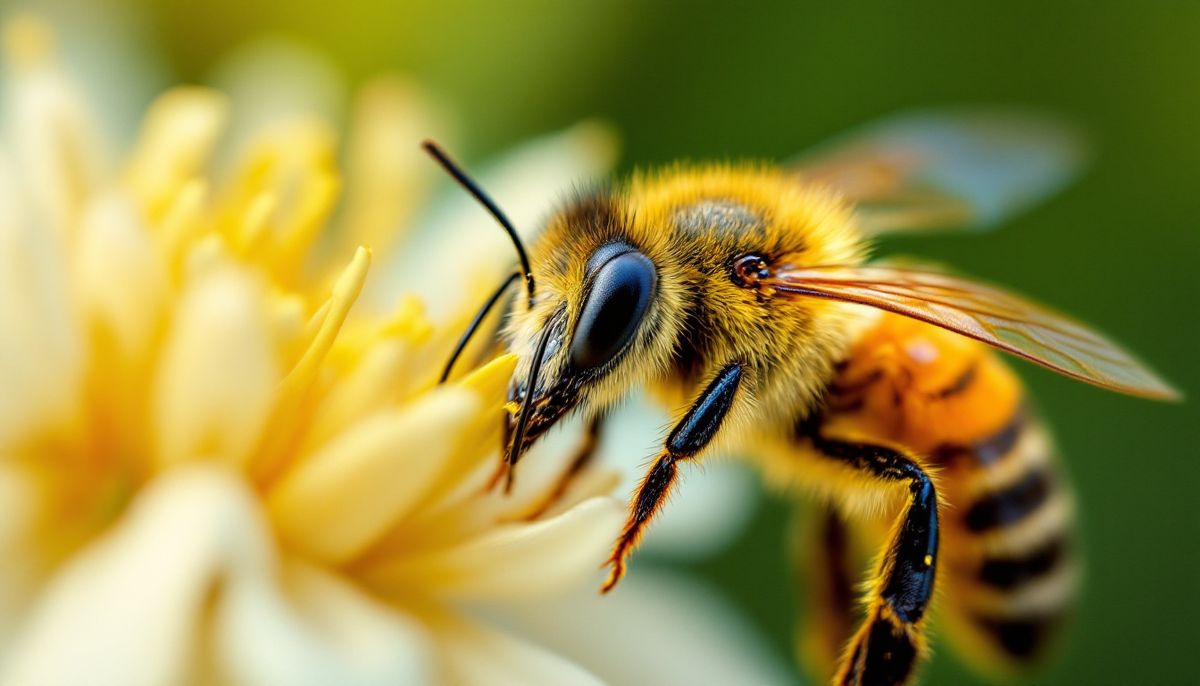
I always figured a honeybee was basically a tiny, single-minded machine: fly out, grab nectar, fly home, repeat until you die. Then I started reading the actual science, and it turns out the bee bumbling around your porch flowers is running a level of software that embarrasses most of the animal kingdom. They give each other GPS directions by dancing. They can pick your face out of a lineup. They grasp a mathematical idea it took humans thousands of years to formalize. Here are five true things about honeybees that made me apologize to the next one I saw.
Did you know honeybees give each other directions by dancing?
When a foraging bee finds a great patch of flowers, she flies home and performs what scientists call the “waggle dance,” a little figure-eight shuffle on the vertical honeycomb. And it’s not random wiggling. The direction she points during the straight “waggle” part of the run tells the other bees the angle to the food relative to the sun. The length of time she waggles tells them how far to fly. Roughly one second of waggling means the flowers are about a kilometer away. An Austrian scientist named Karl von Frisch spent decades decoding this, and when he finally proved that an insect was using a symbolic language to communicate abstract information, it was so unbelievable that other scientists refused to buy it for years. He won the Nobel Prize for it in 1973. A bug invented turn-by-turn navigation, and we needed a Nobel laureate to translate.
Did you know a single honeybee makes only about 1/12 of a teaspoon of honey in her entire life?
That jar of honey in your pantry is the collected life’s work of a small city. A worker bee lives only a few weeks in the summer, and in that whole time, she produces roughly one-twelfth of a teaspoon of honey. Not a jar. Not a tablespoon. A twelfth of a teaspoon. Do the math and it takes the full lifetimes of around 768 bees just to fill a single one-pound jar, and that’s before you count the flying. Those same bees will collectively log tens of thousands of miles of flight to gather the nectar. So the next time you drizzle honey on your toast without thinking, understand that you just casually spent the entire careers of an entire workforce. They gave everything, and you gave it four seconds.
Did you know honeybees can recognize individual human faces?
Your brain is built to recognize faces. It’s one of the most demanding visual tasks you perform, which is why we assume it requires a big, sophisticated brain. A honeybee’s brain is smaller than a grain of sand, with fewer than a million neurons to your 86 billion. And yet, when researchers trained bees by rewarding them with sugar water for landing on specific photos of human faces, the bees learned to reliably tell those faces apart, even from new angles. Follow-up work showed they do it the same way we do, by reading the configuration of features, how the eyes, nose, and mouth are arranged relative to one another. Scramble the features and the bee no longer sees a match. So yes, a bee can, in principle, remember your face. Whether it holds a grudge is thankfully still unproven.
Did you know honeybees understand the concept of zero?
Zero is a genuinely hard idea. Humans didn’t formalize it as a number for most of our history, and small children struggle with the notion that “nothing” is a quantity you can put in order. Only a handful of brainy species, chimpanzees, some monkeys, an African grey parrot, have ever demonstrated they get it. In 2018, researchers at RMIT University in Australia added a surprising new name to that elite list: the honeybee. They trained bees to always fly to the card showing the fewest dots. Then they showed the bees a blank card against a dotted one. The bees, with no training on emptiness, correctly treated the blank card as “less than one,” placing zero at the bottom of the number line. An insect independently arrived at a mathematical concept that stumped entire human civilizations for millennia.
Did you know a beehive stays around 95 degrees inside, even when it’s freezing outside?
A honeybee colony runs its nursery like a hospital’s neonatal ward. The developing baby bees, the brood, have to be kept in a tight band around 95 degrees Fahrenheit to grow properly, and the colony holds that temperature with startling precision no matter what the weather does. In winter, when it’s snowing outside, the workers pile into a dense ball around the queen and the brood and shiver their flight muscles, essentially running in place to generate body heat, rotating from the cold outer edge to the warm center so no single bee freezes. In summer, when it’s too hot, they fan their wings for air conditioning and haul in droplets of water to cool the hive by evaporation. It’s a self-regulating climate-control system, run by thousands of tiny bodies with no thermostat, no manager, and no day off.
Send this to the biggest know-it-all you know… and watch them go quiet when you get to the part about bees understanding zero.
