
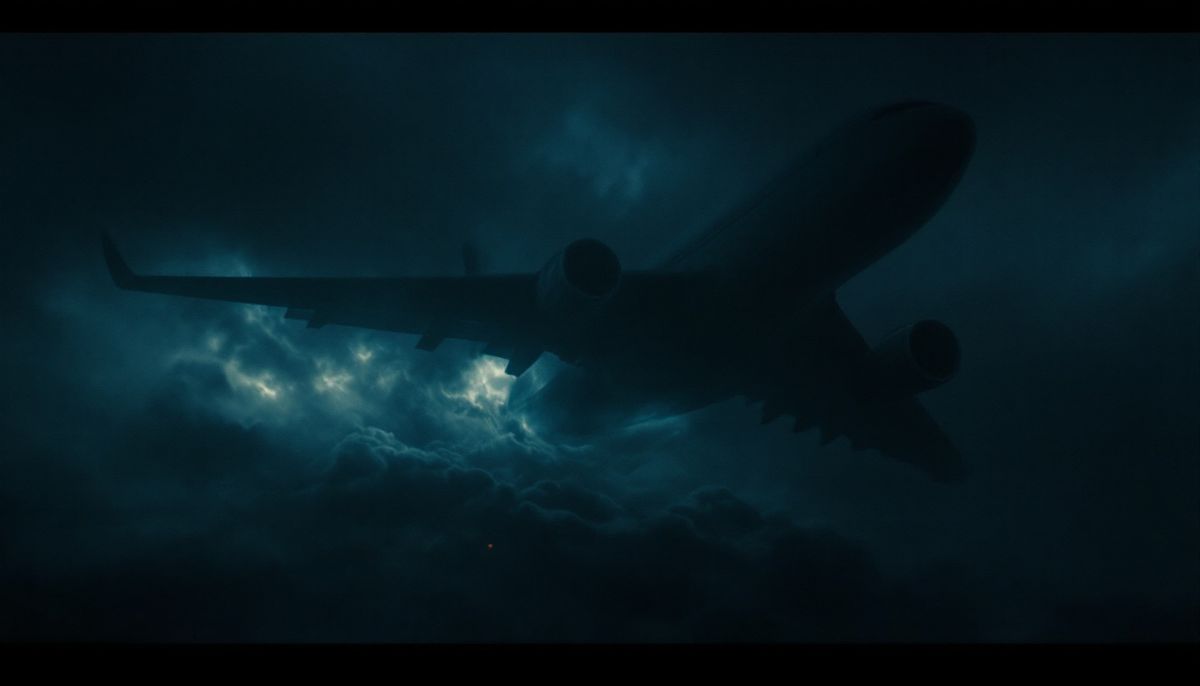
Let me tell you about the most expensive search in aviation history — and before we start, I want to set the ground rules, because this story attracts nonsense like a porch light attracts moths. Everything in the first half of this tale is documented: radar records, satellite data logs, official accident reports from three governments. The second half is where the record ends and the arguing begins. I’ll tell you plainly when we cross that line.
Just after midnight on March 8, 2014, Malaysia Airlines Flight 370 lifted off from Kuala Lumpur bound for Beijing — a Boeing 777, one of the safest aircraft ever built, carrying 239 people on a routine overnight run. At 1:19 a.m., as the plane approached the handoff point between Malaysian and Vietnamese airspace, the cockpit gave a perfectly ordinary sign-off: “Good night, Malaysian three seven zero.” Two minutes later, the plane’s transponder — the device that announces an aircraft’s identity and position to air traffic control — went dark. To the controllers watching their screens, MH370 simply ceased to exist over the South China Sea.
Here’s the part that still raises the hair on my arms: the plane didn’t crash there. It kept flying. Malaysian military radar — which doesn’t need a transponder — tracked an unidentified aircraft turning hard back across the Malay Peninsula, threading northwest up the Strait of Malacca, before slipping off radar coverage around 2:22 a.m. And then the machines took over the storytelling. The 777’s satellite communication system kept exchanging automated hourly “handshakes” — electronic check-ins, essentially the plane’s equipment saying “still here” — with an Inmarsat satellite parked over the Indian Ocean. Seven handshakes in all. The last, a partial one, came at 8:19 a.m. — more than six hours after the plane vanished from every screen in Southeast Asia. Engineers wrung the physics out of those signals — timing delays, Doppler shifts — and reached a conclusion nobody wanted: MH370 had flown south, deep into one of the emptiest stretches of ocean on Earth, until, in all likelihood, it ran out of fuel.
What followed was a search of almost absurd scale. Dozens of ships and aircraft from more than two dozen nations. Then years of methodical sonar mapping — an Australian-led effort that scanned some 120,000 square kilometers of seabed before ending empty-handed in January 2017, followed by the private firm Ocean Infinity, which sent robot submarines over another huge swath in 2018 on a “no find, no fee” deal. Nothing. The ocean did eventually give something back, though: in July 2015, a barnacle-crusted wing piece called a flaperon washed up on Réunion Island, nearly 4,000 kilometers from the search zone. Investigators confirmed it came from MH370. Roughly thirty more fragments followed on the shores of Africa and Indian Ocean islands — a handful positively confirmed, the rest judged likely. So we know the plane ended in that ocean. We just don’t know where. Or — and this is the real mystery — why.
Now we cross the line into theory country. The leading one is the darkest: that the captain, Zaharie Ahmad Shah, did this deliberately. The documented facts feeding it are real — investigators recovering data from his home flight simulator found a deleted practice route that ran up the Strait of Malacca and out into the southern Indian Ocean, eerily close to the plane’s presumed path. That is in the official record. But hear me clearly: it proves he flew a simulated route, not that he flew the real one. No note was found, no motive established, and the official Malaysian investigation declined to blame him. Theory two says the opposite — no villain at all, but a catastrophe: a fire or sudden depressurization that incapacitated everyone aboard, leaving a “ghost flight” cruising on autopilot until the tanks ran dry. It explains the silence; it strains to explain the precise, hand-flown-looking turns. And beyond those two sit the wilder claims — hijacking to a secret airstrip, an accidental shoot-down and cover-up, phantom sightings over the Maldives. None has produced a shred of physical evidence. The debris on those beaches says the southern Indian Ocean, full stop.
You’d think a decade would settle it. It hasn’t. Ocean Infinity came back in 2025 under a new deal with Malaysia — a $70 million reward, payable only on discovery — and swept the seabed again with a fleet of autonomous subs along the so-called “seventh arc,” the line traced by that final 8:19 handshake. In early 2026, that renewed hunt wrapped its latest survey the way every search before it has ended: without a confirmed trace of the fuselage. Somewhere down there, under miles of black water, sits the flight recorder that could answer everything. We have found ships that sank centuries ago. We cannot find a 200-foot airliner that vanished in the age of GPS.
And that’s where I have to leave you, because that’s where the record leaves everyone. Two hundred thirty-nine people boarded a red-eye to Beijing and flew into the largest unsolved mystery in modern aviation. We know the plane turned. We know it flew for hours. We know where it isn’t — 250,000 square kilometers of seabed, scanned inch by inch. What we don’t know is the only thing the families have ever asked: who, or what, was flying that plane through the dark — and why it pointed itself at the loneliest water on the planet and never turned back.
Unsolved Mystery
