
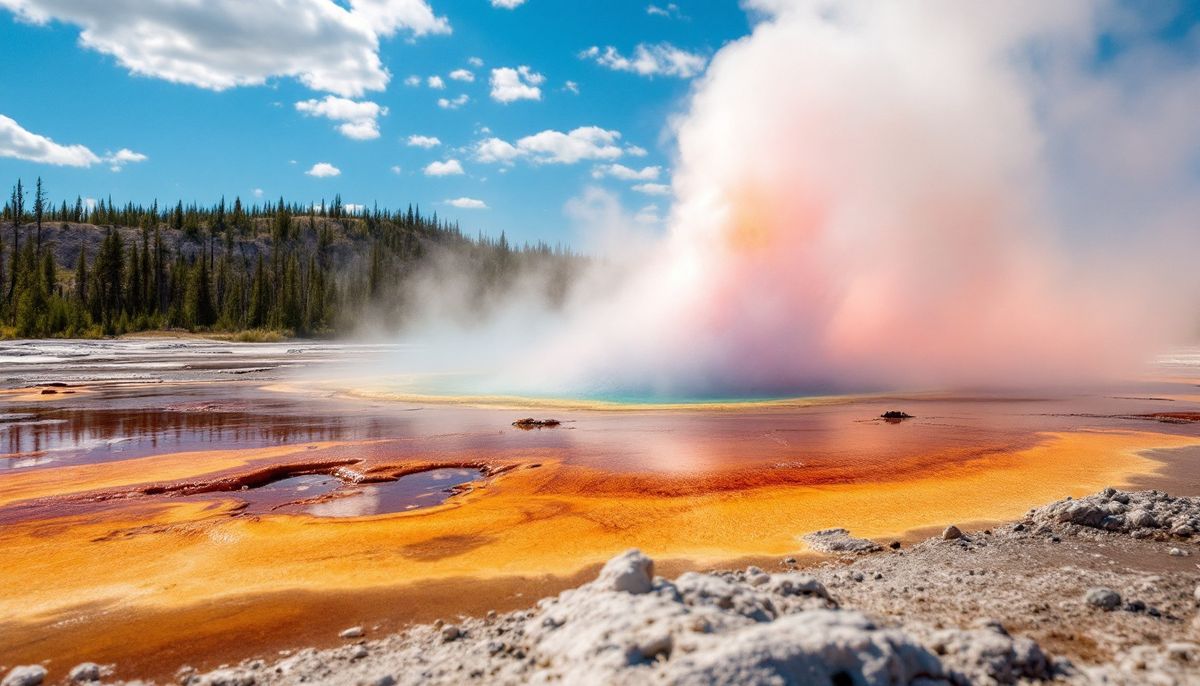
I always assumed geysers were just fancy hot springs, and that Old Faithful was the biggest, best, and most punctual one on Earth. Then I fell down the research hole, and it turns out I was wrong on every count. Geysers are shockingly rare, Old Faithful is neither the biggest nor the most faithful, and the way rangers predict eruptions is a trick so simple you could do it yourself with a stopwatch. Here are five true things about geysers that completely rearranged what I thought I knew.
Did you know the entire planet only has about a thousand geysers, and one park hoards most of them?
Volcanoes? Earth has over a thousand active ones scattered everywhere. Hot springs? Tens of thousands. But true geysers, the ones that actually erupt, number only around a thousand on the whole planet, and more than half of them are packed inside Yellowstone National Park. The remaining few cluster in a tiny handful of geyser fields: Russia’s remote Valley of Geysers in Kamchatka, El Tatio high in the Chilean Andes, New Zealand’s Taupo region, and Iceland, whose famous spouter Geysir literally gave us the word “geyser,” from the Old Norse for “to gush.” That’s essentially the entire global inventory. If geysers were animals, they’d be on the endangered species list, and Yellowstone would be the world’s only major zoo.
Did you know Old Faithful isn’t the biggest geyser, or even the most faithful one?
Old Faithful’s whole reputation is a bit of false advertising. The tallest active geyser on Earth is Steamboat Geyser, sitting in a quieter corner of the same park, and its major eruptions blast water more than 300 feet high, roughly twice Old Faithful’s typical showing. So why isn’t Steamboat the celebrity? Because it’s a diva. Steamboat once went about 50 years between major eruptions, then suddenly woke up in 2018 and fired off dozens of eruptions a year, setting all-time records. Nobody can tell you when the next one is coming. And Old Faithful isn’t even the most punctual performer; its average interval has actually drifted from a little over an hour to around 90 minutes over the decades, partly because earthquakes keep rearranging its underground plumbing. It’s less “faithful” and more “faithful-ish.”
Did you know rangers predict the next eruption by timing the last one?
Here’s the stopwatch trick: the length of an Old Faithful eruption tells you how long until the next one. A short eruption, under about two and a half minutes, means the underground chamber didn’t fully empty, so it refills fast and you’ll wait roughly an hour. A long eruption, four minutes or more, drains the system, and the wait stretches to about an hour and a half or more. Using just that one measurement, rangers call the next show within a ten-minute window and nail it about nine times out of ten. Early visitors found their own use for the schedule: members of the 1870 expedition reportedly stuffed dirty clothes into the crater and let the eruption do their laundry. Linen came back clean. Wool came back shredded.
Did you know a geyser needs a plumbing system so rare that nature almost never builds one?
Making a hot spring is easy: water plus underground heat. Making a geyser requires a trifecta that almost never lines up. You need intense volcanic heat close to the surface, a huge and constant supply of water, and, the rarest piece of all, a natural pressure cooker: a deep, narrow plumbing system with a tight constriction that traps superheated water until it flashes to steam and blows. Even that isn’t enough unless the rock cooperates. Yellowstone’s volcanic rhyolite is loaded with silica, which dissolves into the hot water and then coats the plumbing like a ceramic liner, sealing it so it can hold pressure instead of leaking. Miss any one ingredient and you just get a pleasantly steamy puddle. That’s why Earth has thousands of hot springs and only about a thousand geysers.
Did you know Yellowstone’s geysers are the exhaust system of a sleeping supervolcano?
Every geyser in Yellowstone runs on the same furnace: a giant magma system miles beneath the park, the engine behind one of the largest volcanic systems on Earth. The geysers, hot springs, and mud pots are essentially its radiator, venting heat around the clock. Before you cancel your road trip, here’s the reassuring part: scientists have studied that magma chamber extensively, and it’s mostly solid crystal mush, nowhere near eruptible, with no signs of that changing on any timescale that matters to your vacation plans. In fact, the geysers are part of the monitoring system; along with seismometers and GPS stations, they help scientists keep constant tabs on what’s happening below. One more mind-bender while you wait for the show: the water roaring out of Old Faithful fell as rain and snow long ago, spending an extraordinarily long time underground before being fired back into the sky. You’re watching vintage precipitation.
Send this to the friend who’s always planning a national parks trip… they’ll never wait out a geyser eruption the same way again.
