
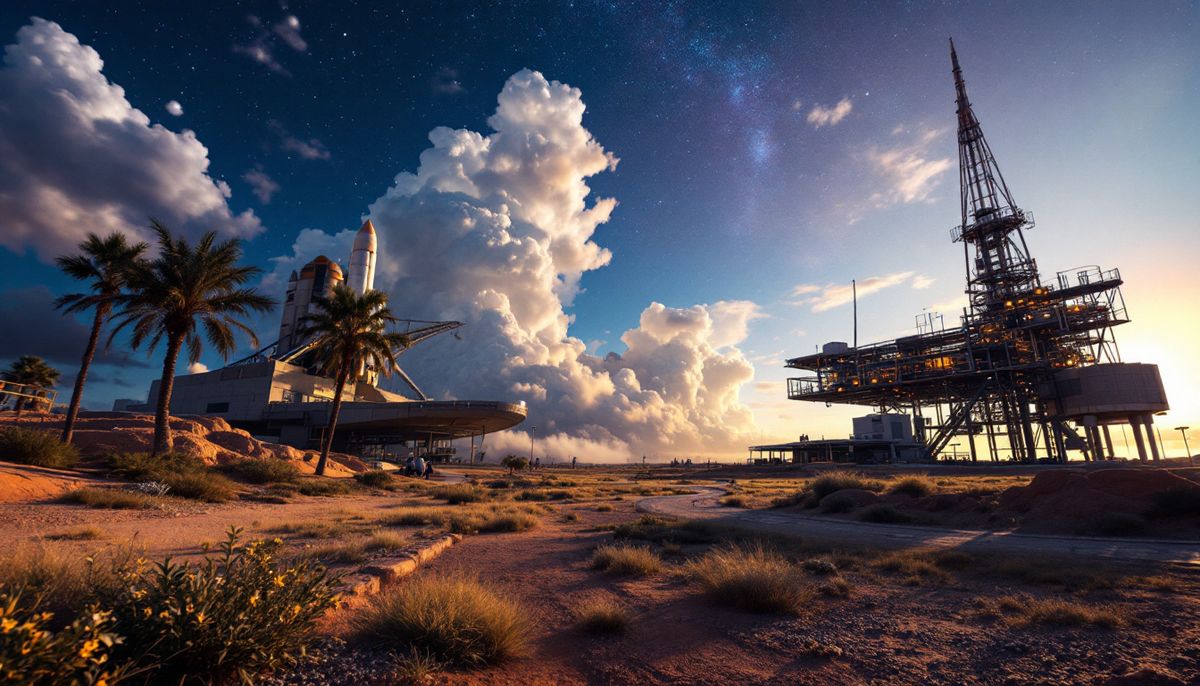
I figured I knew Kennedy Space Center: big building, big rockets, gift shop. Then I started digging into the facility itself — not the missions, the actual place — and it broke my brain a little. Did you know the rocket assembly building is so enormous it can form its own rain clouds indoors? Or that the vehicle that hauls rockets to the pad gets about 32 feet to the gallon? And I haven’t even gotten to the alligators yet — there are more of them on the property than there are employees. Here are ten facts about America’s spaceport that have nothing to do with countdowns and everything to do with the weirdest workplace on Earth.
1. The Vehicle Assembly Building is so huge it has its own weather — including indoor rain clouds.
The VAB encloses roughly 129 million cubic feet of air, making it one of the largest buildings by volume ever constructed. It’s so cavernous that on humid Florida days, moisture can condense near the 525-foot ceiling and form actual clouds inside the building — which is why NASA runs a serious dehumidification system to keep it from drizzling on the rockets. Think about that: they built something so big they had to engineer the weather out of it. Your office argues about the thermostat.
2. The doors take 45 minutes to open.
The VAB’s four high-bay doors are the largest doors in the world — 456 feet tall, roughly the height of a 45-story building, because a fully stacked Moon rocket has to roll out through them standing up. Opening one is not a doorknob situation: the door retracts in sections and takes about 45 minutes to fully open. So if you’ve ever stood at a garage door watching it crawl upward, multiply that feeling by a skyscraper.
3. The American flag painted on the side is measured in football-field units.
Painted for the 1976 bicentennial, the VAB’s flag is one of the largest ever rendered — 209 feet tall and 110 feet wide. Each star is 6 feet across, and each stripe is 9 feet wide — about the width of a highway lane, meaning you could drive a tour bus down a single stripe. When your building is that big, even the decorations need a civil engineer.
4. The crawler-transporter goes 1 mph and gets about 32 feet per gallon.
The machine that carries rockets from the VAB to the launch pad weighs 6.6 million pounds and tops out around 1 mile per hour when loaded. Its fuel economy is the stuff of legend: roughly 32 feet per gallon of diesel — that’s about 165 gallons to cover a single mile. It’s the least efficient vehicle in America and nobody cares, because it’s also the only one that can carry a skyscraper. Suddenly your SUV doesn’t seem so bad.
5. The crawler keeps a 300-foot rocket level while climbing a hill.
The final stretch to the pad is a ramp with about a 5 percent grade, which sounds gentle until you remember the cargo is a fully stacked rocket that absolutely must stay vertical. The crawler’s leveling system automatically tilts its platform on the way up, keeping the top of the stack steady to within a fraction of a degree. Engineers have compared the precision to keeping the rocket’s tip from swaying more than the width of a basketball. It’s the world’s slowest vehicle doing the world’s most careful job.
6. The road it drives on is nearly as wide as an eight-lane highway — and topped with river rock.
The crawlerway runs about 130 feet wide, close to an eight-lane interstate, and it isn’t paved with asphalt — 6.6 million pounds would chew right through it. Instead, the top layer is specially selected river gravel from Alabama and Tennessee, chosen because the stones crush and grind under the crawler’s treads instead of sparking or seizing. The rocks sacrifice themselves so the rocket rides smooth. NASA literally imports gravel with the right personality.
7. Alligators outnumber the employees.
Kennedy Space Center shares its land with the Merritt Island National Wildlife Refuge — 140,000 acres that are home to thousands of alligators, along with more threatened and endangered species than any other national wildlife refuge in the continental United States. The gators famously sun themselves near roads, ditches, and the occasional launch pad, and workers know to give them the right of way. It’s the only workplace in America where “watch out for wildlife” means a 10-foot apex predator in the parking lot.
8. The launch pads have stared down hurricanes — and won.
Sitting on a barrier island on Florida’s Atlantic coast, the launch complex has been raked by hurricanes for six decades — and the pads keep shrugging them off. Built on massive concrete and steel foundations engineered for the violence of a rocket launch, the pads have ridden out storm after storm with damage limited mostly to buildings and support structures around them. It turns out that when you design something to survive millions of pounds of thrust, a hurricane reads as light weather.
9. The pad that launched Apollo 11 is now a rental.
Launch Complex 39A — the exact pad where Apollo 11 left Earth in 1969 — didn’t retire when the shuttle era ended. In 2014, NASA signed a 20-year lease handing the pad to SpaceX, which rebuilt it and now launches Falcon and Dragon missions from the same spot. The most historic patch of concrete in spaceflight is a tenant-occupied property. Somewhere there’s a lease agreement with “Moon launch site” in the property description.
10. Astronauts get their last meal on Earth at a secret beach cottage.
Tucked in the dunes on KSC property sits the Beach House, a modest 1962 cottage that’s one of the space program’s best-kept traditions. Before launch, astronauts retreat there for a final barbecue and a quiet goodbye with their spouses, steps from the Atlantic. Neil Armstrong ate there. Shuttle crews ate there. SpaceX crews eat there now. The most exclusive restaurant in America has no menu, no reservations, and a dress code of “flight suit optional.”
Which one made you say “no way”? Send this to the friend who’s been to a launch — or the one who’d befriend the alligators…
