
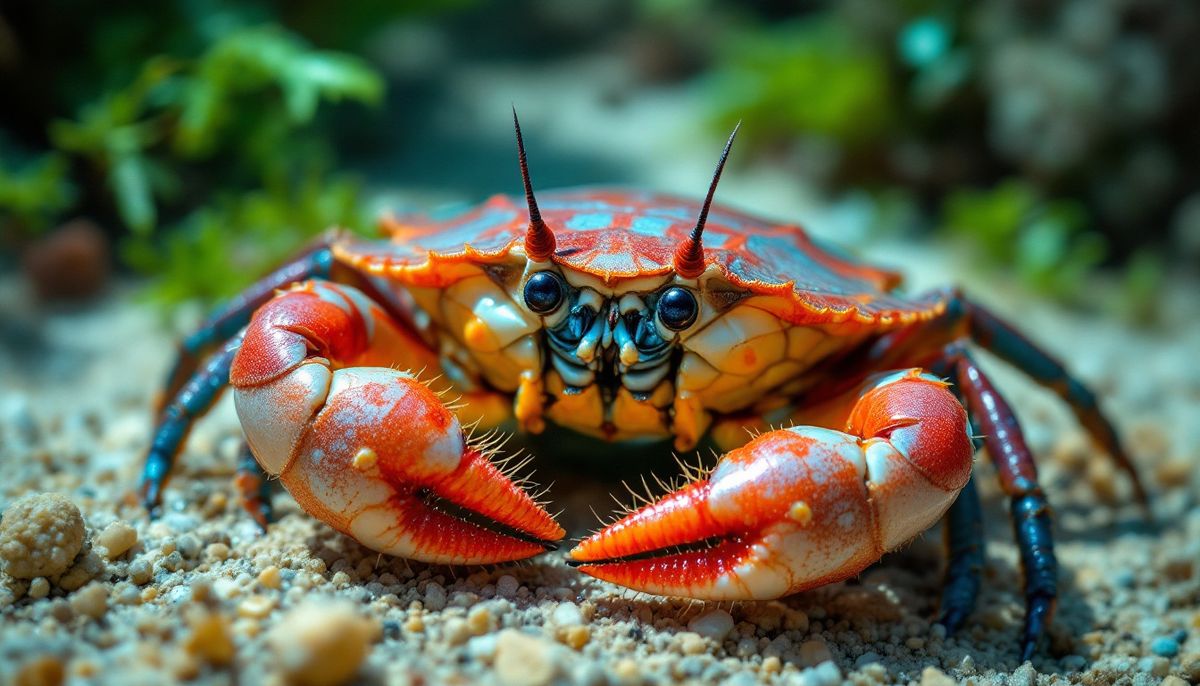
I always filed horseshoe crabs under “weird beach garbage that pinches you.” Then I found out one of them may have literally saved your life, that its blood is worth tens of thousands of dollars a gallon, and that it’s been crawling around basically unchanged since before trees existed. This armored little tank is one of the strangest survival stories on the planet, and almost nobody knows it. Here are five true things about the horseshoe crab that completely rewired how I look at them.
Did you know a horseshoe crab has blue blood, and it’s worth more than a luxury car per gallon?
Horseshoe crab blood isn’t red like ours. It’s a milky, otherworldly blue, because it uses copper-based hemocyanin to carry oxygen instead of iron-based hemoglobin. But the color isn’t even the valuable part. Their blood contains special cells that clot instantly around bacterial toxins, and pharmaceutical companies harvest it to make a substance called Limulus Amebocyte Lysate, or LAL. That stuff is the gold standard for testing whether vaccines, injectable drugs, and medical implants are contaminated. If you’ve ever gotten a shot, it was almost certainly cleared by horseshoe crab blood first. And that blood sells for an estimated $60,000 a gallon, which makes these homely creatures some of the most expensive animals on Earth, drop for drop.
Did you know the horseshoe crab isn’t actually a crab at all?
Despite the name, the horseshoe crab isn’t a crab, isn’t a crustacean, and honestly isn’t even close. Its nearest living relatives are spiders, scorpions, and ticks, putting it firmly in the arachnid neighborhood. Look under that helmet-shaped shell and you’ll find the family resemblance: no antennae, a set of clawed legs, and a body plan that’s pure arachnid. So every time you called one a crab, you were essentially pointing at a giant armored sea spider and getting it wrong. Nature named this thing to mess with us.
Did you know horseshoe crabs are older than dinosaurs by about 200 million years?
We throw the word “ancient” around a lot, but horseshoe crabs earn it. Fossils of their close relatives date back roughly 445 million years, which means they were already an established, going concern when the very first dinosaurs showed up around 230 million years ago. To put that gap in perspective, horseshoe crabs are further removed from the first dinosaur than we are. They predate trees. They predate flowers. They’ve survived all five mass extinctions, including the one that wiped out the dinosaurs entirely, while barely changing their design. When something works that well, apparently you just don’t fix it.
Did you know a horseshoe crab has ten eyes scattered all over its body?
That grumpy-looking creature is watching you from far more angles than you’d think. Horseshoe crabs have about ten eyes total, and they’re spread across the animal in the strangest arrangement in the animal kingdom. There are two large compound eyes on top of the shell, several smaller simple eyes near the front and middle, eyes on the underside near the mouth, and light-sensing photoreceptors running all the way down the tail. Some of those compound eyes are among the largest in the natural world relative to body size, and studying them earned researchers a foundation for understanding how vision works. Not bad for an animal most people assume can’t see them coming.
Did you know that spiky tail isn’t a weapon, it’s a lifeline?
Everyone eyes that long, pointed tail, called a telson, and assumes it’s a stinger. It isn’t. Horseshoe crabs are completely harmless: they can’t sting, and their tail has no venom whatsoever. What the tail actually does is act as a rudder for steering and, crucially, as a lever to flip themselves right-side up when a wave dumps them onto their backs. A stranded horseshoe crab that can’t right itself will die in the sun, so that “scary” tail is really an emergency self-rescue tool. In fact, conservationists beg beachgoers never to pick one up by the tail, because damaging it can be a death sentence. The most menacing-looking part of the animal is the one keeping it alive.
Send this to the ocean lover in your life… they’ll never call it “just a beach bug” again.
