
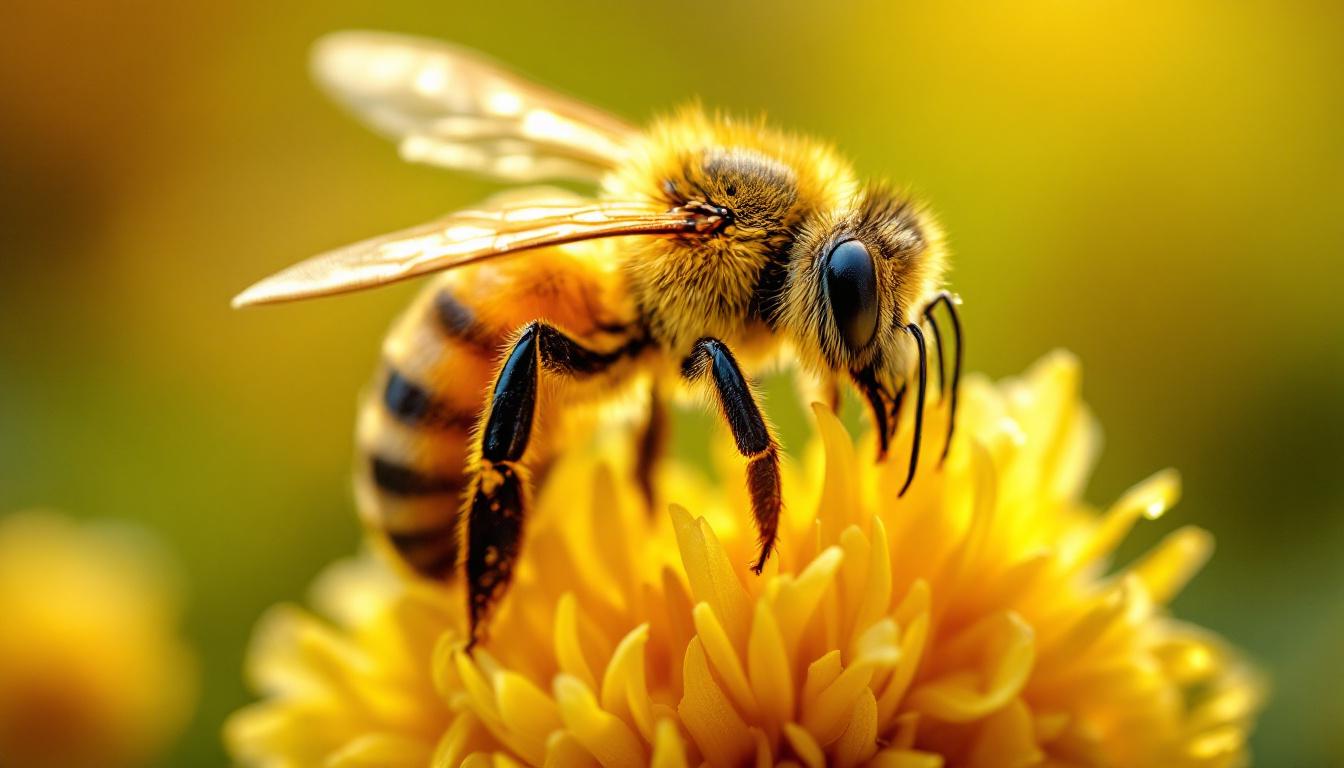
I went down a honeybee rabbit hole this week and I have not emotionally recovered. These tiny insects have hairy eyeballs, vote on real estate, and have been recruited by the U.S. military. I’m just the messenger. Buckle up.
1. The U.S. military has trained honeybees to sniff out bombs.
Scientists at Los Alamos National Laboratory figured out you can Pavlov a honeybee in about ten minutes. Wave a whiff of TNT or C4 under its nose, follow it with sugar water, and the bee learns to stick its tongue out the next time it smells explosives. They can detect explosive vapors at a few parts per trillion — through lotion, deodorant, even tobacco smoke — and the program was deployed to help find IEDs. Bomb-sniffing dogs cost a fortune. Bomb-sniffing bees cost sugar.
2. Honeybees have hairy eyeballs.
I want you to picture that for a second. The two big compound eyes on a bee’s head are covered in tiny hairs. The hairs help them measure wind speed in flight and keep pollen from gunking up their vision — they swipe their hairy eyes clean with their hairy legs, like a guy wiping his glasses on his shirt. Once you know bees have hairy eyeballs you cannot un-know it.
3. Honeybees have five eyes, not two.
Two big compound eyes on the sides of the head — the ones with the hair, see above — plus three smaller “simple” eyes called ocelli arranged in a little triangle on top of the skull. The ocelli are basically light meters. They let the bee track the sun’s position even on cloudy days, which is how it navigates back to the hive without GPS. Five eyes. Top of the head. I’ve been looking at bees my whole life and never noticed.
4. If you remove the queen from a hive, the entire colony notices in about 15 minutes.
The queen constantly emits a pheromone called Queen Mandibular Pheromone. Worker bees feed it to each other in a kind of chemical group chat that says “queen still here, queen still here, queen still here.” The moment that signal stops, the message reaches the whole colony in 15 to 30 minutes and the workers immediately start the emergency protocol of raising a new queen. Tens of thousands of insects, no email, faster than your office.
5. Queen bees and worker bees are genetically identical. The only difference is what they ate as babies.
Every fertilized egg the queen lays could become either a queen or a sterile worker. The colony decides by feeding certain larvae a substance called royal jelly for their entire development instead of cutting them off after three days like everyone else. The royal jelly triggers epigenetic changes — chemical tags on the DNA — that turn one genetically identical bee into a fertile, long-lived queen and another into a six-week worker. It’s nature versus nurture, except nurture wins so hard it’s almost rude.
6. Honeybees are not native to North America. Settlers brought them over in 1622.
The Pilgrims unpacked their hives in the Virginia Colony and the bees promptly escaped into the woods, where Native Americans called them “white man’s flies” because their arrival reliably preceded the arrival of European settlers. By 1639 there were wild colonies all over Massachusetts. It took the bees another 231 years to spread to the West Coast on their own. Whatever bee just landed on your picnic — its great-great-great-great-grandparents took a boat.
7. When honeybees pick a new home, they hold an actual democratic vote.
This was the discovery of Cornell biologist Thomas Seeley, and it is wild. When a swarm needs a new hive location, a few hundred scout bees fly off to inspect candidate sites, then return and waggle-dance to advertise their findings. Better sites get more enthusiastic dances. Other scouts go check out the recommendations and either agree (and dance for that site too) or don’t. When about 15 scouts have committed to the same location — a quorum — the whole swarm of 10,000 bees takes off for it. They debate. They tour. They vote. There is a quorum. It is more functional than most condo boards.
8. The male honeybee’s reproductive organs explode off his body when he mates with the queen, killing him instantly.
The drones — the male bees — exist for exactly one purpose, and they’re not subtle about it. When a virgin queen takes her mating flight, drones from miles around chase her down, and the lucky one to catch her mates with her in midair for about two seconds. Then his genitals tear away from his body, lodge inside the queen, and he falls dead from the sky. The queen mates with 10 to 20 drones on a single flight. She stores enough sperm from those few minutes to lay fertilized eggs for the next five years. Nature is metal.
9. Honey never spoils. Archaeologists have eaten 3,000-year-old honey from Egyptian tombs and it was fine.
Three thousand years. You read that right. Honey buried with pharaohs in sealed jars stayed perfectly edible across the entire span of human civilization, because honey is basically a fortress against decay — almost no water (so bacteria can’t grow), naturally acidic (pH 3 to 4.5), and the bees themselves add an enzyme that produces tiny amounts of hydrogen peroxide. As long as it’s sealed and dry, honey is functionally immortal. I bought a jar in March and I’m already side-eyeing it. The Egyptians were just better at jars than me.
Which one made you say “wait, what?” out loud? Send this to the friend who needs better facts at parties.
