I figured the eye was simple enough: light goes in, picture comes out. Then I learned mine is wired backwards, has a built-in hole I can’t see, and quietly edits time itself so I never notice. The thing in your head is doing way more than you give it credit for.
1. Your eye is technically wired backwards.
In the human retina, the light-sensing cells point away from the light. Incoming light has to pass through layers of nerves and wiring before it ever reaches the photoreceptors that actually detect it. It sounds like a design flaw, and scientists argued about it for years — until they discovered that special glial cells in the retina act like fiber-optic cables, funneling the light cleanly through the clutter to exactly where it needs to go.
2. You have a permanent blind spot in each eye — and your brain just paints over it.
Where the optic nerve connects to the back of each eye, there are zero photoreceptors. That means there’s a real, sizable gap in your vision at all times. You never notice it because your brain quietly fills in the hole with a best guess based on whatever’s surrounding it. You are walking around with a blank spot in your sight, and your brain has decided you don’t need to know about that.
3. Everything you see arrives upside down — your brain flips it.
The lens at the front of your eye focuses light onto the retina the same way a camera lens works, which means the image lands upside down and reversed. Your brain rotates the whole world right-side up before you’re ever aware of it. There have been experiments where people wore glasses that flipped their vision the other way — and after a few days, their brains simply re-flipped it and the world looked normal again.
4. Roughly half your brain is involved in seeing.
Vision isn’t a small side job for the brain. Estimates suggest about 50% of the brain’s cortex is dedicated, in some way, to processing what your eyes take in. Seeing feels effortless and instant, but behind the scenes it’s the single most demanding thing your brain does all day — which is exactly why it’s so good at it that you never notice the work.
5. Blue eyes don’t actually contain any blue pigment.
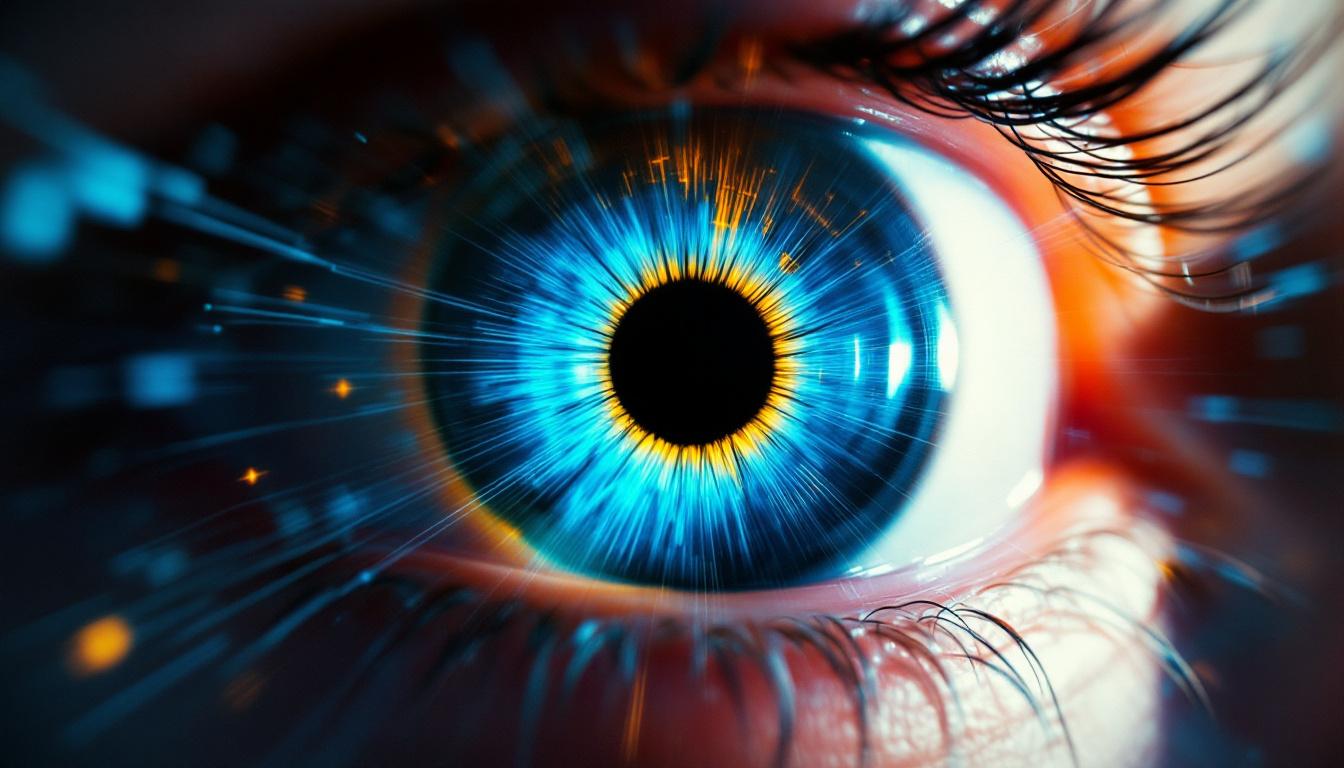
There is no blue dye in a blue iris. There’s no green dye in a green one, either. Those colors come from the way light scatters inside the iris — the same physics that makes the sky look blue when the air itself is colorless. The only true eye-color pigment is brown melanin; how much you have, and how light bounces around what’s left, decides everything else.
6. Every blue-eyed person alive shares a single common ancestor.
Originally, every human on Earth had brown eyes. Then, somewhere between roughly 6,000 and 10,000 years ago, one person was born with a tiny genetic mutation — a “switch” that dialed down brown pigment in the iris. Blue eyes spread from that single individual. So everyone with blue eyes today, all of them, are distant relatives carrying that one ancestor’s mutation.
7. The cornea is the only part of your body with no blood supply.
Almost every tissue you have is fed by blood vessels. The cornea — the clear dome at the front of your eye — is the lone exception, and for a very good reason: blood vessels would cloud it and you wouldn’t be able to see through it. Instead, the cornea gets its oxygen straight from the air and its nutrients from the fluid and tears around it. It’s the one place in you that breathes on its own.
8. Your eyes make tiny jerking movements constantly, and you go briefly blind during each one.
Your eyes never hold perfectly still. They dart in rapid little jumps called saccades, several times a second, even when you think you’re staring at one thing. During each of those jumps your brain actually suppresses your vision so you don’t see a nauseating blur — meaning you are momentarily, repeatedly blind all day long. The brain stitches the steady moments together so smoothly you have no idea any of it happened.
9. Your eyeballs are basically the same size your whole life.
Your nose keeps growing. Your ears keep growing. Your eyes, more or less, do not. The eyeball you have as an adult is only modestly larger than the one you were born with — which is why babies’ eyes look so enormous on their little faces. They’re nearly grown-up eyes that the rest of the head simply hasn’t caught up to yet.
10. When you glance at a clock, your brain rewinds time so the first second looks frozen.
You’ve probably noticed it: you look over at a clock and the second hand seems to hang in place a beat too long before ticking. It’s called chronostasis, and it’s real. To hide the blackout that happens while your eyes are mid-jump, your brain backdates what you see — it stretches that first moment after your eyes land and stitches it over the gap. Your brain is editing time, every single day, just to spare you the splice marks.
Which one made you go “wait, what?” Send this to the friend who’s never once thought about their own blind spot.
