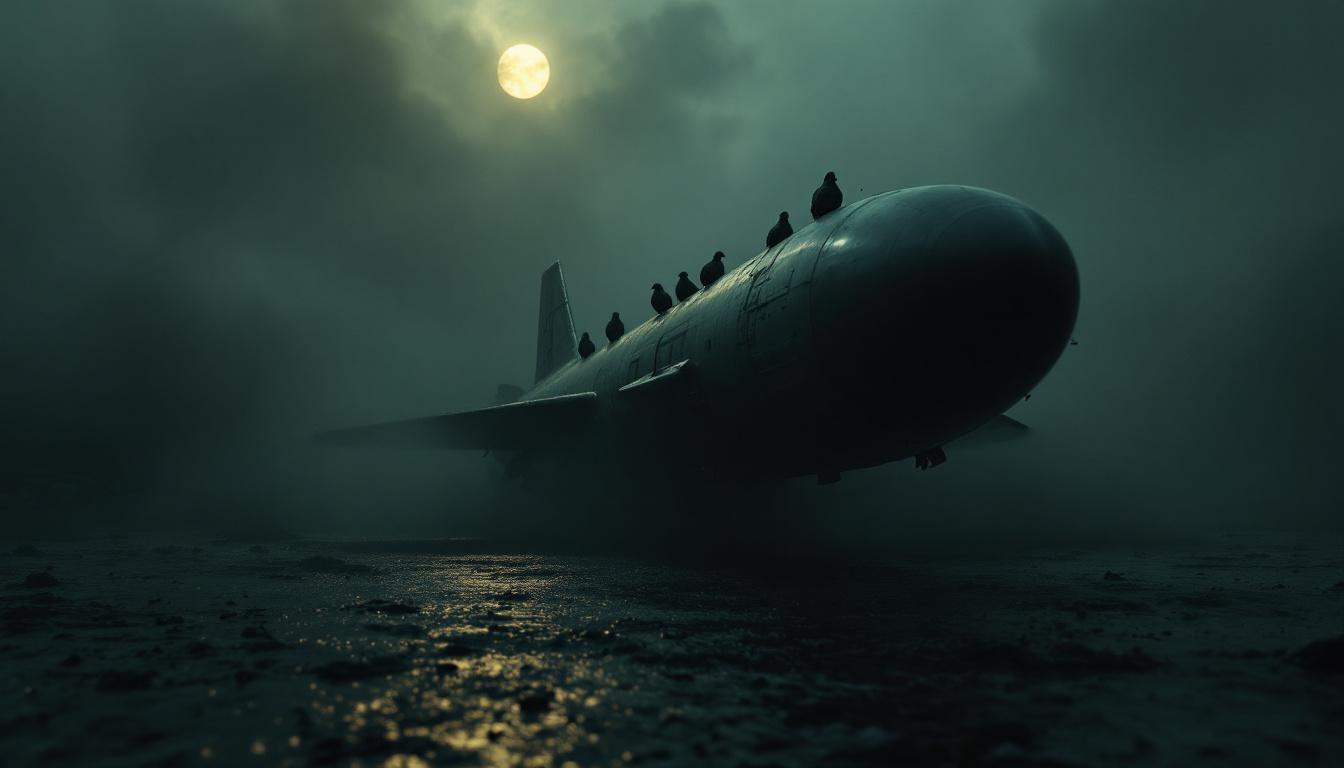
Picture a steel bomb falling out of the belly of a bomber somewhere over the Pacific in 1944. Inside the nose of that bomb, behind three small glass lenses, there is a compartment. And inside that compartment, riding the weapon down toward a Japanese warship, are three live pigeons. Each one is strapped into a little jacket. Each one is staring at a screen. And each one, as the ship slides into view, leans forward and starts to peck.
Now I know how that sounds. I want you to hear me out before you decide I’m pulling your leg, because I’m not. This is not a tall tale. This is not a thing somebody dreamed up for a cartoon. The United States government wrote checks for this. There is a nose cone sitting in the Smithsonian right now with the pigeon harnesses still in it. So sit down, because this one is going to take a minute.
The man behind it was B.F. Skinner — and if that name rings a bell, it should. Skinner is one of the most famous psychologists who ever lived, the father of an entire branch of behavioral science, the guy whose name is in every Psych 101 textbook in the country. In the early 1940s he was not yet that legend. He was a researcher with a wild idea and a war on. The story goes that he was on a train, watching a flock of birds bank and wheel outside the window in perfect formation, and instead of seeing birds he saw something else. He saw devices. Devices with extraordinary eyesight and reflexes no machine of that era could touch. And he thought: what if you put one of those inside a bomb.
Here is the thing you have to understand about 1943. The “smart bomb” did not exist. Missiles flew where the wind and gravity told them to fly, and electronic guidance systems were primitive, jam-prone, and mostly useless against a moving ship. Every side in the war was desperate for a weapon that could actually steer itself to a target. So when Skinner came knocking with a pigeon, he didn’t get laughed out of the room — not entirely. He got something better. He got a contract.
The food company General Mills — yes, the cereal people — backed him first, putting up money and lab space. Then in 1943 the National Defense Research Committee, the federal body running America’s wartime science, looked at the proposal, called it eccentric and impractical in writing, and then handed over $25,000 anyway. In 1943 dollars. The official project ran from February 1st to December 31st of that year, and it had a name. Project Pigeon.
The design was genuinely clever, and that’s the part nobody expects. Skinner trained the birds using operant conditioning — the very technique that made him famous. He’d show a pigeon an image of a target, a ship, an intersection, whatever, and reward it with a grain of food for pecking at it. Then he’d make it peck faster. Then faster still. Before long he had pigeons that would hammer away at a target image four times a second, all day, for one reason: they were good at their job and they wanted to be paid. Inside the bomb, three lenses projected the live image of whatever was below onto a translucent screen. As long as the pigeons kept pecking dead center, the bomb flew straight. The moment the target drifted toward the edge — because the bomb was off course — the birds would chase it with their beaks, and that pecking was mechanically linked to the bomb’s control surfaces. The pigeons, quite literally, flew the weapon.
Skinner used three birds instead of one, and his reasoning is my favorite detail in the whole file. Three pigeons meant a vote. If one bird got confused or distracted and pecked the wrong spot, the other two would outvote it and keep the bomb on course. In Skinner’s own dry description, the dissenting bird would simply be “punished for his minority opinion.” A democracy of pigeons, three feet from the warhead, settling disagreements by majority rule on the way down.
And here is where I have to be straight with you, because the storyteller’s job is the whole story, not just the fun parts. The pigeons worked. That’s the problem. In test after test the birds performed — they tracked targets, they corrected course, they did exactly what Skinner promised. One servomechanism engineer who watched them, a man named Harold Hazen, said flatly that the pigeons were “better than radar.” But the committee of scientists Skinner had to convince could not get past the absurdity of it. They sat through his demonstration and they were amused. Not impressed — amused. They could not look at a bird in a bomb and write a serious memo recommending it. Skinner watched a working weapon get killed by a snicker, and he summed up the whole experience in one of the most quietly bitter lines a scientist has ever committed to paper: “A pigeon was more easily controlled than a physical scientist serving on a committee.” On October 8, 1944, the government cancelled Project Pigeon.
But the story doesn’t end there, and this is the turn. In 1948 the Navy quietly dug the idea back up, because their electronic homing missiles were still getting jammed and they were willing to try anything that couldn’t be. They renamed it Project Orcon — short for “organic control” — and this time they ran the numbers cold. The results, declassified later, are not a punchline. The pigeons kept the target locked on screen for more than half the run on 55.3 percent of test flights. Better than 80 percent of their pecks landed within a quarter inch of the target. A quarter inch. The project was finally shelved in 1953, and not because the birds failed — it died because a pigeon can only see in daylight and only as far as its own eyes reach, and by then electronics had finally gotten good enough to work at night and at range. The technology beat the pigeon. The pigeon never lost its nerve.
Here is the part that gets me. Skinner kept some of those trained birds after the war, just to see. He’d pull one out and test it a year later. Then two years. Then four. Then six years after Project Pigeon was killed, he’d set a pigeon in front of a target — and it would lock in and peck, four times a second, dead center, ready for a war that was long over and a mission that was never coming. Skinner declassified the whole program himself around 1958 and described it in a lecture with a title only he would choose: “Pigeons in a Pelican.” You can find the nose cone today at the Smithsonian’s National Museum of American History — three little compartments, three little jackets, the strangest weapon the United States ever almost built. The government spent the money, proved it worked, and walked away because nobody could keep a straight face. I’m not telling you it should have flown. I’m just telling you it could have.
Conspiracy Confirmed
