
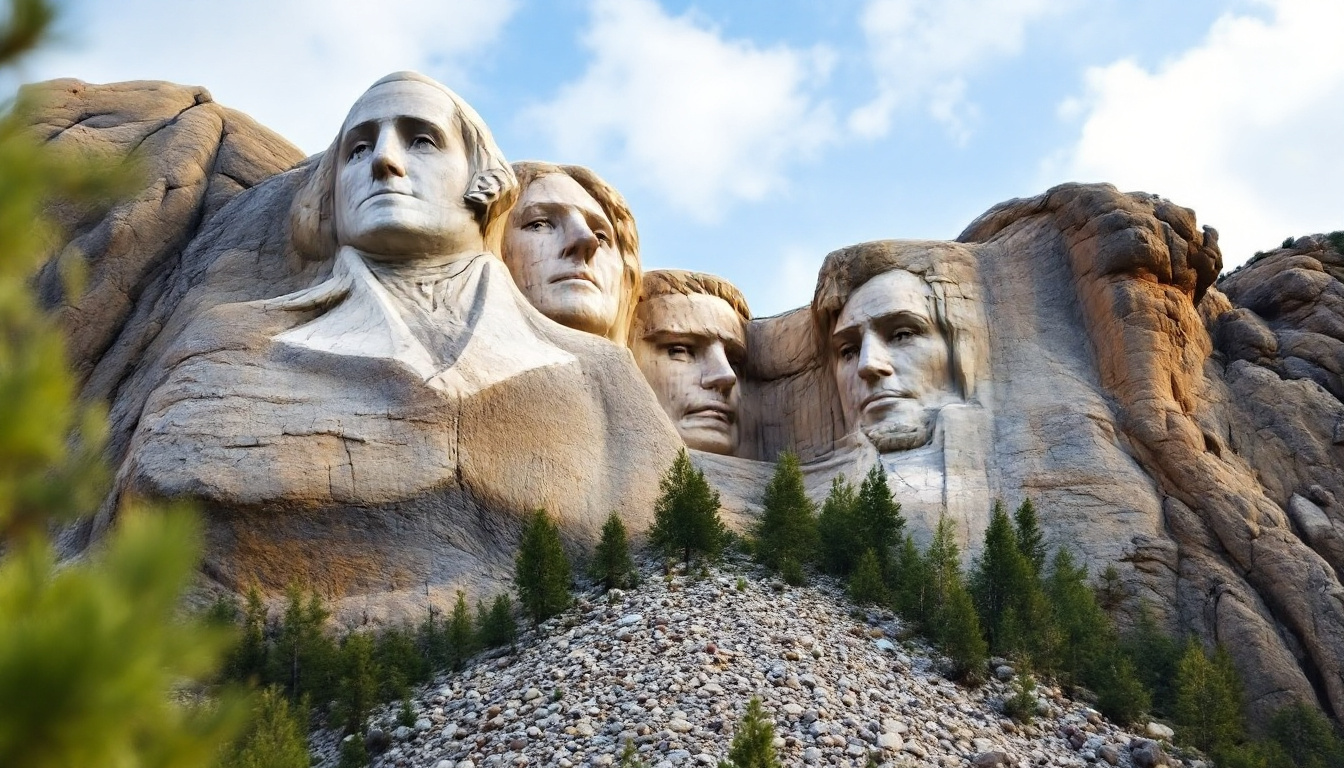
I thought I knew Mount Rushmore: four presidents, one big rock, carved by some guy a long time ago. Turns out the four faces were supposed to have bodies, there’s a secret room sealed inside the mountain that almost nobody has ever entered, and Jefferson originally sat on the wrong side of Washington before they blew him up and started over. America’s most famous mountain has a lot more going on than the postcard lets on.
1. There’s a hidden chamber sealed behind Lincoln’s head.
This sounds like a movie plot, but it’s real and it’s called the Hall of Records. The sculptor wanted a vault carved into the canyon wall behind the faces to store America’s most important documents so future civilizations would know what the monument meant. He only got the entrance hall partly dug before he died, and it sat empty for decades. In 1998, the National Park Service finally sealed a titanium vault inside the floor — porcelain panels holding the Declaration of Independence, the Constitution, and the story of the carving — under a 1,200-pound granite capstone. It is not open to the public. You basically can’t get in.
2. The faces were originally supposed to be carved down to the waist.
The four heads we know today were only ever meant to be the top of the design. Sculptor Gutzon Borglum’s plan showed the presidents carved from the head down to roughly the waist, with hands, lapels, and Washington in a full coat. The money ran out, World War II pulled away funding and workers, and Borglum died in 1941 — so the project stopped at the heads. The version everyone recognizes as “finished” is really an abandoned torso project that happened to look complete from the neck up.
3. Thomas Jefferson was first carved on the other side — then dynamited off the mountain.
Jefferson wasn’t always to Washington’s left. The original plan put him on Washington’s right, and crews actually started carving him there. After about 18 months of work, the rock turned out to be too cracked and weak to hold a face, so Borglum made the call to blast the unfinished Jefferson off the mountain entirely with dynamite and start fresh on the other side. The Jefferson you see today is take two, on the opposite shoulder from where he began.
4. Not one worker died building it — despite using 450,000 tons of dynamite.
Around 400 people worked on Mount Rushmore over 14 years, dangling off the cliff face in leather bib harnesses, drilling and packing explosives into a mountain. Roughly 90 percent of the carving was done not with delicate chisels but with dynamite — workers got so precise they could blast to within inches of the final surface. For all that danger, across all those years, the official count of deaths during construction is zero. (Several workers later developed silicosis from breathing rock dust, but no one died on the job during the carving itself.)
5. The whole thing was originally meant to be a tourist trap — and it wasn’t even supposed to be presidents.
Mount Rushmore began as a marketing scheme. A South Dakota historian named Doane Robinson pitched a giant carving in the 1920s purely to lure tourists to the state. His first idea wasn’t presidents at all — he wanted Western legends like Lewis and Clark, Sacagawea, and Buffalo Bill Cody carved into the granite spires called the Needles. Borglum talked him out of it, argued for figures of national importance, and picked a different mountain with better rock and better sun. The Wild West theme park we never got became a monument to four presidents.
6. The mountain is named after a New York lawyer who was just visiting.
The granite peak didn’t have an official name for most of its existence — the Lakota called it Six Grandfathers. The “Rushmore” comes from Charles E. Rushmore, a New York City attorney who traveled out in 1885 to check on mining claims. As the story goes, he asked his guide what the mountain was called, and the guide essentially said “it doesn’t have a name, but from now on we’ll call it Rushmore.” The name stuck, became official in 1930, and now one of the most patriotic landmarks in America is named after a lawyer who happened to ask a question on a business trip.
7. Lincoln Borglum, the sculptor’s son, finished the monument.
Gutzon Borglum died in March 1941 with the carving not quite complete. The man who stepped in to finish the last months of work was his own son, Lincoln Borglum — named, fittingly, after one of the presidents on the mountain. Lincoln had grown up on the project, started as a teenage pointer and driller, and rose to superintendent. So the family name is literally built into the rock twice: once on the cliff, and once in the man who finished it.
8. Each president’s face is about 60 feet tall — and the eyes have a clever lighting trick.
These heads are roughly the height of a six-story building. Scaled to those proportions, each president would stand around 465 feet tall if the full bodies had been carved. And look closely at the eyes: to make the pupils read as alive from far below, Borglum left a small shaft of uncarved granite sticking out in the center of each eye. Sunlight catches that little post and the surrounding shadow tricks your brain into seeing a gleaming, glinting pupil. The “twinkle” in their eyes is solid rock, on purpose.
9. Washington’s nose is longer than the other three — because he’s slightly closer to the edge.
You’d assume four faces carved to the same scale would have matching features, but Washington’s nose measures about 21 feet, while the others come in around 20 feet. Washington was carved first and positioned a touch farther out on the rock face, so his proportions were set slightly differently to keep him looking right from the ground. It’s the kind of thing you’d never notice from the viewing terrace — but up close, the first president is sporting the biggest nose on the mountain.
10. The monument is still technically unfinished — and the rock is built to outlast civilization.
Because the bodies were never carved and the Hall of Records was never fully realized, Mount Rushmore is, by its original blueprint, an incomplete work. And it’s likely to stay that way for a very, very long time. The granite erodes at an estimated rate of about one inch every 10,000 years. At that pace, geologists figure the faces could still be recognizable hundreds of thousands — even millions — of years from now, long after almost everything else we’ve built has crumbled to dust. The unfinished monument may end up being one of the longest-lasting things humans ever made.
Which one surprised you most? Send this to the friend who’s driven past Rushmore but never knew about the secret room behind Lincoln’s head.
