
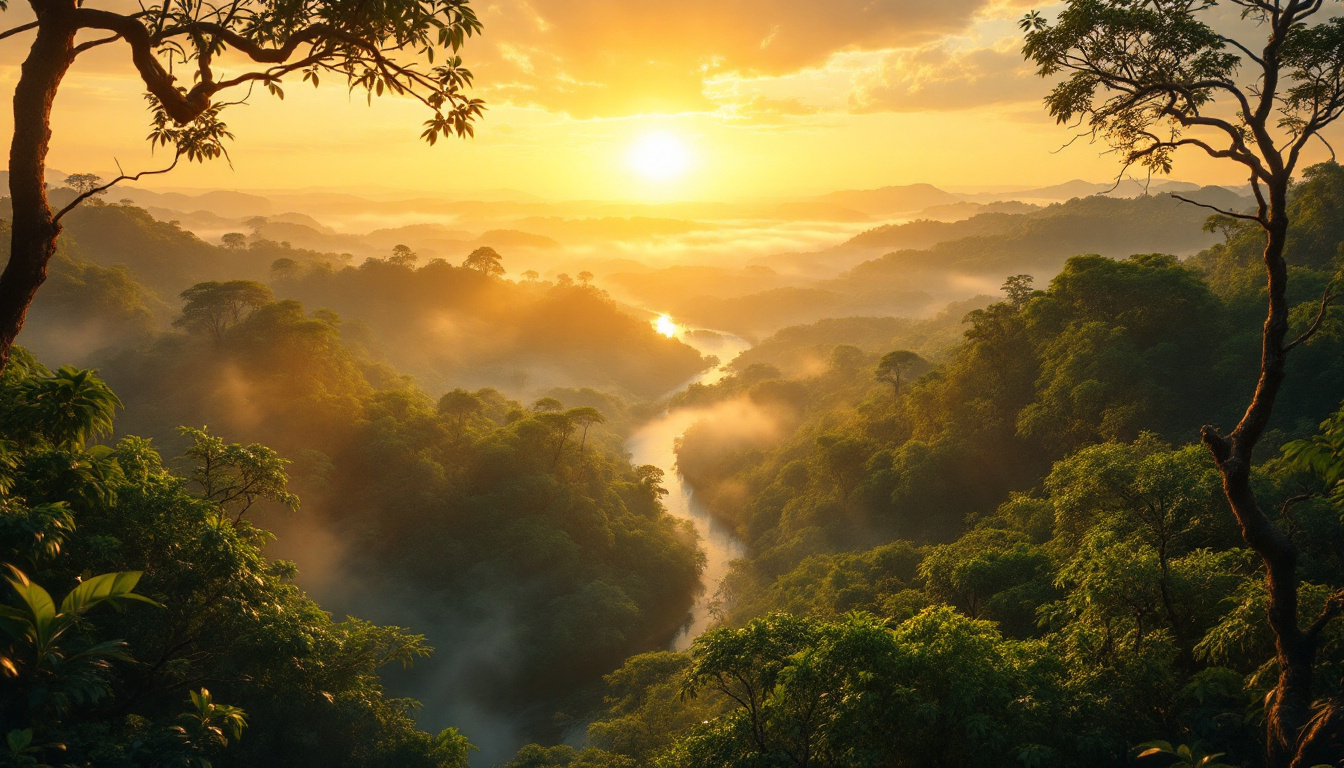
I figured the Amazon was just a really big, really green forest with a lot of bugs. Then I started reading, and now I’m a little unsettled. It’s fertilized by dust from a desert on another continent. It makes its own rain. The river used to flow the other direction. And there are people living in there right now who have never met an outsider. The biggest forest on Earth is way stranger than the documentary version.
1. The Amazon is fertilized by dust blown across the entire Atlantic Ocean from the Sahara Desert.
This one broke my brain a little. The Amazon’s soil is actually pretty poor in nutrients, especially phosphorus, because the constant rain washes it away. So where does the replacement come from? The Sahara. Every year, winds lift millions of tons of phosphorus-rich dust off the African desert and carry it thousands of miles across the Atlantic. A huge chunk of it comes from a single ancient dried-up lakebed in Chad called the Bodélé Depression. The world’s biggest rainforest is being kept alive, in part, by the world’s biggest hot desert. Satellites have tracked the dust plumes the whole way across.
2. The Amazon River once flowed in the opposite direction — east to west.
Today the Amazon famously dumps into the Atlantic on the east coast of South America. But geologists studying ancient sediments figured out that long ago — we’re talking many millions of years — the river drained the other way, toward the Pacific. What flipped it? The Andes mountains. As the Andes slowly rose along the west coast, they walled off the old exit, the water backed up into a giant inland wetland, and the whole system eventually reversed course and broke out to the east instead. A mountain range turned a continent’s plumbing completely around.
3. There’s a river deep in the Amazon that runs hot enough to boil you alive.
For years scientists assumed a “boiling river” in the Peruvian Amazon was just a legend. Then a geoscientist named Andrés Ruzo went and found it. It’s real — a roughly four-mile stretch of river that runs as hot as 200°F, hot enough to cook small animals that fall in and steaming like a kettle. The wild part is there’s no volcano anywhere near it to explain the heat. The leading theory is that it’s fed by deeply circulated groundwater that gets superheated far underground and surfaces along a fault. Locals knew about it the whole time. Western science just didn’t believe them.
4. The Amazon basically waters itself by making its own rain.
The trees don’t just sit in the rain — they manufacture it. Through a process called transpiration, a single large tree can pump hundreds of gallons of water into the air in a day, and the forest as a whole releases an astonishing amount of moisture. That water vapor forms clouds, the clouds rain back down, and the cycle repeats, sometimes recycling the same water five or six times as it crosses the basin. Scientists call these airborne moisture streams “flying rivers,” and one of them can carry more water through the sky than the Amazon River carries on the ground. The forest is, in a very real sense, irrigating itself.
5. There are still around 100 uncontacted tribes living in the Amazon today.
Not a hundred years ago. Today. Brazil’s government agency for indigenous affairs estimates there are roughly 100 uncontacted or isolated groups in the Amazon — people who have chosen to live with no regular contact with the outside world, and in some cases have never had any. We mostly know they exist from aerial photos showing clearings, huts, and figures looking up at the plane. It is genuinely one of the last places on the planet where you can fly over inhabited land and find people who don’t know the rest of us are up here.
6. A single Amazon tree can be home to more ant species than all of the British Isles.
Entomologists love this one and now I do too. The biodiversity in the Amazon is so dense that researchers studying just one tree have found more species of ants on that one tree than exist in the entire British Isles. Zoom out and the numbers get ridiculous: the Amazon is thought to hold roughly 10% of all known species on Earth, including hundreds of mammals, well over a thousand birds, thousands of fish, and an estimated 2.5 million different kinds of insects. Scientists are still naming new species there constantly — sometimes hundreds in a single year.
7. There’s a city-sized ancient civilization hidden under the trees, and we found it with lasers.
For a long time the assumption was that the Amazon was untouched wilderness — too harsh for big societies. Then researchers started flying planes with LiDAR, a laser tool that strips away the tree cover and maps the bare ground beneath. What they found in the Bolivian and Brazilian Amazon were the buried outlines of sprawling settlements: platform mounds, plazas, raised causeways, and canals belonging to ancient cultures, including a Casarabe-culture network of urban centers spread across the landscape. People built something city-like in the rainforest more than a thousand years ago, the forest swallowed it, and we only saw it once we could see through the leaves.
8. The Amazon River is so wide and powerful that no bridge crosses its main stem.
You’d think the most famous river on Earth would be lined with bridges. Nope. For the entire length of the Amazon’s main channel, there is essentially no bridge spanning it. Part of it is that the river is staggeringly wide — miles across in the wet season — and part of it is simple practicality: there are very few large roads or cities along its banks that would need to be connected, so people cross by ferry and boat instead. The river also pushes so much freshwater into the Atlantic that you can scoop up drinkable water out at sea, well before any land is in sight.
9. The pink river dolphin of the Amazon turns brighter pink the more excited it gets.
The Amazon has dolphins. Freshwater, river-dwelling, genuinely pink dolphins called botos, swimming around hundreds of miles from any ocean. And they’re not always the same shade — males in particular flush a brighter, rosier pink when they’re active, agitated, or showing off, sort of like a built-in mood ring. They’ve also got unusually flexible necks that let them turn their heads to navigate the flooded forest, weaving between submerged tree trunks. A pink, neck-turning dolphin paddling through a forest is exactly the kind of thing the Amazon just casually has.
10. The Amazon produces a massive share of the planet’s oxygen — but quietly uses up most of it too.
You’ve heard the Amazon called “the lungs of the Earth,” and it does generate an enormous amount of oxygen through photosynthesis. But here’s the twist scientists point out: the forest is so alive — so packed with plants, animals, microbes, and decomposing matter all breathing and rotting — that it consumes nearly all the oxygen it makes. The net amount it adds to the air we breathe is much smaller than the famous nickname suggests. It’s less a giant oxygen factory shipping product worldwide and more an unbelievably busy, self-contained ecosystem running full tilt all day, every day. Which, honestly, is even cooler.
Which one of these made you rethink the Amazon? Send this to the friend who still thinks it’s just a big forest with a lot of frogs.
