
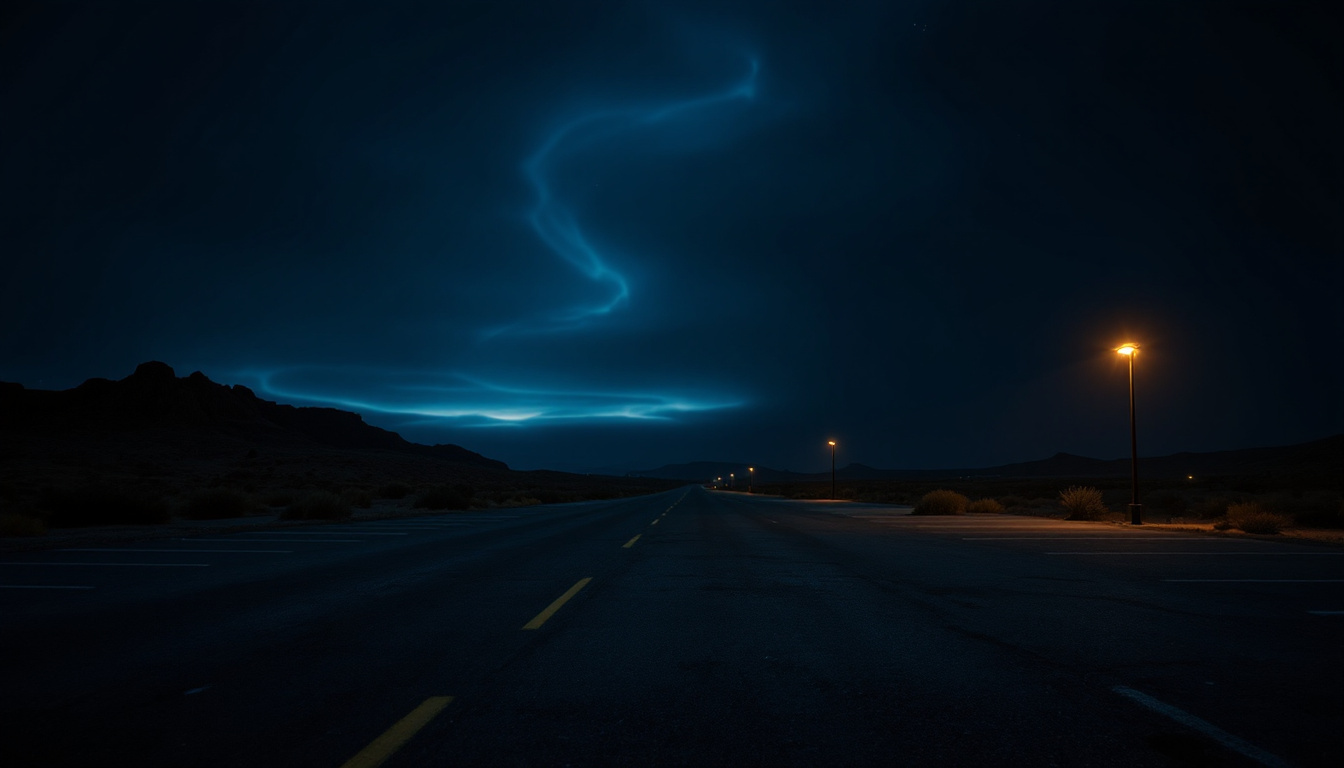
Let me set the scene for you, because this one needs the scene to work. You’re in far West Texas, out past the Pecos River, in a stretch of high desert so empty and so flat that the night sky comes all the way down to the ground in every direction. There’s a town out there called Marfa — a tiny place, a few thousand people, the kind of town you’d drive through in ninety seconds if you didn’t have a reason to stop. And nine miles east of it, along U.S. Highway 90, the state of Texas has built something you almost never see a government build for a thing that officially doesn’t exist: a paved parking lot. Restrooms. A stone viewing platform with a little sign. People drive there from all over the world, they get out of their cars after dark, they face south toward the Chinati Mountains, and they wait. And a lot of nights — not every night, but a lot of them — the lights show up.
Now I want to be careful here, because I’m going to tell you what people see, and I want you to hear it the way they describe it, not the way a movie would dress it up. The Marfa Lights are not dramatic. That’s almost the strangest part. They look like distant glowing orbs — usually about the size of a basketball held at arm’s length, sometimes white, sometimes yellow, sometimes red or blue or green. They hover near the horizon. They split apart and merge back together. They drift sideways, they bob, they wink out and reappear somewhere they have no business being. Sometimes there’s one. Sometimes there are a dozen. People who’ve watched them for years will tell you the lights seem to move with a kind of intention — that they’ll dance for a while, dim, and then come back, like they’re aware they have an audience. And here’s the detail that ought to get your attention: nobody has ever been able to walk up to one. People have tried. They’ve driven toward them, hiked toward them, flown over the area. The lights stay on the horizon. They keep their distance. You cannot get close to a Marfa Light.
So the obvious question is the one you’re already asking. How long has this been going on? And the answer is the thing that makes this story hard to wave away.
The first account most people point to goes back to 1883. A young cattle rancher named Robert Reed Ellison was driving a herd through the area, and one night he saw flickering lights out toward the Chinati Mountains. His first thought was the reasonable one — Apache campfires. So he watched, and he waited, and the next morning he and others rode out to where the fires should have been. There were no ashes. No campsite. No sign anybody had ever been there. Local settlers told him they’d seen the same lights, and that they’d been seeing them for as long as anybody could remember. Now here is why that 1883 date matters so much, and I want you to really sit with it. The automobile had not been invented yet. There were no headlights out there. No highways. No distant cities throwing up a glow. The thing people most love to use to explain the Marfa Lights away simply did not exist when the first ranchers started reporting them.
Because that’s the explanation you’ll hear first, every time. Car headlights. U.S. 90 runs right through that basin, and so does old Highway 67 heading down toward Presidio, and skeptics — reasonable, careful people — point out that headlights from cars miles away, bent and magnified by layers of desert air at different temperatures, could absolutely produce floating points of light that seem to hover and shift. And honestly? They’ve got a real case for some of it. In 2004 a group of physics students from the University of Texas at Dallas went out there, set up telescopes and cameras, and tracked the lights over several nights. Their conclusion was blunt: a good number of the lights they recorded lined up perfectly, in timing and in position, with traffic on Highway 67. Cars. Just cars, doing strange things to your eyes across miles of shimmering air. And you know what? I believe them. I think a lot of what people see out there on a given night really is headlights playing tricks.
But — and you knew there was a but, because I told you there was a parking lot — that explanation has a nineteenth-century hole in it the size of West Texas. The lights were reported in 1883. They were reported by ranchers, soldiers, and settlers for decades before a single automobile ever rolled into that basin. There are accounts from people who knew that country in the days of horses and wagons, who swore the lights were out there long before anyone in Marfa had ever seen a car. So even if every headlight skeptic is completely right about the modern sightings — and they might be — they still have to explain the ones that came before there were any headlights to blame. The mundane answer cleans up the recent mess. It cannot reach back far enough to close the case.
So what’s left? The honest scientific candidates are atmospheric. The leading serious theory is some form of mirage — specifically what’s called a Fata Morgana, where layers of air at sharply different temperatures, stacked over that desert basin, bend distant light into hovering, shifting, shape-changing forms. Other researchers have floated electrical discharge, glowing gases venting from the ground, even a kind of luminous static produced by the unusual minerals and stresses in the rock out there. These are real ideas proposed by real scientists, and any one of them could be the answer. But here’s where it stands, almost a century and a half later: not one of them has ever been proven. No experiment has produced a Marfa Light on demand. No one has ever caught one, measured one up close, or explained the whole phenomenon to the point where the experts agree and pack up and go home. The Chamber of Commerce will happily sell you a T-shirt, and the official line is essentially a friendly shrug.
And I’ll be straight with you, the way a storyteller has to be. Because there’s an open door on this one, the wilder explanations have walked right through it, same as they always do. People have called the Marfa Lights ghosts — the spirit of an Apache chief, the lantern of a lost prospector still searching the desert. People have called them UFOs. People have built whole belief systems around that flat patch of Texas dirt. There’s no evidence for any of it, and I’m not asking you to buy a word of it. I’m just telling you what’s actually true, which is plenty strange on its own: that for nearly a hundred and forty years, ordinary people in far West Texas — ranchers, soldiers, schoolteachers, tourists, scientists — have stood in the dark and watched lights that nobody can reach, nobody can fully explain, and nobody has ever managed to make stop. The state of Texas got tired of arguing about it and just built a place to stand. You can drive out there tonight. Face south. Wait. And see for yourself what those ranchers saw in 1883, back before the world had a comfortable answer to hand you.
Unsolved Mystery
