
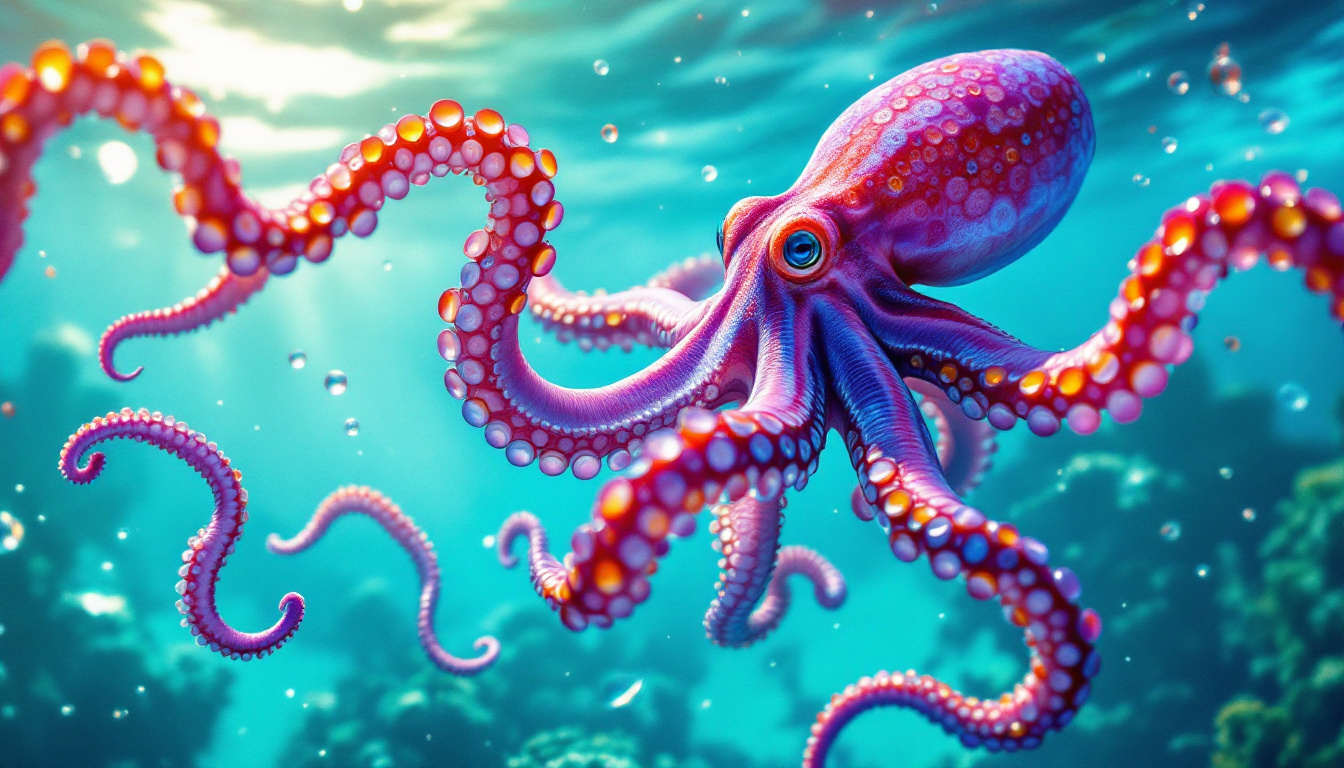
Okay, I went down an octopus rabbit hole this week and I cannot stop thinking about these aliens that happen to live on our planet. They’ve got three hearts, blue blood, and a brain so weirdly distributed that each arm basically thinks for itself. One famously broke out of an aquarium and slipped down a drainpipe to the sea. Another carries coconut shells around like a tiny, eight-armed survivalist. Buckle up, because every single one of these is true.
1. An octopus has three hearts, and one of them quits when it swims.
Two hearts pump blood through the gills, and a third sends it out to the rest of the body. Here’s the kicker: that third heart stops beating whenever the octopus swims. Swimming literally exhausts them, which is why they’d rather crawl along the seafloor than zip around like a fish. Imagine your heart taking a coffee break every time you jogged. No wonder they take it slow.
2. Their blood is blue.
Forget the red, iron-based blood you and I run on. Octopus blood uses a copper-based protein called hemocyanin, and copper turns the whole thing blue. It’s not just for looks, either. That copper chemistry hauls oxygen far more efficiently in cold, low-oxygen deep water, where iron-based blood would basically tap out. They’re literally blue-blooded royalty of the ocean.
3. They have nine brains.
One central brain, plus a mini-brain in each of the eight arms. About two-thirds of an octopus’s roughly 500 million neurons live in the arms, not the head. That means each arm can taste, grip, and make decisions largely on its own while the central brain handles the big-picture plan. It’s less “one creature with eight arms” and more “a committee of nine that mostly gets along.”
4. They taste everything they touch.
An octopus doesn’t need to bring food to its mouth to know what it is. The suckers lining its arms are packed with chemical sensors, with some estimates putting around 10,000 neurons in a single sucker. So when an octopus reaches into a crevice, it’s tasting the rock, the water, and whatever’s hiding in there all at once. Picture licking everything you grab. They do, constantly, and they like it that way.
5. They’re colorblind, yet they’re the best color-changers on Earth.
Here’s a genuine biological puzzle. Octopuses have just one type of photoreceptor, which technically makes them colorblind. And yet they can match the colors of their surroundings in under a third of a second. Scientists think part of the answer is that their skin itself contains light-sensitive proteins, essentially “seeing” light without the eyes involved. They camouflage to colors they can’t even perceive.
6. They can squeeze through any gap bigger than their beak.
An octopus has no bones. The only hard part of its entire body is its beak, made of the same tough chitin found in crab claws. That means a several-foot octopus can pour itself through a hole barely an inch wide, as long as the beak fits. If the beak makes it, the rest of that boneless body follows. It’s the ultimate “is this opening load-bearing?” flex.
7. One named Inky busted out of an aquarium and escaped to the sea.
In 2016, an octopus named Inky at New Zealand’s National Aquarium found his tank lid left slightly ajar after maintenance. Overnight, he climbed out, crossed the floor leaving telltale tracks, and slid down a roughly 160-foot drainpipe that emptied straight into the ocean. He was never seen again. Somewhere out there is a free octopus with one heck of a prison-break story.
8. The coconut octopus carries its own armor.
In 2009, researchers caught a species hauling discarded coconut shells across the seafloor, sometimes for 60-plus feet, then assembling them into a portable hideout. That made it the first known invertebrate to use tools. The wild part is the planning involved: the coconut is useless dead weight until the moment danger arrives. Carrying something just in case you’ll need it later? That’s some genuinely advanced thinking from a mollusk.
9. The mimic octopus impersonates more than a dozen other animals.
The mimic octopus doesn’t just change color, it changes its shape and behavior to imitate creatures like venomous sea snakes, spiky lionfish, and flatfish, with researchers cataloging well over a dozen impressions. To “become” a sea snake, it buries six arms and waves the other two in opposite directions. It even seems to pick which disguise best scares off whatever predator is currently bothering it. A method actor with a survival instinct.
10. Mothers starve themselves to death guarding their eggs.
Most octopuses reproduce only once. After a female lays her eggs, a gland between her eyes triggers her to stop eating entirely. She spends her final days fanning fresh water over the clutch and protecting it, slowly wasting away, and usually dies right around the time they hatch. It’s a heartbreaking, one-shot devotion. The next generation’s first day in the world is, quite literally, her last.
Which one had your jaw on the floor? Send this to the friend who swears they could never eat calamari again…
