
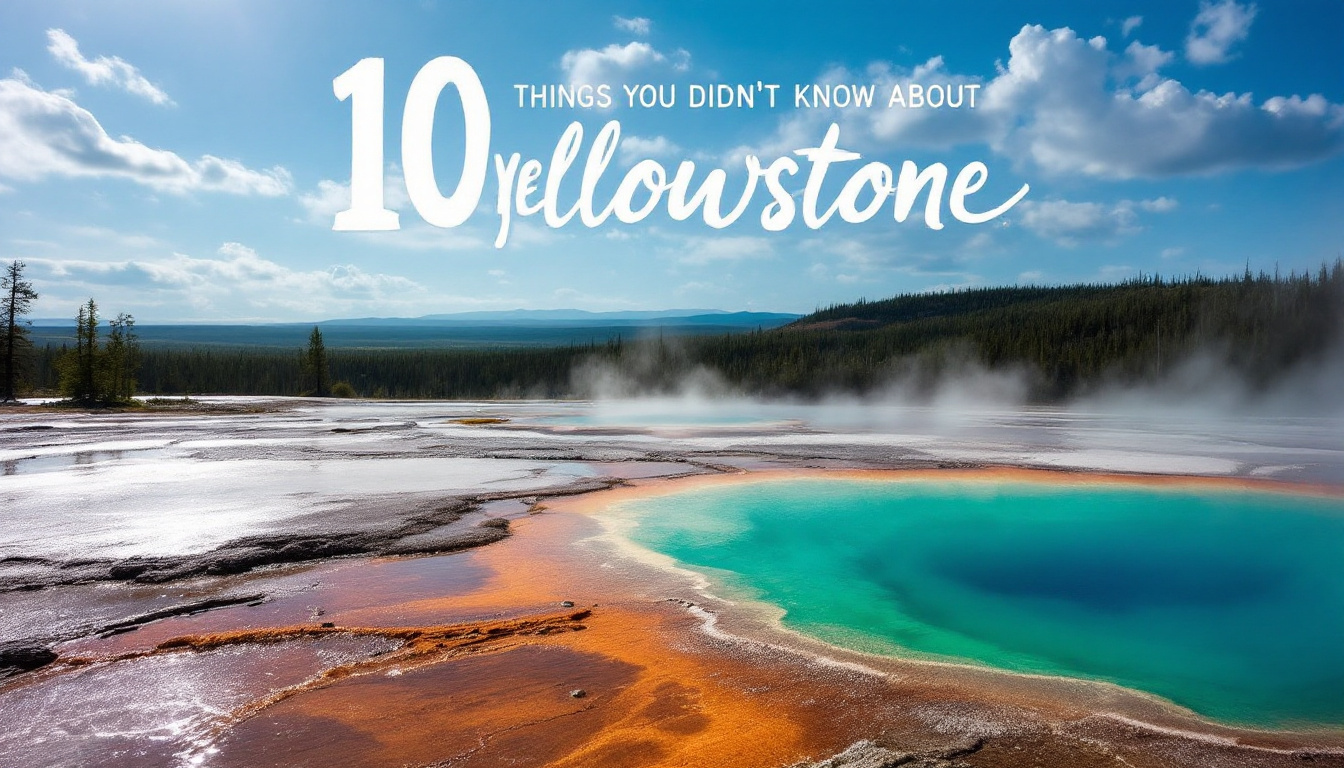
Most of us picture Yellowstone as Old Faithful blasting steam while a bison ambles across the road. All true. But did you know the whole park sits on top of one of Earth’s largest active volcanoes? Or that there’s a 50-square-mile sliver of it where, on paper, you might literally get away with murder? Once you start pulling on the threads, America’s first national park gets a lot stranger than the postcards let on. Here are ten facts that’ll change how you see the place.
1. It was the very first national park in the world.
Not just in America, the whole world. President Ulysses S. Grant signed Yellowstone into existence on March 1, 1872, decades before “national park” was even a concept anyone else had tried. There was no playbook, no model, nothing to copy. The U.S. essentially invented the idea of setting aside wild land for everyone, forever, right here. Every park from Yosemite to the Serengeti owes a little something to that signature.
2. The entire park sits on top of an active supervolcano.
Those bubbling mud pots and shooting geysers? They’re powered by a massive chamber of molten rock just a few miles beneath your feet. Yellowstone has had three caldera-forming super-eruptions, and the biggest blasted out enough ash and debris to bury vast stretches of the continent. The good news for your summer road trip: scientists say the magma chambers are nowhere near molten enough to erupt anytime soon. So go ahead, roast your marshmallow.
3. It holds about half the world’s geysers.
Out of every geyser on planet Earth, roughly half of them are crammed into this one park. Yellowstone has more than 500 geysers and over 10,000 hydrothermal features in total, the largest concentration anywhere on the globe. There’s no other place that even comes close. When people say Yellowstone is geothermally special, that’s a wild understatement.
4. Old Faithful is famous for being reliable, not for being the biggest.
Old Faithful isn’t the tallest or most powerful geyser in the park. It got famous because it’s punctual. It erupts roughly every 90 minutes or so, and rangers can predict the next show within about ten minutes. In a landscape this chaotic and unpredictable, a geyser you can practically set your watch to felt downright miraculous to early visitors. That dependability is the whole brand.
5. It’s bigger than Rhode Island and Delaware combined.
Yellowstone sprawls across nearly 2.2 million acres, which is larger than Rhode Island and Delaware put together. You could drive for hours and never see the same scenery twice. People plan a single day to “do Yellowstone” and quickly realize they’ve barely scratched a corner of it. It’s less a park and more a small country of forests, canyons, and steam.
6. The U.S. Army ran the park for 30 years.
Before the National Park Service even existed, poachers and vandals were tearing the place apart and nobody had the authority to stop them. So in 1886 the U.S. Army rode in and took over, running Yellowstone for the next three decades. The soldiers built Fort Yellowstone and basically wrote the rulebook for how to protect a park. When the Park Service was created in 1916, it simply adopted what the Army had already figured out, ranger hats and all.
7. Wolves vanished for 70 years, then came roaring back.
By the 1920s, the last wolves in Yellowstone had been hunted out, and the ecosystem quietly fell apart without them. Elk overran the place and chewed the landscape bare. In 1995, biologists reintroduced 31 gray wolves from Canada, and the recovery became one of the most famous comeback stories in conservation. The wolves thinned the elk, the plants grew back, and the whole food web rebalanced. Few experiments have ever proven a point so dramatically.
8. It’s home to America’s oldest and largest wild bison herd.
While bison were getting wiped out nearly everywhere else in the country, Yellowstone’s herd never disappeared. Today around 5,000 bison roam the park, and it’s the oldest continuously wild, free-ranging bison population in the United States. These aren’t transplants or zoo descendants, they’re the genuine, unbroken article. That shaggy giant blocking traffic is a living piece of American history.
9. The Grand Prismatic Spring gets its rainbow colors from bacteria.
The Grand Prismatic is the largest hot spring in the U.S. and the third largest on Earth, and those electric bands of orange, yellow, and green aren’t minerals. They’re living mats of heat-loving microbes, each thriving at a different water temperature, painting the rings like nature’s color chart. The deep, almost glowing blue in the center is just very pure, very hot, very deep water. It’s biology and physics collaborating on one of the most photographed sights in the world.
10. There’s a slice of the park where you might get away with murder.
Welcome to the “Zone of Death,” a 50-square-mile chunk of Yellowstone that spills over into Idaho. Thanks to a quirk in the Constitution, a jury for a crime there would have to be drawn from that exact strip of land, and the only residents are elk, bears, and a few thousand trees. A law professor spotted the loophole years ago and warned Congress to close it. Congress shrugged. To this day, it’s still technically open.
Which one made your jaw drop the most? Send this to the friend who thinks they already know Yellowstone…
