
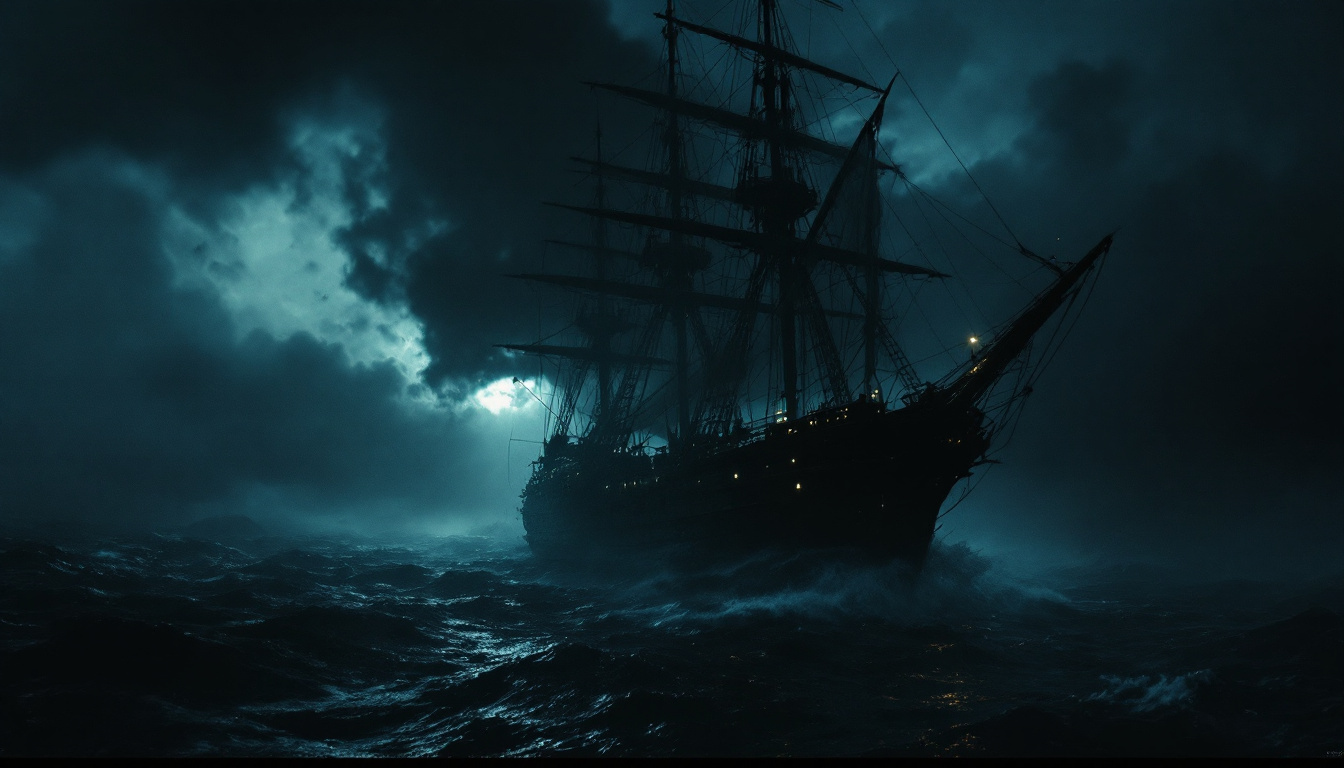
Let me set the scene for you, because this is one of those stories that has been told so many times, by so many people who weren’t there, that the truth has nearly drowned under the legend. Picture the North Atlantic on December 4th, 1872 — gray, restless, the kind of cold that gets into a sailor’s bones. The British-Canadian brigantine Dei Gratia is making her way between the Azores and the coast of Portugal when her helmsman spots another ship in the distance, yawing strangely, her sails set wrong and flapping loose. Something is off about the way she moves. A ship under command does not stagger like a drunk. The Dei Gratia‘s captain, David Morehouse, knew that vessel — she was the Mary Celeste, and he’d actually shared a meal with her captain, Benjamin Briggs, back in New York harbor not a month before. So they drew alongside, hailed her, and got no answer. None at all. They sent a small party across the swells to climb aboard, and what they found is the part nobody has ever been able to explain.
She was empty. Not a soul aboard. The Mary Celeste had sailed from New York on November 7th, bound for Genoa with 1,701 barrels of raw industrial alcohol in her hold, carrying ten people: Captain Briggs, his wife Sarah, their two-year-old daughter Sophia, and a crew of seven seasoned men. Now there was no one. The single lifeboat was gone, apparently launched deliberately rather than torn away. And here’s where I have to stop you, friend, because you’ve probably heard the famous version — the one with the half-eaten breakfasts still warm on the table, the cups of tea still steaming, the captain’s pipe smoldering, as though the crew had been plucked into the sky mid-bite. None of that is true. I want to be plain about it. That was invented. The galley was cold. The cooking gear was stowed away. There was no warm meal, no steaming tea, no abandoned pie. The men who actually boarded her described something far stranger in its ordinariness: a ship in working order, simply… vacated.
What they did find is genuinely unsettling, and it doesn’t need any embellishment. The cargo was intact — all those barrels of alcohol, untouched. There was a six-month supply of food and fresh water still aboard. The crew’s personal belongings, their oilskins, their pipes, even valuables, were left behind undisturbed. The captain’s logbook sat where it belonged, its final entry dated November 25th — nine or ten days before she was found, placing the ship near the island of Santa Maria in the Azores. But the ship’s chronometer and sextant, the two instruments a captain needs to navigate, were missing. A makeshift sounding rod, used to measure water in the hold, lay abandoned on the deck. There was about three and a half feet of seawater sloshing in her belly — serious, yes, but not nearly enough to sink a vessel her size. Some sails were set, some were furled, some were missing entirely, and the rigging hung in loose, damaged ropes over her sides. Everything pointed to one inescapable conclusion: these people had not been attacked, had not starved, had not been swept overboard one by one. They had made a choice. They had climbed into that lifeboat and rowed away from a perfectly seaworthy ship — and then they had vanished from the face of the earth.
Now, why would ten experienced sailors abandon a sound vessel in the middle of the ocean? That’s the whole riddle, isn’t it? When the Mary Celeste was towed into Gibraltar, the authorities there — led by a suspicious Attorney General named Frederick Solly Flood — were convinced foul play was involved. Mutiny, perhaps. Murder for the cargo. Maybe the Dei Gratia‘s own crew had butchered everyone aboard to claim the salvage money. Flood searched for bloodstains, for sword marks on the rails, for any sign of violence. He found essentially nothing he could prove, and the salvage was eventually, grudgingly, awarded. No evidence of crime ever surfaced. And so the official answer became the most frustrating answer of all: we don’t know.
Here’s where I think the real damage to the truth was done, and I find it almost funny that the culprit is a name you’d recognize. In 1884, twelve years after the abandonment, a young, then-unknown doctor named Arthur Conan Doyle — yes, that Conan Doyle, years before Sherlock Holmes — published an anonymous short story called “J. Habakuk Jephson’s Statement.” It was fiction, a thriller, told as the confession of a survivor. Doyle changed the ship’s name slightly to Marie Celeste, invented a tale of murder and revenge, and dressed it up with vivid, entirely fabricated details — including those phantom warm meals on the table. The public devoured it. Many readers, especially in America, took it as a true account. Solly Flood himself was so alarmed that he denounced the story to the authorities as “a fabrication from beginning to end.” But it was too late. Doyle’s fiction fused with the facts, the misspelled “Marie Celeste” stuck so hard it’s still the more common name today, and the steaming-teacup myth became “history.” So whenever you hear that eerie image of the table set for a meal nobody finished — know that you’re quoting a novelist, not a witness.
So what actually happened to Benjamin Briggs and his little family and his crew? The theories are many, and I’ll give you the ones that hold water — and the ones that don’t. The most respected explanation centers on that volatile cargo. Genoa’s records later showed nine of the 1,701 alcohol barrels were found empty — and those nine were made of red oak, a more porous wood than the rest. The thinking goes like this: in the cold of the voyage, alcohol vapor leaked and built up in the hold. Perhaps a sudden warming, or the rumble of the barrels shifting, caused a frightening whoomp of escaping fumes — what one modern chemist, Dr. Andrea Sella, demonstrated in 2006 could produce a brief, terrifying pressure-wave “explosion” with little or no scorching, no soot, no fire damage at all. To a captain standing on the deck above 1,700 barrels of explosive spirit, that single terrifying belch from below might have screamed abandon ship before she blows. Combine that with the water in the hold, a possibly faulty pump, and a chronometer Briggs may have feared was wrong — and you can picture a careful, frightened man ordering everyone into the lifeboat, tethered to the ship by a rope, meaning to wait out the danger and reboard once it passed. Then the wind freshens. The rope snaps, or is cut. And the Mary Celeste sails away from them — sails herself across the open ocean for nine days — while the lifeboat, with ten souls aboard and no instruments and no provisions, is swallowed by the Atlantic.
It’s a plausible story. It’s even a likely one. But notice that I said picture and perhaps and might have — because not one shred of it is proven, and not one of those ten people was ever seen again, alive or dead. No bodies washed ashore. No lifeboat was ever found. No survivor ever surfaced to tell the tale. The sea simply closed over them and kept its silence. Other theories have come and gone over the past century and a half — waterspouts, seaquakes, a rogue iceberg, piracy, insurance fraud, and yes, even sea monsters and aliens for those who like their mysteries seasoned with the impossible. None of them can be confirmed. None of them can be ruled out entirely. The Mary Celeste herself sailed on under new owners for another twelve unlucky years before a captain deliberately wrecked her off the coast of Haiti in a clumsy insurance scam — as though the ship had been cursed to the very end. So here we are, more than 150 years later, still standing on that gray December deck in our minds, looking at the cold galley and the missing lifeboat and the captain’s open logbook, asking the same question the Dei Gratia‘s crew asked into the wind and got no answer to: Where did everyone go? And the honest truth, the one without the steaming teacups, is that nobody knows. Nobody has ever known.
Unsolved Mystery
