
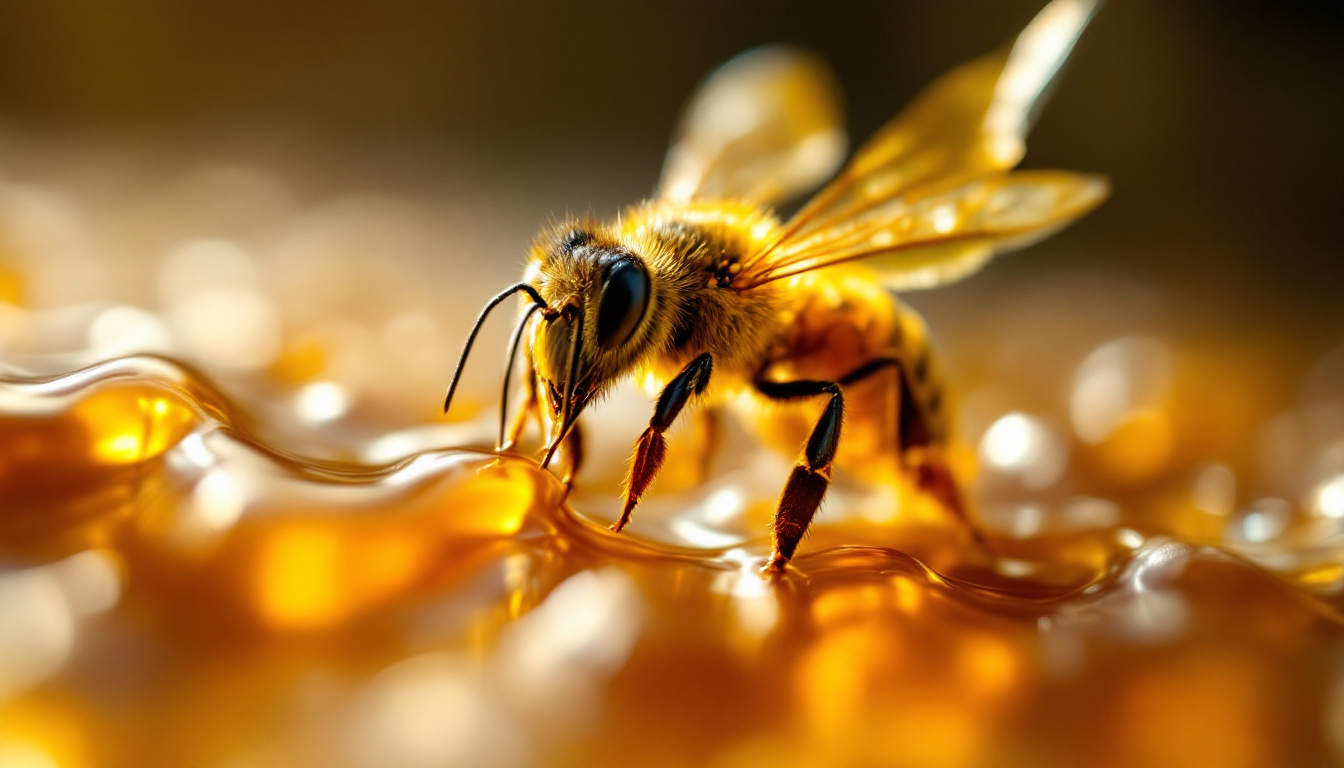
Okay, I went down a honey rabbit hole this week and I cannot keep it to myself. I always assumed honey was just pretty bear-shaped sugar, but it turns out the stuff in your pantry might outlive your great-great-grandchildren. The little insects that make it are running one of the most impressive supply chains on the planet, and they do it all on legs covered in pollen. So pour yourself some tea, stir in a spoonful, and let me ruin “boring breakfast condiments” for you forever.
Did you know archaeologists found 3,000-year-old honey in Egyptian tombs that was STILL edible?
When Howard Carter cracked open King Tutankhamun’s tomb in 1922, among the treasures were sealed jars of honey left for the pharaoh’s trip to the afterlife. Three thousand-plus years later, the honey was still in remarkable shape and theoretically safe to eat. The reason is pure chemistry: honey is extremely low in water, sky-high in sugar, and naturally acidic with a pH down around 3 to 4.5, which is a miserable place for bacteria to set up shop. On top of that, bees add an enzyme that produces tiny amounts of hydrogen peroxide, a built-in preservative. The one catch is the lid, because open honey in a humid kitchen will slowly pull water from the air and eventually ferment. Seal it, though, and you’ve basically got immortal breakfast.
Did you know bees tell each other where the flowers are by DANCING?
It sounds like a children’s book, but it’s hard science. When a forager finds a good patch of nectar, she comes home and performs a “waggle dance,” a little figure-eight shimmy on the honeycomb. The angle of her straight-line waggle relative to the sun tells the other bees which direction to fly, and the length of the waggle tells them how far. The harder and faster she shakes, the better the food source she’s bragging about. And the watching bees don’t just observe from the cheap seats, they press right up against her to feel the vibrations and learn the route. A bug with no map and no words just gave turn-by-turn directions with her butt.
Did you know it takes about two million flower visits and 55,000 miles of flying to make ONE pound of honey?
That jar in your cupboard is the result of an almost unbelievable amount of work. To produce a single pound of honey, bees collectively visit roughly two million flowers and rack up more than 55,000 miles of flight, which is enough to circle the Earth more than twice. A single bee typically hits 50 to 100 flowers on one trip out of the hive. Put it all together and one pound of honey represents the lifetime labor of hundreds of bees. So the next time honey seems a little pricey, remember you’re buying a frequent-flyer balance no human could ever earn.
Did you know a single worker bee makes only about 1/12 of a teaspoon of honey in her ENTIRE life?
Here’s the gut-punch behind that 55,000-mile stat. The average worker bee lives roughly six weeks in the warm months, and in all that time her personal honey output is about one-twelfth of a teaspoon. That’s not a typo, it’s basically a dab you’d struggle to see on your finger. And foragers don’t even start collecting nectar until the last couple weeks of their lives, when they’re already the old-timers of the hive. So every spoonful you eat is the combined life’s work of dozens of bees that each gave nearly everything for a smear. Suddenly “busy as a bee” sounds like an understatement.
Did you know a honeybee beats its wings around 200 times PER SECOND, and that’s where the buzz comes from?
That lazy summer hum is actually a tiny insect redlining its engine. Honeybees beat their wings somewhere around 200 times every second, which lets them cruise at about 15 to 20 miles per hour. The buzz you hear isn’t the wings slapping the air directly, either, it’s the rapid vibration of their flight muscles working the springy walls of their thorax. Wild detail: that buzzing frequency, generally between 200 and 250 Hz, has been shown to have a calming effect on people. So part of why a meadow full of bees feels so peaceful is that they’re basically humming you a frequency your brain enjoys, all while flapping faster than you can blink.
Send this to the friend who keeps a bear-shaped bottle in the cupboard and has no idea it might outlive us all…
