
Let me set the scene for you, because the details matter more than you’d think. It’s the day before Thanksgiving, 1971. A man in a dark suit, a skinny black tie, and a white shirt walks up to the counter at Portland International Airport and buys a one-way ticket to Seattle. He gives the name Dan Cooper. There’s no security theater in 1971, no metal detectors, no shoes off, no questions. He just walks onto Northwest Orient Flight 305 — a Boeing 727 — settles into seat 18-E near the back, orders a bourbon and soda, and lights a cigarette like any tired businessman heading home for the holiday. The flight attendants would later remember him as polite. Calm. Almost forgettable. Which, when you think about how this ends, is the most unsettling part of all.
Shortly after takeoff, he passed a note to a flight attendant named Florence Schaffner. She assumed it was a lonely man slipping her his phone number and tucked it into her pocket without reading it. He leaned over and murmured something she’d never forget: “Miss, you’d better look at that note. I have a bomb.” When she did look, she saw it — or saw what he wanted her to see. He cracked open his attaché case and showed her a glimpse of red cylinders, a tangle of wires, a battery. And then he told her exactly what he wanted: two hundred thousand dollars in twenty-dollar bills, and four parachutes. Two main chutes, two reserves. Here’s a chilling little detail the investigators would chew on for decades — he asked for four. Why four, if he was jumping alone? Was he planning to take a hostage? Or did he ask for the extras precisely so the FBI couldn’t sabotage his chutes, knowing he might pick any of them? This was a man who had thought it through.
When the plane landed in Seattle, the authorities had scrambled to meet his demands. The Seattle First National Bank had assembled the cash — ten thousand unmarked twenty-dollar bills, weighing about twenty-one pounds, stuffed into a canvas bag. But here’s the part Cooper didn’t know, and the part that would matter so much later: the bank had photographed every single bill on microfilm first, recording all ten thousand serial numbers. Most of them began with the letter “L.” On the ground in Seattle, Cooper released all thirty-six passengers and two of the flight attendants in exchange for the money and the chutes. Then he ordered the pilots to take off again — to fly low, slow, under ten thousand feet, with the landing gear down and the flaps set, heading south toward Mexico. He sent the remaining crew up to the cockpit and told them to stay there. And he was alone in the back of that jet, in the dark, with twenty-one pounds of cash and the night howling outside.
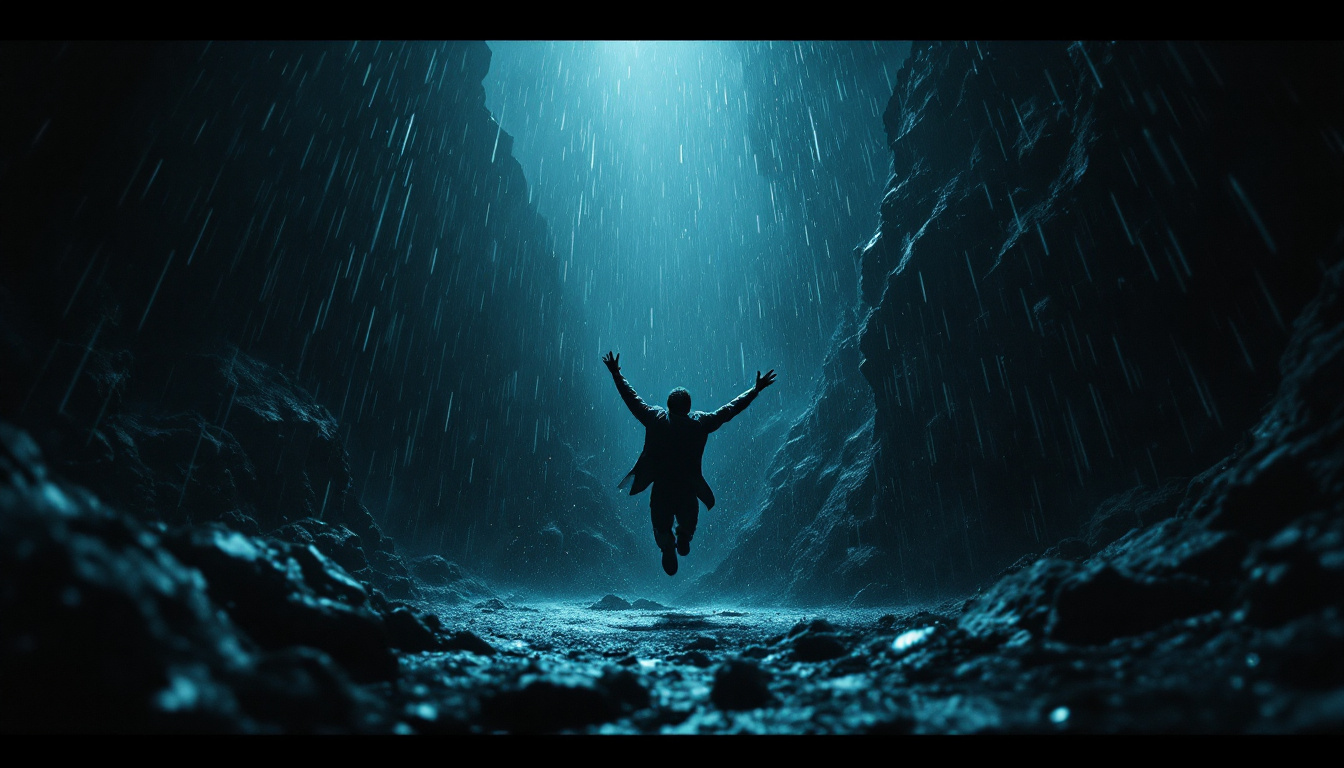
Somewhere over the black forests of southwest Washington, around 8:00 in the evening, in cold November rain, the crew felt it — a strange bump, a shift in the cabin pressure. Cooper had lowered the aft staircase, the 727’s rear airstair that drops down like a ramp beneath the tail. And then, the investigators believe, around 8:13 p.m., the tail of the plane registered a sudden movement. That was the moment. That was Cooper stepping backward off the staircase into a freezing slipstream, two hundred miles an hour of wind and dark and rain, with the money strapped to his body and a parachute on his back. The plane flew on to Reno without him. When they opened that rear staircase on the ground, he was simply gone. No body. No money. No chute. Nothing but two of the parachutes he’d left behind and a clip-on tie he’d taken off — that black skinny tie — lying on a seat.
Now here’s where I have to be honest with you, because this story has spawned more fairy tales than almost any case in American history. The FBI launched a massive manhunt they code-named NORJAK. They combed the forests. They dragged in suspects — hundreds of them, more than eight hundred over the years. And the suspects are fascinating, I won’t pretend otherwise. There was Richard McCoy, who pulled off an almost identical parachute hijacking just months later — but his face didn’t match the flight attendants’ descriptions. There was Kenneth Christiansen, a former paratrooper who’d actually worked for Northwest Orient. There was Robert Rackstraw, a charismatic ex-military con man whose resemblance to the sketch got him a whole documentary built around him — but the FBI eliminated him back in 1979, and a flight attendant who’d stood beside Cooper said she saw no resemblance at all. There was Duane Weber, who whispered “I’m Dan Cooper” to his wife on his deathbed. Every one of them — every single one — was eventually ruled out. Not one suspect has ever been confirmed. That’s the truth underneath all the theories: we have a lot of names, and not a single answer.
For nine years, there was nothing. No bills surfaced — and remember, the FBI had every serial number, so the moment one of those twenties got spent at a bank, it should have lit up like a flare. None did. Then, in February of 1980, an eight-year-old boy named Brian Ingram was on a family picnic at a sandy spot called Tena Bar, on the Washington bank of the Columbia River, a few miles downstream from Vancouver. He was smoothing out the sand to build a campfire when his fingers hit something. Three rotting bundles of twenty-dollar bills, still held together by disintegrating rubber bands, the money decaying but the stacks still in order. The FBI checked the serial numbers against that 1971 microfilm. It matched. It was Cooper’s money — about $5,800 of it. The first and only piece of the ransom ever recovered. And here’s what makes my skin prickle: how did it get there? The rubber bands shouldn’t have survived years in a river. The location didn’t fit the flight path cleanly. To this day, nobody can fully explain how those particular bills ended up buried in that particular sandbar. The other $194,000 has never appeared. Not one bill, in over fifty years.
So what happened to him? The grim, sensible theory says he died on the jump — a man in a business suit and slip-on loafers, no helmet, no jump experience anyone could prove, leaping into freezing rain and pitch darkness over rugged wilderness. Maybe he hit the trees. Maybe he drowned in the Columbia. Maybe his bones are still out there under the moss somewhere, and the money simply washed downriver over the years until a fraction of it surfaced under a little boy’s hands. But then there’s the other voice, the one that keeps the legend alive: in 2016, after forty-five years, the FBI officially closed the case — still unsolved, the only unsolved act of air piracy in the entire history of the United States. They never found a body. They never found the chute. They never spent another one of those bills. And if a man can step off the back of a jetliner into a storm and simply cease to exist — well, then maybe, just maybe, he opened that parachute, drifted down through the rain, gathered up his soaking bag of cash, and walked out of the woods to live a long, quiet, ordinary life under his real name, whatever that was. Sitting beside you, maybe, on some flight years later. Polite. Calm. Forgettable. We will probably never know. And honestly — isn’t that exactly how he’d have wanted it?
Unsolved Mystery
