
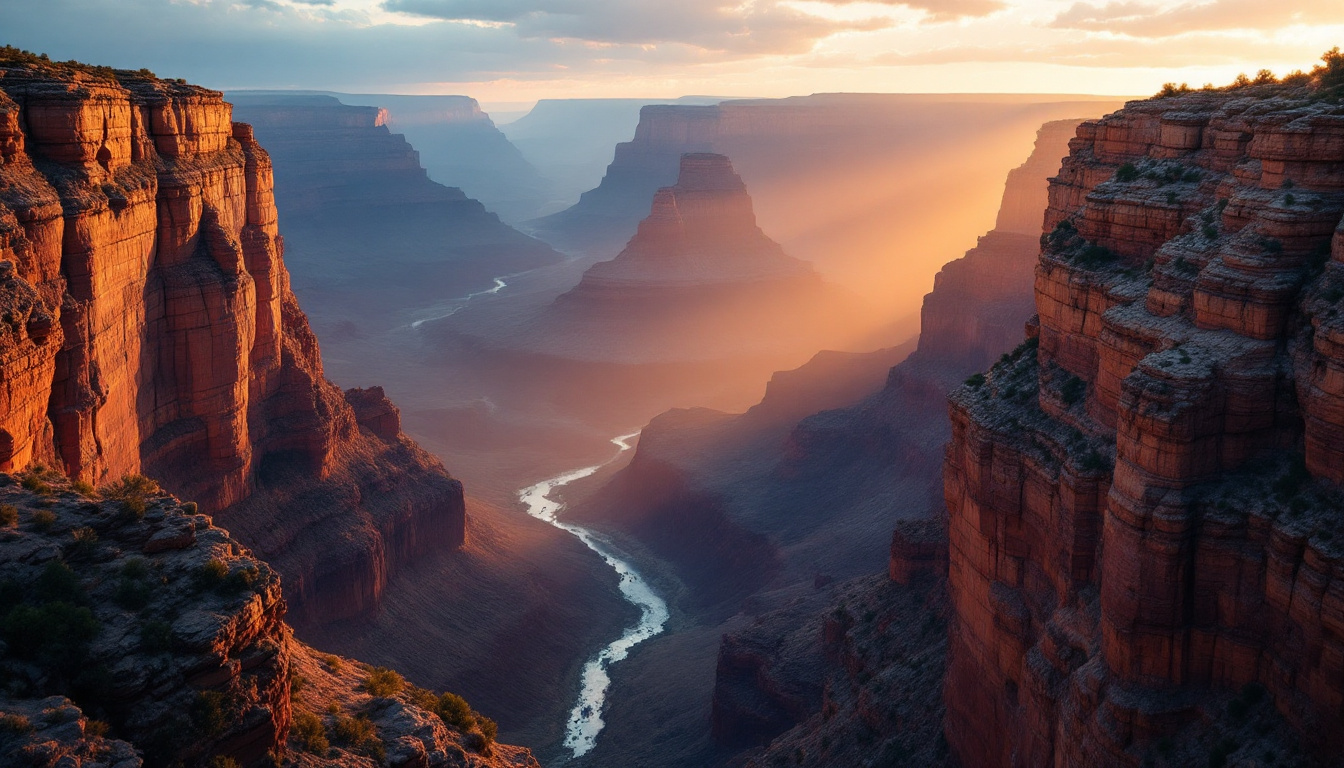
I thought I knew the Grand Canyon. Big hole, red rocks, gorgeous sunsets, end of story. Then I found out there’s a town at the bottom that still gets its mail by mule, a rattlesnake that’s literally pink, and a stretch of rock down there that’s been sitting around for nearly two billion years. By the time you finish this list, “big hole in the ground” is going to feel like a wild understatement. Let’s go down.
1. There’s a town at the bottom of the canyon, and it’s the only place in America that still gets its mail by mule.
It’s called Supai, home to the Havasupai tribe, and it sits eight miles from the nearest road. No cars get there. So five days a week, a mule train hauls the mail down, three hours descending and about five hours grinding back up. Packages, medicine, even small appliances ride down on the backs of mules. It is, no exaggeration, the most remote community in the lower 48.
2. A rattlesnake lives down there that exists nowhere else on Earth.
Meet the Grand Canyon pink rattlesnake, and yes, it’s actually pink. Evolution tinted it to match the canyon’s rosy rock, making it nearly invisible against the stone. It lives from the rims all the way down to the Colorado River and absolutely nowhere else on the planet. Pack accordingly.
3. The canyon makes its own weather.
Walk from the rim to the river and the temperature can climb 20 to 30 degrees on the same afternoon. The South Rim might be a pleasant 84°F while Phantom Ranch at the bottom is roasting at 106°F. In winter it flips into something stranger: snow falls on the rims, but it often melts into rain before it ever reaches the canyon floor. One landmark, two completely different climates.
4. It has over 1,000 caves, and you’re only allowed inside one.
Geologists estimate the canyon hides more than a thousand caves, and most have never been fully explored. Exactly one, the Cave of the Domes on Horseshoe Mesa, is open to the public. The rest are sealed off to protect fragile formations and, frankly, because nobody’s mapped them all yet. There’s an underground Grand Canyon down there we’ve barely touched.
5. The oldest rocks at the bottom are nearly 1.8 BILLION years old.
The dark basement rock near the river, called Vishnu Schist, clocks in around 1,840 million years old. That’s not a typo. Those stones formed when the only life on Earth was single-celled microbes, hundreds of millions of years before complex life even bothered to show up. You can reach out and touch nearly two billion years of history.
6. Despite the fame, it’s not the deepest canyon in America.
The Grand Canyon goes about a mile down, roughly 6,000 feet. Impressive, until you meet Hells Canyon on the Oregon-Idaho border, which plunges nearly 8,000 feet. So why is one a household name and the other a trivia answer? Width. The Grand Canyon spreads up to 18 miles across, giving you those jaw-dropping vistas. Hells Canyon is deeper but narrow, so it never got the postcard treatment.
7. You can mail a postcard “by mule” from the bottom, and it’s the last of its kind.
At Phantom Ranch, the lodge at the canyon floor, you can buy a postcard and have it stamped “Mailed by Mule at the Bottom of the Grand Canyon.” The same mules that haul supplies carry your mail back up to the rim post office. It’s officially recognized as the last remaining mule-train mail route in the country. Best souvenir you can send for the price of a stamp.
8. The lodge at the bottom was designed by a woman in 1922, and mules built it.
Phantom Ranch was designed by pioneering architect Mary Colter back in 1922, when female architects were vanishingly rare. There’s no road in, so every building material except the local rock had to be hauled down by mule. Colter leaned into the constraint, building from on-site stone and rough timber in a style now called National Park Service Rustic. A century later, it’s still standing and still only reachable by foot, mule, or raft.
9. The canyon is staggeringly old in some ways and surprisingly young in others.
Here’s the brain-bender: the rocks are ancient, but the canyon itself is a relative newborn. The Colorado River only carved the gorge we see in the last 5 to 6 million years. So you’ve got nearly-two-billion-year-old rock sitting at the bottom of a canyon that, geologically speaking, was dug yesterday. The stone is old. The hole is young.
10. No, you can’t see it from space with the naked eye.
It’s one of the most repeated “facts” about the canyon, and it’s a myth. The Grand Canyon is enormous, but it’s not wide enough to spot unaided from orbit. Astronauts can see it with help and know where to look, but the idea that it just pops out at you from space alongside the oceans and clouds? Pure tall tale. Turns out the real facts are weirder than the made-up one.
Which one made your jaw drop? Send this to the friend who thinks the Grand Canyon is “just a big hole”…
