
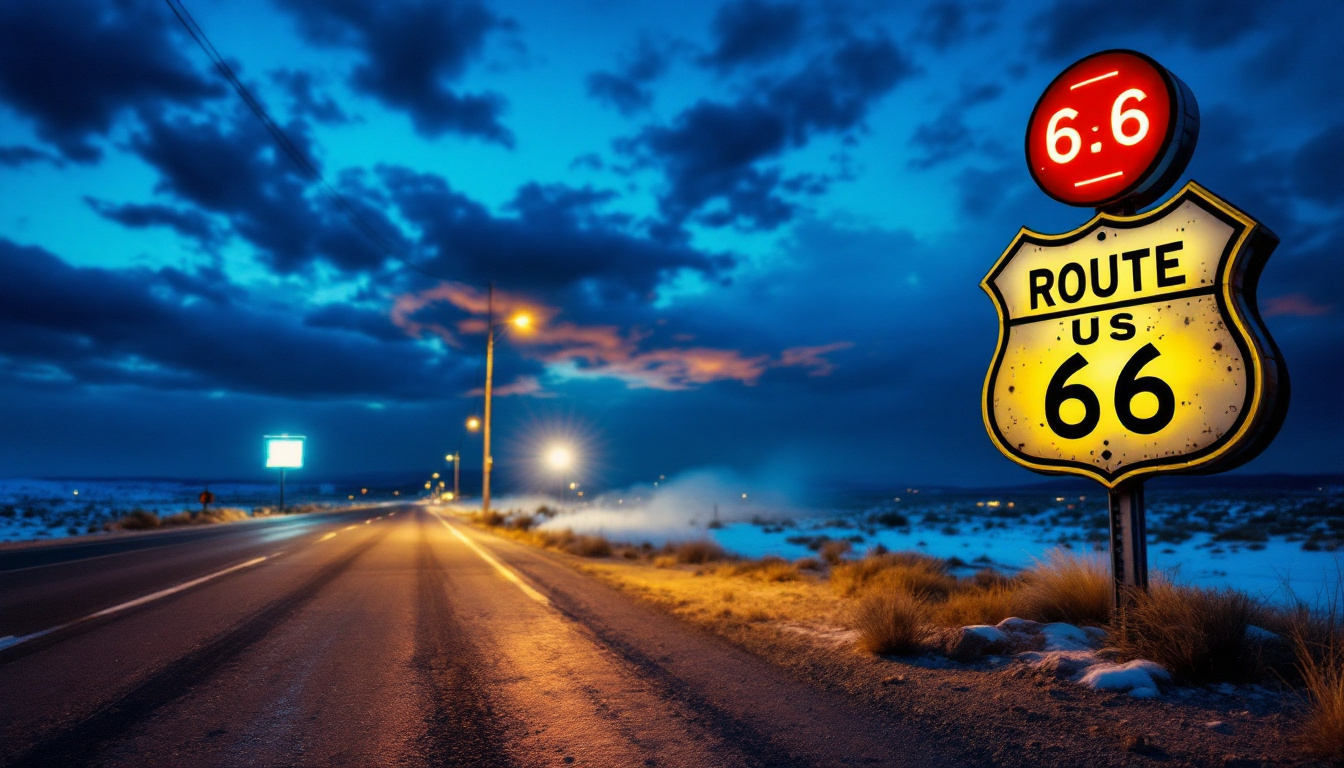
You think you know Route 66 — the convertibles, the neon, the song stuck in your head right now. But here’s what gets me: the road’s most famous nickname came from a Pulitzer-winning novel about people fleeing for their lives, the legendary anthem was scribbled by a guy because his wife told him to, and the whole thing technically doesn’t even exist anymore. Buckle up. Number 7 is an 80-foot whale a man built so his grandkids could go swimming.
1. Route 66 isn’t an official U.S. highway anymore — it was decommissioned in 1985.
After the interstate system steamrolled past it, the federal government formally pulled the plug on June 27, 1985. The “66” shields came down and it ceased to be an official U.S. route. So every “Historic Route 66” sign you see today is, in a sense, a memorial. The road that built American car culture got fired by American car culture.
2. The nickname “Mother Road” comes from a Dust Bowl novel about desperate refugees.
John Steinbeck coined it in his 1939 masterpiece The Grapes of Wrath, writing, “66 is the mother road, the road of flight.” It wasn’t a tourism slogan — it was the highway tens of thousands of broke, starving families took west to escape the Dust Bowl. The most romantic nickname in road-trip history was born from one of the most heartbreaking migrations in American history. Funny how that works.
3. It ran about 2,448 miles — from a Chicago intersection to a California pier.
The Mother Road stretched from Chicago, Illinois, all the way to Santa Monica, California, cutting through eight states. That’s roughly the distance from New York to London if the ocean weren’t in the way. And it did it while passing through Missouri, Kansas, Oklahoma, Texas, New Mexico, and Arizona. No wonder people made it a life goal.
4. The most famous Route 66 song was written because a guy’s wife told him to.
In 1946, jazz musician Bobby Troup was driving west to chase fame in Los Angeles when his wife Cynthia, staring at a road map over lunch, fed him the title: “Get your kicks on Route 66.” He turned it into a tune, Nat King Cole recorded it that same year, and the rest is history. Chuck Berry and the Rolling Stones later covered it. Cynthia got a “thank you” in the credits for inventing the hook. We hope she also got dinner.
5. Kansas only gets about 13 miles of it.
Route 66 clipped the very corner of Kansas, giving the state a measly stretch of around 13 miles through the town of Galena. Blink on a road trip and you’d miss the whole thing. It’s the shortest piece of the road in any of the eight states. Kansas: technically on Route 66, the way your toe is technically in the pool.
6. They also called it “The Main Street of America.”
Before Steinbeck made “Mother Road” stick, the highway earned the nickname “The Main Street of America.” And it earned it honestly — unlike the interstates that bypass towns entirely, old 66 ran straight down the center of countless small towns, past the diners, motels, and gas stations that lived or died by the traffic. It wasn’t a road around America. It was a road through it.
7. There’s an 80-foot blue whale a man built so his grandkids could swim.
In Catoosa, Oklahoma, a retired zoologist named Hugh Davis built a giant smiling blue whale on his pond in the early 1970s — about 80 feet long — as an anniversary gift and a swimming hole for his grandchildren. Word got out, strangers started showing up, and it became one of the most beloved roadside attractions on the entire route. It’s still there. A man’s backyard hobby outlasted the federal highway it sat on.
8. Cadillac Ranch is ten Cadillacs buried nose-first in a Texas field — on purpose.
Outside Amarillo, an art collective called Ant Farm planted ten Cadillacs hood-down in the dirt in 1974, tail fins jutting toward the sky. Almost immediately people showed up with spray paint to tag them — and the artists loved it, encouraging visitors to keep going. So the cars get repainted by random strangers practically every day. It’s a sculpture that’s never finished and never the same twice.
9. The Dust Bowl turned this highway into an escape route for hundreds of thousands.
Throughout the 1930s, ferocious dust storms and failed crops drove waves of families off their land in Oklahoma and the Plains. Route 66 became their lifeline west toward the promise of work in California. This is the human story underneath Steinbeck’s novel — real people, real cars overloaded with everything they owned, betting their lives on one ribbon of pavement. The road of flight, indeed.
10. About 85% of the original road still exists — you just have to hunt for it.
Even though it’s officially gone, an estimated 85% of the old alignment is still drivable today, hiding under different names, state highways, and frontage roads. Devotees still chase it cross-country, map in hand, looking for the next faded diner or rusted gas pump. You can’t find “Route 66” on an official federal map anymore. But you can absolutely still drive it. It just won’t tell you its old name.
Which one surprised you most — the buried Cadillacs or the whale? Send this to the friend who’s always threatening to take that cross-country road trip…
