
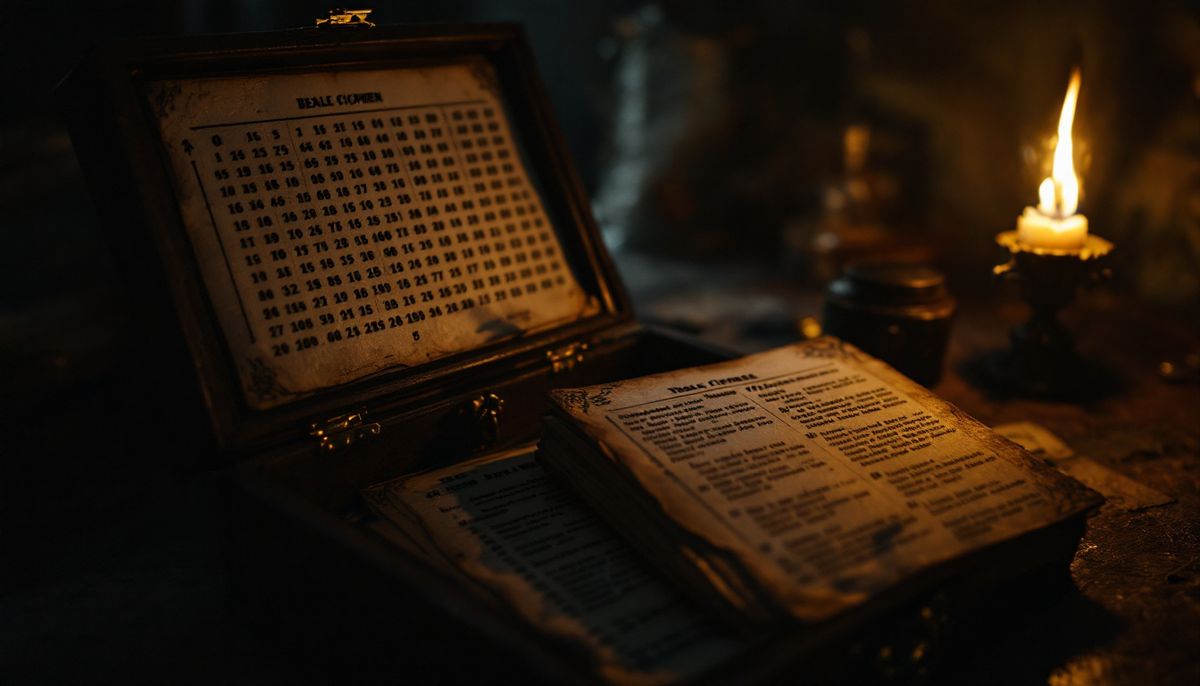
Let me hand you a problem that has beaten amateurs, professors, and supercomputers for well over a century — and start it the way the legend starts, with a stranger walking into a Virginia inn.
The year is 1820. A man named Thomas J. Beale rides into Lynchburg, Virginia, and takes a room at the Washington Hotel, run by a respected innkeeper named Robert Morriss. Beale is the kind of guest people remember — well-dressed, easy in conversation, dark-haired and strikingly handsome, the sort of man who turns a head in a dining room. He stays the winter, drifts off in the spring, and comes back two years later for another season. Then, in early 1822, he hands Morriss a small locked iron box and asks him to keep it safe. Inside, Beale says, are “papers of value and importance.” A while later a letter arrives from St. Louis with strange instructions: if Beale and his companions have not returned within ten years, Morriss is to open the box — and the key to understanding what’s inside will be mailed to him separately by a friend. That key never came. And Thomas J. Beale was never seen again.
Here’s where most people would have pried the box open the next morning. Morriss didn’t. According to the story, he sat on that box, untouched, for twenty-three years — until 1845, long after any ten-year deadline had passed and any reasonable man would have given up on its owner returning. When he finally lifted the lid, he found two letters in plain English and three sheets covered in nothing but numbers. Hundreds and hundreds of numbers, in three separate batches, with no apparent pattern at all.
The plain letters told an astonishing tale. Beale wrote that back in 1817, he and a party of about thirty Virginia adventurers had ridden west on a hunting trip and, somewhere north of Santa Fe in what was then Spanish New Mexico, stumbled onto a fabulous deposit of gold and silver. They spent the next couple of years mining it, then hauled the haul east in wagons and buried it, in stages, in a stone-lined vault somewhere in Bedford County, Virginia — not far from Morriss’s own inn. The three sheets of numbers, Beale explained, were ciphers. One gave the exact location of the vault. One described what was buried there. And one named every man in the company, so their relatives could claim their rightful shares if the worst happened. Without the key, the numbers were gibberish. And the key, of course, had never arrived.
Morriss tried for years to crack them and failed. Near the end of his life he handed the whole bundle off to a friend — and that friend is the one who found the crack in the wall. After endless trial and error, he tried the most American key imaginable: the Declaration of Independence. He numbered every word in the Declaration — first word, second word, third word, on and on — and then read Beale’s cipher as a list of word-positions. Cipher number two, the second sheet, suddenly broke open. The numbers, matched against the first letters of the numbered words in the Declaration, spelled out plain English. And what it described made the blood run a little faster: roughly three thousand pounds of gold, more than five thousand pounds of silver, and a quantity of jewels — a hoard that, by modern estimates, would be worth somewhere in the neighborhood of sixty million dollars, sitting in a stone vault about four miles from a meeting house in Bedford County.
You can imagine the man’s hands shaking as he reached for the other two sheets. The first one — the one that gives the exact spot — and the third — the one with all the names. Surely the same trick would open them. It didn’t. He tried the Declaration on cipher one and got nothing but nonsense. Cipher three, the same. He’d been handed the description of the treasure and not one usable clue to where it actually was. He burned years of his life and, by his own account, neglected his family and finances chasing it, until in 1885 he gave up, dumped the entire story into a cheap pamphlet called The Beale Papers, published it through a man named James B. Ward, and effectively dared the public to do what he couldn’t. That pamphlet is the only reason any of us know this story at all.
And ever since, people have been digging — literally and figuratively. Treasure hunters have torn up the fields and hillsides of Bedford County looking for the vault. Cryptographers have hammered the two unsolved ciphers with every tool the centuries have offered. In the 1960s, a code expert named Carl Hammer ran the numbers through some of the most advanced computers of the era and concluded that the undeciphered ciphers weren’t random — they showed patterns suggesting they really do encode some genuine, intelligible message waiting to be read. That finding is catnip to believers. It says: keep going. The treasure is real, the answer is in there, you just haven’t found the right book to read it against.
But now I have to turn the lamp the other way, because the skeptics have built a powerful, sobering case that the whole thing is a beautifully constructed hoax — and it deserves an honest hearing. In 1980, a cryptographer named Jim Gillogly tried running the Declaration of Independence against the unsolved first cipher, just to see what fell out. What he got wasn’t readable English — but it wasn’t random noise either. Buried in the result was a near-perfect alphabetical string: roughly a-b-c-d-e-f-g-h-i-i-j-k-l-m-m-n-o-h-p-p. Letters marching in order. The odds of that happening by accident are astronomically small. Gillogly’s conclusion was deflating: this wasn’t a message at all. It looked like someone had simply written out the alphabet and used the Declaration to dress it up as a cipher — the fingerprints of a hoaxer amusing himself, not a frontiersman hiding a fortune.
The doubts pile higher from there. In 1982, the investigator Joe Nickell went at the language of the pamphlet itself and found words and phrases that don’t belong in the 1820s — most famously “stampeding,” a term that came into common use decades later, betraying a writer working long after the dates the story claims. Researchers have combed census and tax records and found no solid trace of a Thomas J. Beale who matches the tale. And the story’s structure is suspiciously convenient: the one cipher that “proves” the treasure exists is the one that got solved, while the two that would actually let you find it or claim it remain locked forever. A skeptic will tell you that’s not a coincidence — that’s how you sell a pamphlet. Keep the prize visible and the door bolted, and people will pay to keep trying.
So which is it? Here is where the honest storyteller has to set the lamp down and admit the room is still half-dark. The hoax case is strong — the alphabet string in cipher one is genuinely hard to explain away, the anachronisms are real, and Thomas Beale himself may never have drawn a breath. And yet the thing refuses to die quietly, because the solved cipher works flawlessly against the Declaration, the unsolved ones still carry statistical hints of structure, and no one has ever produced the smoking gun that names the hoaxer or shows exactly how the trick was done. We are left with three sheets of numbers, a vault that may or may not exist under a Virginia hillside, and a fortune that has been four miles from a country meeting house — or four miles from nowhere — for two hundred years.
Maybe it’s gold. Maybe it’s the cleverest practical joke in American history, still landing its punchline on people willing to grab a shovel. The only thing we can say for certain is that two of Beale’s three pages have kept their mouths shut since before the Civil War, and every key anyone has ever tried has turned in the lock without opening the door. The numbers are still sitting there, waiting. And somebody, someday, is going to try one more book.
Unsolved Mystery
