
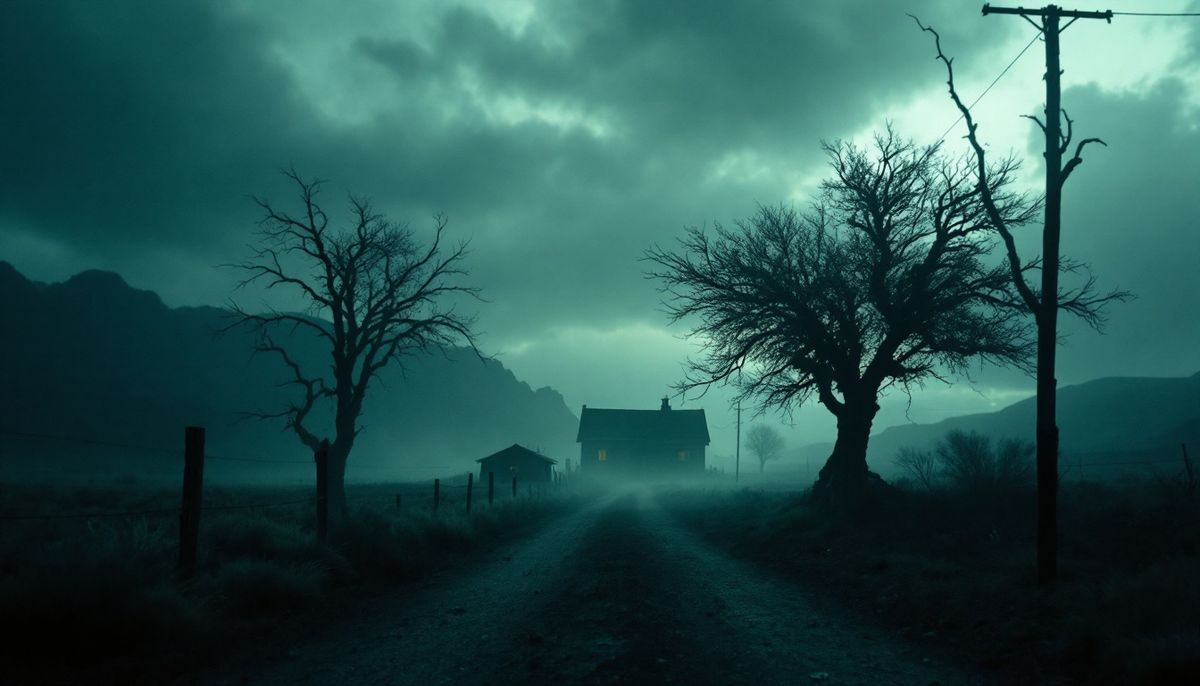
Let me take you to a place most people have never heard of, tucked into the high desert of northeastern Utah. Drive east out of Ballard, out past the alfalfa fields and the irrigation ditches, until the pavement gives way to dirt and the Uintah Basin opens up flat and silent around you. Out here, hard against the edge of the Uintah and Ouray Indian Reservation, sits an unremarkable-looking spread of about 512 acres. A house. A few outbuildings. Fences and pasture and big empty sky. You could pass it a hundred times and never look twice. And yet this ordinary patch of ranchland has chewed up two and a half decades of investigation, a $200,000 sale, a $22 million government contract, and a hit cable television show — and to this day nobody can say for certain what, if anything, is actually going on there. They call it Skinwalker Ranch. And the strangest part of its story isn’t the lights in the sky. It’s how many serious people kept coming back to look.
Start with the name, because that’s where the legend really begins. “Skinwalker” comes from Navajo folklore — a malevolent witch said to be able to take the shape of an animal. The local Ute people, whose reservation borders the property, have their own long-standing uneasiness about the land. According to the accounts that made the ranch famous, the Ute have for generations spoken of the area as lying along “the path of the skinwalker,” a place to be avoided and kept away from. I’ll be honest with you right up front, because it matters: skinwalker beliefs are really part of Navajo tradition, not Ute religion, and folklorists are careful about how those threads get tangled together. But the reputation was there in the soil long before any TV cameras arrived. This was already a place people whispered about.
Then came the Sherman family, and this is where the documented story takes hold. In 1994, Terry and Gwen Sherman bought the ranch hoping for the quiet life ranchers buy ranches for. What they got, by their own account, was about eighteen months of escalating strangeness. They described lights and craft in the night sky. They described crop-circle-style impressions pressed into the fields. They described a wolf-like creature that — in the most chilling version of the tale — Terry said he shot at point-blank range, only for it to trot away unharmed. And then there were the cattle. The Shermans reported animals turning up dead and mutilated in a way that didn’t fit a predator: surgical, bloodless, precise. In one account Terry found a cow with a strange hole bored through the center of its eyeball, the rest of the animal untouched, no blood at the scene. In June 1996, after a year and a half of this, the Shermans went to a local reporter. The story ran in Salt Lake City’s Deseret News, and from there it spread — carried wider by investigative journalist George Knapp — until a quiet Utah ranch became a name people argued about.
Here’s where it stops being just a spooky local story and becomes something genuinely odd. Within about three months of that newspaper article, a Las Vegas real estate magnate and longtime UFO enthusiast named Robert Bigelow bought the ranch — reportedly for around $200,000. He didn’t buy it to live there. He bought it to study it. Under the banner of his National Institute for Discovery Science, or NIDS, Bigelow put the place under round-the-clock scientific surveillance: cameras, sensors, researchers stationed on-site, all trying to catch the phenomena in the act and pin it to hard data. They watched that ranch, on and off, for years. And here’s the punchline that the legend tends to skip over. One of Bigelow’s own researchers, Colm Kelleher — co-author of the book Hunt for the Skinwalker — later admitted that after years of family trauma and focused investigation, they had managed to obtain very little physical evidence of anomalous phenomena, and nothing that could be called conclusive proof of anything. They looked as hard as anyone ever has. They came away with almost nothing they could hold up.
But the story isn’t done, because the ranch’s reach extended somewhere you wouldn’t expect: the Pentagon. In 2008, the Defense Intelligence Agency awarded a roughly $22 million contract to Bigelow’s research arm under a program called the Advanced Aerospace Weapon System Applications Program — AAWSAP. The program studied reports of unidentified aerial phenomena and their effects on the people who encountered them, and the ranch became one of its reference points. That’s the detail that makes skeptics and believers alike sit up. Whatever you think actually happens out there, the U.S. government paid real money to take reports of the unexplained seriously. NIDS itself disbanded in 2004, but Bigelow held onto the property until 2016, when he sold it to a buyer hiding behind a Delaware company called Adamantium Real Estate. That buyer kept his identity secret for four years, until 2020, when Utah real estate mogul Brandon Fugal stepped forward, claimed the ranch, and announced that the History Channel would be filming a series there — The Secret of Skinwalker Ranch. The whispered legend had become prime-time television.
So what do we actually know? Let me draw the honest line through it, the way the evidence draws it. We know the ranch exists, and we know its reputation runs back generations. We know the Sherman family reported a genuinely unsettling run of experiences in the mid-1990s — and we know those are reports, eyewitness accounts of mutilated cattle and strange lights, not laboratory results. We know that serious, well-funded people — a private institute, and eventually a Pentagon program — found the place compelling enough to study with real instruments and real budgets. And we know what came of all that watching: by the admission of the researchers themselves, no conclusive physical proof of anything paranormal. Skeptics have plenty of ordinary explanations on the table — predators and natural decomposition can mimic “surgical” mutilation, the basin sits under busy airspace, expectation and fear shape what frightened people see in the dark, and a property this famous now has every commercial reason to keep the mystery alive. None of that has been proven either. It just sits there, as flat and unresolved as the basin itself.
And maybe that’s the real curse of those 512 acres. Not a creature, not a craft, not a witch walking in the shape of a wolf — but a question that refuses to close. The Shermans sold and moved on. Bigelow watched for years and let it go. The government studied it and folded the program. And still the cameras roll, and still people drive that dirt road out past Ballard hoping to catch the thing that no instrument has ever quite caught. We have decades of stories, millions of dollars, top-secret clearances, and a TV crew — and at the end of all of it, the same plain answer the high desert has always given: maybe. Out there at the end of that road, under that enormous Utah sky, the mystery is still standing exactly where the Shermans found it. Watching back.
Unsolved Mystery
