
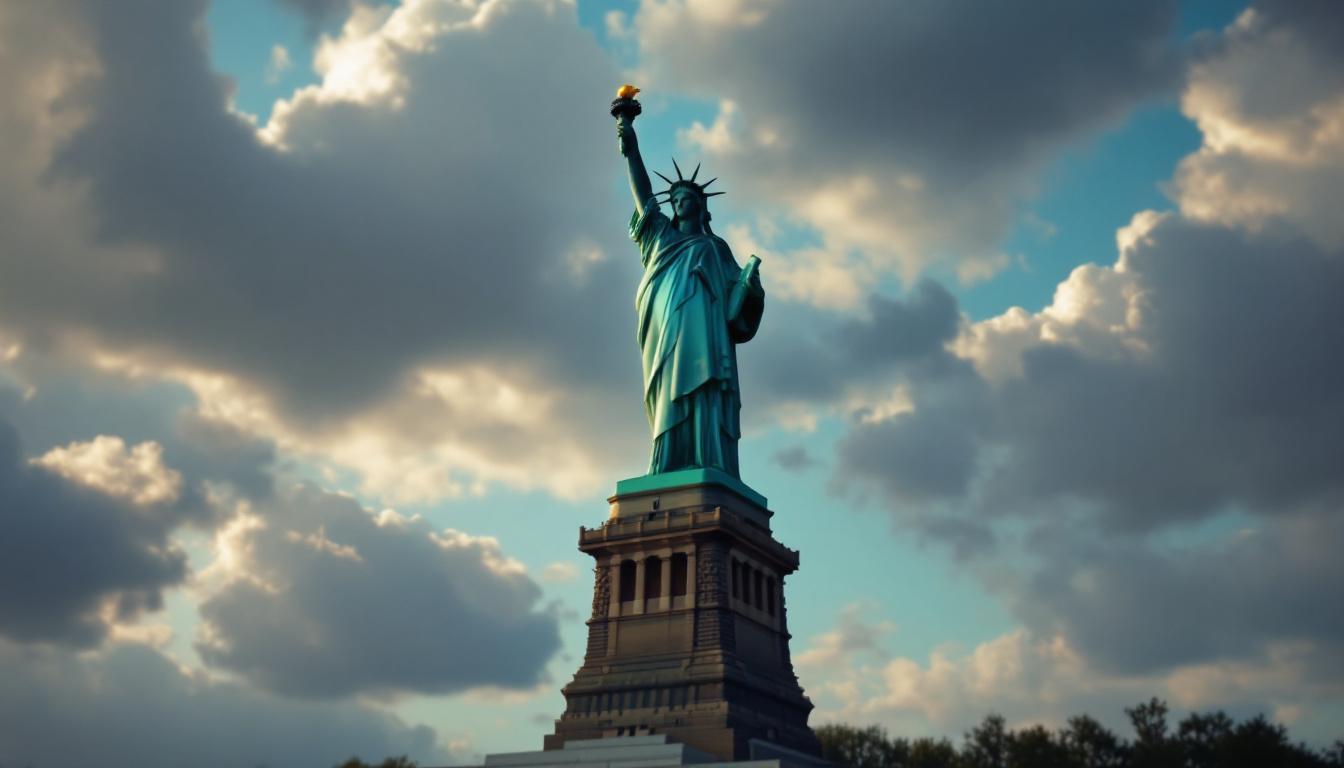
I thought I knew the Statue of Liberty. Big lady, torch, copper, Ellis Island, give me your tired and your poor, end of file. Then I spent a few hours reading about her and realized I knew approximately nothing. She was almost Egyptian. She used to be brown. She gets struck by lightning hundreds of times a year. And the reason you can’t go up in her torch is a story you’ve probably never heard.
1. She was originally designed for Egypt, not the United States.
Before he ever pitched the statue to America, French sculptor Frédéric Auguste Bartholdi proposed an enormous robed woman holding a torch to stand at the entrance of the brand-new Suez Canal. He called the project “Egypt Carrying the Light to Asia.” The Egyptian ruler, Khedive Isma’il Pasha, took one look at the price tag, said no thanks, and built a much cheaper lighthouse instead. Bartholdi shopped the design around, eventually pointed it at New York Harbor, and the rest is on every postcard.
2. She wasn’t always green. She was originally brown, like a giant penny.
When the statue was unveiled in 1886, her copper skin was a shiny brownish-orange — the natural color of, well, copper. It took about 25 to 30 years of New York Harbor weather to oxidize her into the green you know today, a coating called verdigris. The Treasury Department actually considered painting her in 1906 to stop the discoloration. Public outcry shut that down, which is good, because the green layer is what’s been protecting the copper underneath ever since.
3. Her internal skeleton was designed by Gustave Eiffel — before the Eiffel Tower existed.
The Statue of Liberty isn’t a solid block of copper. She’s a copper skin about as thick as two pennies stretched over an iron skeleton, and that skeleton was engineered by the same guy who would, a few years later, build the most famous tower in Europe. Eiffel designed the structure to flex — the copper hangs from the iron frame on flexible saddles, so the whole statue can expand, contract, and sway in the wind without cracking. He basically invented the modern curtain-wall building, and then put it inside a lady.
4. The pedestal she stands on was paid for by 125,000 ordinary Americans donating less than a dollar each.
France paid for the statue. America was supposed to pay for the pedestal. America promptly did not. The statue sat in 214 wooden crates for months while wealthy donors and the U.S. government argued about money. Newspaper publisher Joseph Pulitzer finally got fed up and ran a front-page fundraising campaign in his paper, The New York World, promising to print the name of every single donor no matter how small the gift. 125,000 working-class people chipped in, mostly under a dollar, and the pedestal got built. It is arguably the first major crowdfunding campaign in American history.
5. The seven rays in her crown are not what you were told in school.
Most kids learn the seven spikes represent the seven continents and seven seas, which is a nice clean answer that the National Park Service quietly says is not actually documented anywhere. The crown is what art historians call an aureole — a radiant halo, the kind ancient sculptors put on sun gods. The seven rays are more likely a divine-light symbol borrowed straight from the Greek god Helios. Also, the crown has 25 small windows in it, one for each gemstone known to the artist’s era. Nobody told me about the windows.
6. The tablet in her left hand is dated July 4, 1776 — but in Roman numerals.
She’s holding a tabula ansata, a Roman-style law tablet, and the only thing written on it is “JULY IV MDCCLXXVI.” That’s the date the Declaration of Independence was adopted, etched in Roman numerals because Bartholdi thought it looked more classical and more permanent than plain Arabic numbers. He admired the U.S. Constitution but specifically picked the Declaration date because he wanted to associate liberty with the founding act of rebellion, not the legal framework that came later. The man had opinions.
7. In a strong wind, the statue sways 3 inches and the torch sways 5 inches — on purpose.
At 50 mph winds, the statue’s body moves about 3 inches off-center and the torch at the top of her arm rocks about 5 inches. That’s not a defect. That’s Eiffel’s design at work — a rigid statue would crack and fall apart in storms, so the whole structure is built to wobble like a tall tree. You wouldn’t notice from the ground, but if you were standing in the crown during a gust, you would absolutely feel her move.
8. There are broken chains and a shackle at her feet, and most people have never seen them.
Bartholdi and his French abolitionist patron Édouard de Laboulaye originally designed Lady Liberty holding broken chains in one hand — a direct symbol of the abolition of slavery, which had just ended in America at the close of the Civil War. American financiers thought that was too politically loud, so the chains got removed from her hand. But Bartholdi quietly moved them. If you stand at her feet and look up, you can see a broken shackle and chain trailing out from under her robe, partly hidden by the pedestal. They’ve been there since 1886. Almost no tourist photo ever captures them.
9. She gets hit by lightning hundreds of times a year, and she’s fine.
A 305-foot copper statue standing alone on an island in the middle of open water is, in lightning terms, a giant antenna. Estimates vary widely — the National Park Service has cited around 600 strikes per year, while engineering analyses put the realistic number closer to 15 to 25 strikes per year — but either way, she gets zapped constantly. Copper is one of the best electrical conductors on Earth, so the lightning runs straight through her skin and grounds out through Eiffel’s skeleton into the harbor. She has been a working lightning rod for 140 years.
10. The reason you can’t go up in her torch is that German spies blew up New Jersey in 1916.
On July 30, 1916 — before the United States had even entered World War I — German saboteurs detonated more than two million pounds of munitions at the Black Tom rail depot in Jersey City, less than a mile from Liberty Island. The blast was felt as far as Maryland and shattered windows across Manhattan. Shrapnel slammed into the side of the statue, the shockwave shoved her torch arm into her crown, and the structural damage was so severe that the torch was permanently closed to visitors. That was 110 years ago. It is still closed. A German terror attack on American soil during a war we hadn’t joined yet is the reason millions of tourists every year can climb to her crown and no further.
Which one made you go “wait, what?” Send this to the friend who thinks they know American history.
