
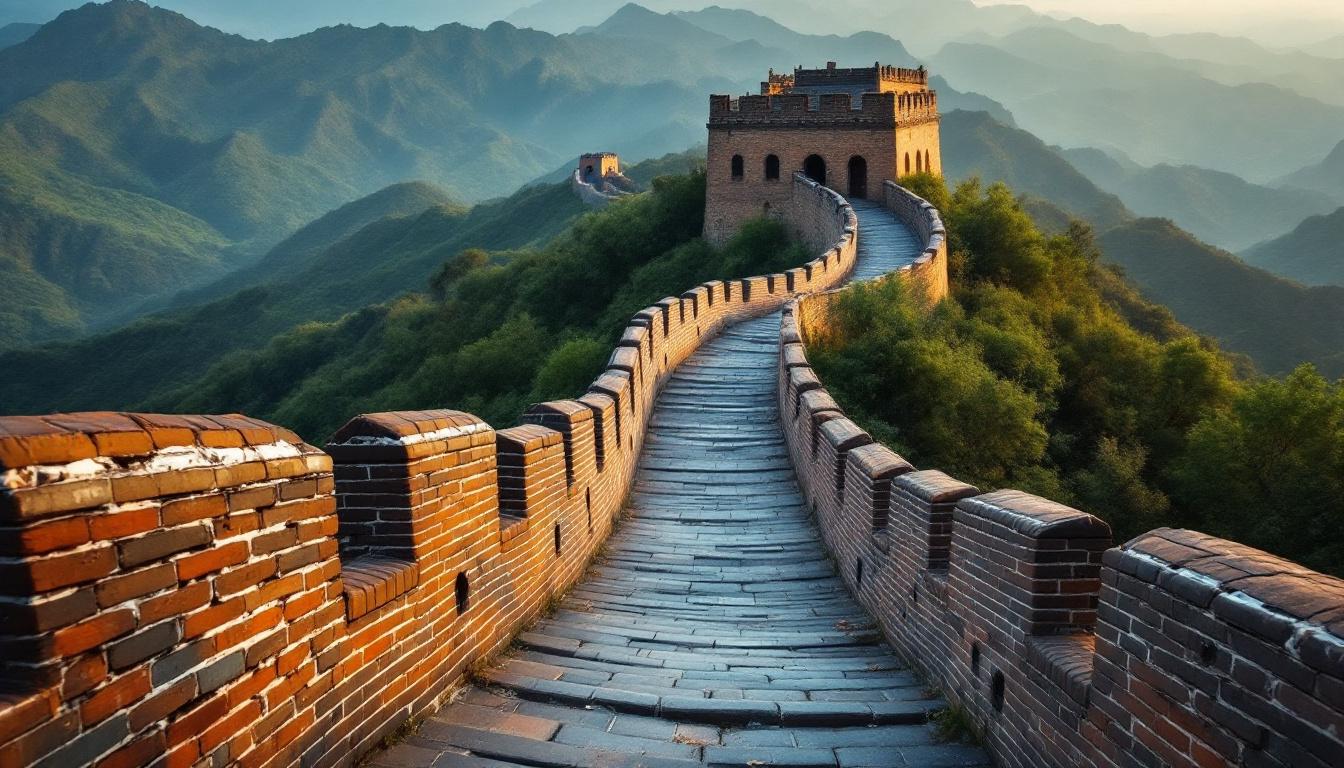
I always pictured the Great Wall as one long stone snake somebody finished a really long time ago. Turns out it’s not one wall, nobody ever finished it, it was glued together with rice, and the most famous “fact” about it is flat-out wrong. The thing you’ve seen in a thousand photos is stranger than the postcard lets on.
1. You cannot see the Great Wall from space.
This is the one “fact” everyone repeats, and it’s simply not true. The myth started in 1923 when National Geographic claimed the Wall was the only human-made object visible from the Moon — decades before anyone had been to space to check. Astronauts have since confirmed you can’t pick it out with the naked eye even from low orbit. China’s own astronaut, Yang Liwei, looked for it on his 2003 mission and couldn’t find it.
2. It’s not one wall — it’s thousands of separate walls.
We say “the Great Wall” like it’s a single structure, but it’s actually a sprawling network of overlapping walls, trenches, hills, and rivers stitched together over centuries. You physically cannot walk it end to end without interruption. It’s less “a wall” and more “a 2,000-year-old collection of walls that all got filed under the same name.”
3. It was held together with sticky rice.
During the Ming Dynasty, builders mixed sticky rice flour into the lime mortar binding the bricks. That sounds like a kitchen accident, but it created the world’s first composite mortar — organic and inorganic materials combined — and it worked astonishingly well. The rice mortar is so strong and water-resistant that on some sections, weeds still can’t grow in the joints today.
4. Builders used arsenic as bug spray.
Ancient engineers had a pest problem: insects like ants would burrow into the structure and weaken it. Their solution was arsenic — the same poison nicknamed “the poison of kings” — worked into parts of the Wall to keep the bugs out. It’s a grim but effective bit of ancient pest control, and a reminder that the people building this thing were solving very real engineering headaches.
5. No emperor ever “built the Great Wall.”
The First Emperor of Qin gets the credit, but the first walls predate him by 400 years, going back to the 7th century BC. More than a dozen dynasties added to it over roughly two millennia. Nobody ever stood back and declared it finished — it was a 2,000-year group project that simply stopped getting worked on.
6. About a third of it has already vanished.
Roughly 30% of the original Wall has disappeared entirely. Some of that is natural erosion — wind, rain, and time — but a lot of it is people: locals over the centuries hauled away bricks to build homes, and modern visitors chip off stones as souvenirs. The longest structure ever built by humans is quietly shrinking.
7. Its width swings from a sidewalk to a four-lane road.
The Wall is wildly inconsistent in size. At its narrowest, it pinches down to about 16 inches across — barely enough for one person to shuffle along single file. At its widest, it stretches to nearly 50 feet, wide enough to drive a pickup truck on top. It depended entirely on the terrain and which dynasty’s crew was building that stretch.
8. It worked like an ancient internet.
The watchtowers weren’t just lookout posts — they were a communication network. Soldiers sent smoke signals by day and fire signals by night, relaying word of an attack from tower to tower faster than any horse could carry it. A warning could travel hundreds of miles in hours, with the number of smoke columns even telling distant garrisons how big the incoming army was.
9. The famous “buried bodies” story is a myth — but the death toll was very real.
There’s a grisly old legend that workers who died were ground up and mixed into the mortar. Archaeologists have searched and found no human remains inside the Wall — corpses would have weakened it anyway. But the human cost was staggering: estimates run from 400,000 to a million workers dead over the centuries, many buried in mass graves alongside the very Wall they died building.
10. The whole thing is over 13,000 miles long — more than half the Earth’s circumference.
For decades, estimates were vague. Then China spent five years and thousands of surveyors with GPS mapping every section, and in 2012 announced the official figure: 13,170 miles, or 21,196 kilometers. That’s longer than half the distance around the entire planet. If you somehow unrolled the Great Wall and laid it along the equator, it would wrap better than halfway around the globe.
Which one got you — the rice, the arsenic, or the fact that the “visible from space” thing was made up before anyone could even check? Send this to the friend who’s been confidently repeating that one for years.
