
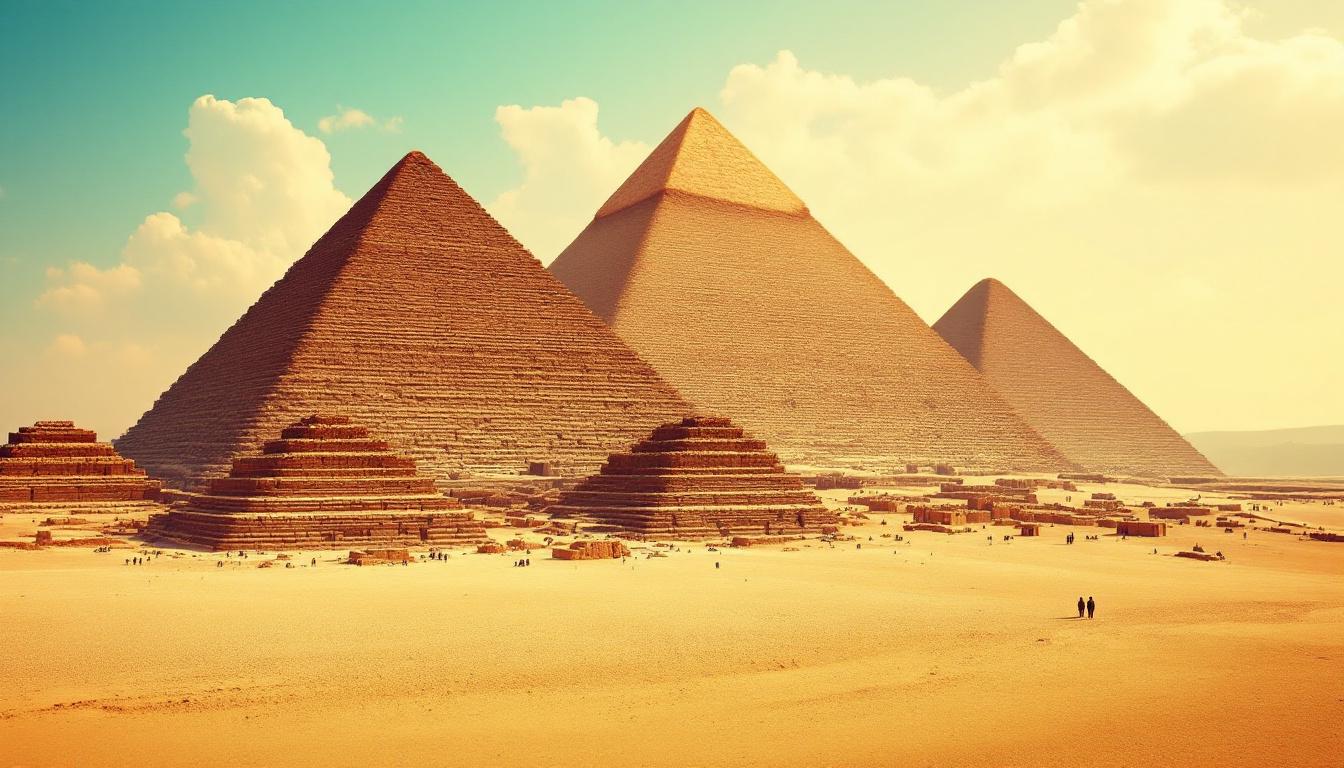
I thought I had the pyramids figured out: big triangles, full of mummies and gold, built by armies of whip-cracked slaves. Turns out almost none of that holds up. No mummy has ever been found inside one, the builders got days off and beer rations, and the Great Pyramid technically has eight sides. The most famous structure on Earth is hiding more than you’d guess.
1. No pharaoh’s mummy has ever been found inside any of the three Giza pyramids.
We call them tombs, and they almost certainly were — but when explorers finally got inside, the burial chambers were empty. No mummy, no jewelry, no painted hieroglyphs covering the walls like in later tombs. Grave robbers likely cleaned them out thousands of years ago, but the strange truth is the “tomb” everyone pictures has never actually been found with its occupant still in it.
2. The pyramids were not built by slaves.
This myth traces back to the Greek historian Herodotus, who wrote about the pyramids 2,000 years after they were built — basically ancient hearsay. Archaeologists have since found the builders’ village right next to the site, complete with bakeries, breweries, and tombs of honored workers buried near the pharaoh himself. They were skilled, paid laborers who were fed beef and beer. Slaves don’t get a tomb next to the king.
3. We know the builders got medical care, because their healed bones are still here.
Skeletons recovered from the workers’ cemetery tell a remarkably human story. Many show broken arms and legs that were set, splinted, and healed well enough for the worker to get back on the job — and a few even show successful amputations. Someone on site was practicing real medicine 4,500 years ago. These weren’t expendable bodies; they were valued enough to patch up and keep around.
4. The Great Pyramid was the tallest structure on Earth for nearly 3,800 years.
Finished around 2560 BC at about 481 feet, it held the world height record longer than any building before or since. Nothing humans built topped it until Lincoln Cathedral in England added its central spire around 1311 AD. To put 3,800 years in perspective: that’s longer than the entire span from the pyramid’s loss of the title to today.
5. The Great Pyramid actually has eight sides, not four.
Each of the four faces has a subtle concave indentation running straight down the middle, splitting it into two halves — so there are technically eight surfaces. The effect is so slight you’d never notice from the ground. It was spotted in 1940 by a British pilot who happened to fly over at the right moment and caught the shadows lining up. The dip is best seen at dawn and dusk on the spring and fall equinoxes.
6. The pyramids used to be blindingly white and smooth.
Today we see rough, stepped brown blocks — but that was never the intended look. The Great Pyramid was originally sheathed in polished white Tura limestone, so smooth and bright it would have gleamed like a mirror in the desert sun, visible for miles. A massive earthquake in 1303 AD shook many casing stones loose, and medieval builders happily carted the pre-cut, polished blocks off to construct mosques and forts in Cairo.
7. The Great Pyramid is aligned to true north almost perfectly — built before the compass existed.
Its sides line up with the cardinal directions to within about one-twentieth of a single degree. The magnetic compass wouldn’t be invented for thousands of years, so the Egyptians most likely used the stars to find true north. Modern surveyors with laser equipment struggle to do meaningfully better.
8. The Great Pyramid is built from roughly 2.3 million blocks — and it went up in about 20 years.
That’s an average of one block placed every couple of minutes, working nonstop for two decades. The blocks average over two tons each, with some interior granite slabs weighing 50 to 80 tons and hauled from a quarry 500 miles away. The Egyptians pulled this off with copper tools, rope, ramps, and a freakish amount of organization — no wheels-on-axles for hauling, no iron, no pulleys.
9. A 4,600-year-old wooden ship was found sealed in a pit beside the Great Pyramid — and it could still float.
In 1954, archaeologists uncovered a pit containing 1,224 pieces of cedar wood, neatly disassembled and stored. Reassembled, they formed a 143-foot ship built for the pharaoh Khufu, likely meant to carry him through the afterlife. It’s the oldest intact ship in the world, and experts say the craftsmanship is so sound it could actually sail today if you put it in a river.
10. In 2017, scientists found a huge hidden room inside the Great Pyramid — and nobody knows what it’s for.
Physicists scanned the pyramid using muons, particles that rain down from cosmic rays and pass through solid stone, essentially X-raying it from the inside. They found a previously unknown void at least 100 feet long sitting above the Grand Gallery — the first major space discovered inside the pyramid since the 1800s. It has never been entered, and nobody can say whether it’s a sealed chamber, a construction gap, or something else entirely. After 4,500 years, the most studied building on Earth still won’t fully give up its secrets.
Which one made you rethink the postcard version of the pyramids? Send this to the friend who still thinks they’re full of mummies.
