
May 19th
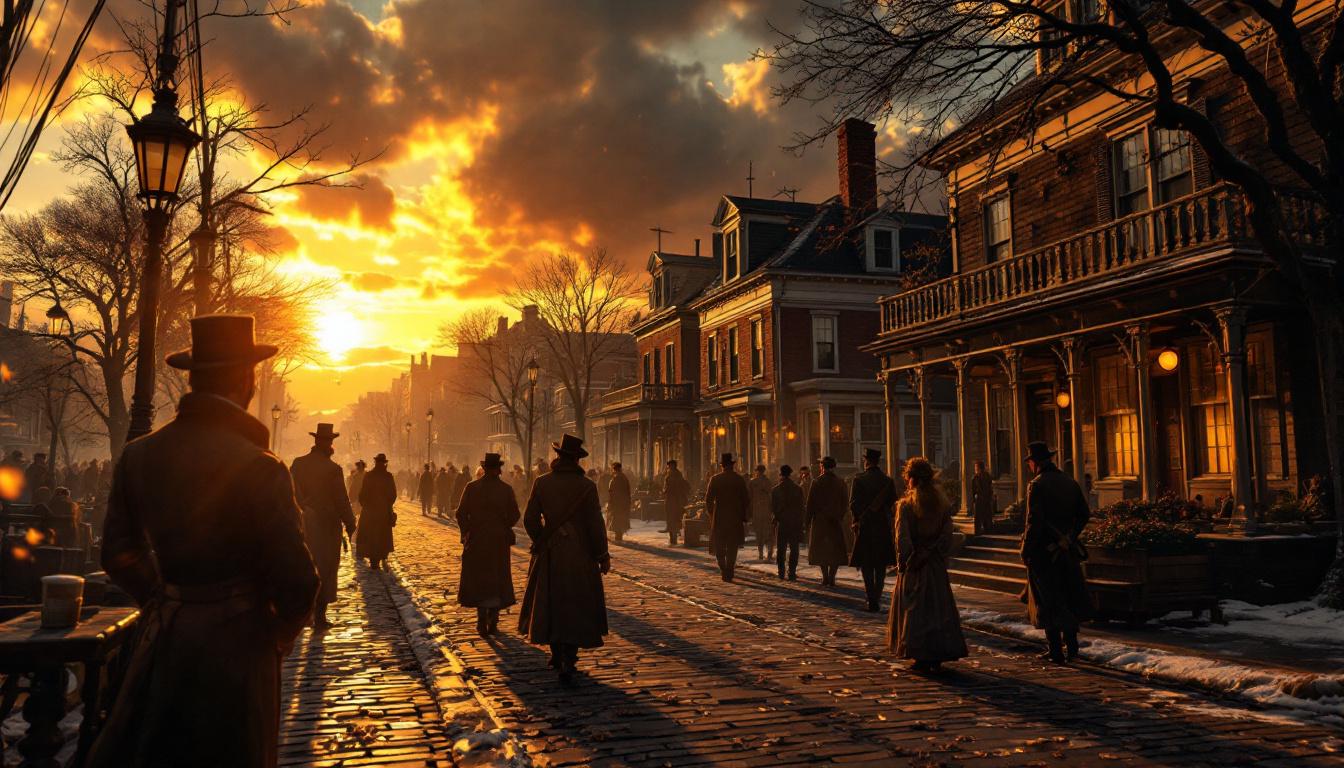
On the morning of May 19, 1780, the sun came up over New England a strange, dull red, smeared behind a haze that nobody could quite explain. By 10 a.m. the sky was darkening. By noon it was effectively night. Across Connecticut, Massachusetts, and New Hampshire, people lit candles to eat lunch. Cows wandered back to their barns. Chickens climbed up to roost. Birds went quiet, then went silent. Men came in from the fields because they could no longer see their own hands well enough to work. It was not an eclipse — there was no eclipse scheduled, and an eclipse lasts minutes, not most of a day. It was just darkness, and it would not lift.
You have to remember what 1780 felt like. The Revolutionary War was still on. There were no weather satellites, no telegraph, no scientific explanation waiting around the corner. So a great many people in New England did the only reasonable thing they could think of and concluded that this was it — the Day of Judgment, the literal end of the world, arriving on a Friday. In some towns, frightened families crowded into churches. The Connecticut state legislature was in session in Hartford that afternoon, and as the room went dark, members began calling for an adjournment so they could, presumably, go home and meet the end with their families.
That is when a council member named Abraham Davenport stood up and delivered one of the great underrated lines in American history. “I am against an adjournment,” he said. “The day of judgment is either approaching, or it is not. If it is not, there is no cause for an adjournment. If it is, I choose to be found doing my duty. I wish therefore that candles may be brought.” And the candles were brought, and the Connecticut legislature kept right on working in the dark. As for the cause — it took until 2008 for scientists studying tree rings to pin it down. A massive wildfire had been burning in the forests of Ontario, and the smoke, trapped under low cloud and fog, drifted south and simply blotted out the sun. Not the end of the world. Just Canada, on fire, two hundred miles away.
Also On This Day…
1536 — A queen of England was beheaded by a swordsman flown in from France On May 19, 1536, Anne Boleyn — the second wife of Henry VIII, the woman he had upended the entire English church to marry — was executed inside the Tower of London on charges of adultery and treason that almost no historian today believes were true. Henry granted her one small mercy: instead of the clumsy axe, he paid for an expert swordsman to be brought over from France for a single, clean stroke. Anne climbed the scaffold with what one witness called “a goodly countenance,” gave a short, gracious speech that pointedly accused no one, and asked the crowd to pray for the king. She had been queen for three years. Henry was engaged to Jane Seymour within twenty-four hours.
1643 — The day Spain stopped being the scariest army in Europe At the Battle of Rocroi in northern France, a young French commander — the 21-year-old Duke of Enghien — shattered the famous Spanish infantry, the tercios, who had been considered nearly unbeatable for over a century. For generations, the Spanish squares were the thing other armies feared most. At Rocroi, the French cavalry rolled up the flank and broke them. It was less a single battle than a changing of the guard: historians often mark Rocroi as the symbolic moment Spain stopped being the dominant land power in Europe and France started.
1863 — Grant threw himself at Vicksburg, and Vicksburg held On May 19, 1863, Union General Ulysses S. Grant ordered a direct assault on the Confederate fortress city of Vicksburg, Mississippi — the last great rebel stronghold on the Mississippi River. The attack failed, and a second one three days later failed too. So Grant did the thing he was actually very good at: he stopped attacking and settled in for a siege, ringing the city and simply waiting it out. Six weeks later, on July 4, a starving Vicksburg surrendered. The Union now controlled the entire Mississippi, the Confederacy was cut in two, and Grant was on his way to commanding the whole Army.
1883 — Buffalo Bill invented the Wild West (the show, anyway) On May 19, 1883, in Omaha, Nebraska, William F. “Buffalo Bill” Cody staged the very first performance of “Buffalo Bill’s Wild West” — an outdoor extravaganza of trick riders, sharpshooters, staged buffalo hunts, and mock stagecoach robberies. It was a massive hit, toured for decades, played for Queen Victoria, and made stars of performers like Annie Oakley. Here is the strange part: the real frontier was still the real frontier in 1883. Cody was packaging the American West into nostalgic entertainment while it was, technically, still happening. He more or less invented how the whole world would picture cowboys forever after.
1920 — A shootout in a tiny coal town that the country tried to forget On May 19, 1920, in the little mining town of Matewan, West Virginia, a dozen private detectives from the Baldwin-Felts agency arrived to evict coal miners and their families from company-owned houses — punishment for joining a union. The town’s police chief, Sid Hatfield, sided with the miners. When the detectives tried to leave, words turned to gunfire on Main Street, and when it stopped, ten men lay dead, including the town’s mayor and two brothers of the detective agency’s founder. The “Matewan Massacre” became a flashpoint in the long, violent struggle over labor rights in Appalachian coal country — a chapter of American history that, for a long time, almost nobody outside West Virginia learned about.
1935 — Lawrence of Arabia died chasing the thing he loved most T.E. Lawrence — the British officer who helped lead the Arab Revolt in World War I and became a global legend as “Lawrence of Arabia” — died on May 19, 1935, at age 46. He had survived a desert war, but what killed him was a country road in Dorset. Six days earlier, riding his beloved Brough Superior motorcycle, he crested a dip that hid two boys on bicycles, swerved to miss them, and was thrown over the handlebars. He never regained consciousness. One of the doctors who treated his head injury, a young neurosurgeon named Hugh Cairns, was so disturbed by the death that he spent years researching motorcycle crashes — work that led directly to the widespread adoption of the crash helmet.
1962 — Marilyn Monroe sang “Happy Birthday” and the room stopped breathing On May 19, 1962, at a Democratic fundraiser inside Madison Square Garden, actress Marilyn Monroe walked to a microphone and sang “Happy Birthday, Mr. President” to John F. Kennedy. She wore a flesh-toned, skintight gown sewn with more than 2,500 crystals — a dress so snug she had to be sewn into it. The breathy, slow, unmistakably flirtatious performance became one of the most famous moments in American pop culture. It was also one of the last times Monroe appeared in public; she died less than three months later. That single dress sold at auction in 2016 for $4.8 million.
It is a remarkable thing that on one date you can fit a beheaded queen, a broken empire, a coal-town gunfight, and Marilyn Monroe — but the eeriest May 19 of them all was the one where half of New England lit candles at noon and genuinely wondered if the world was ending, when it was really just smoke drifting down from a forest fire nobody could see.
