
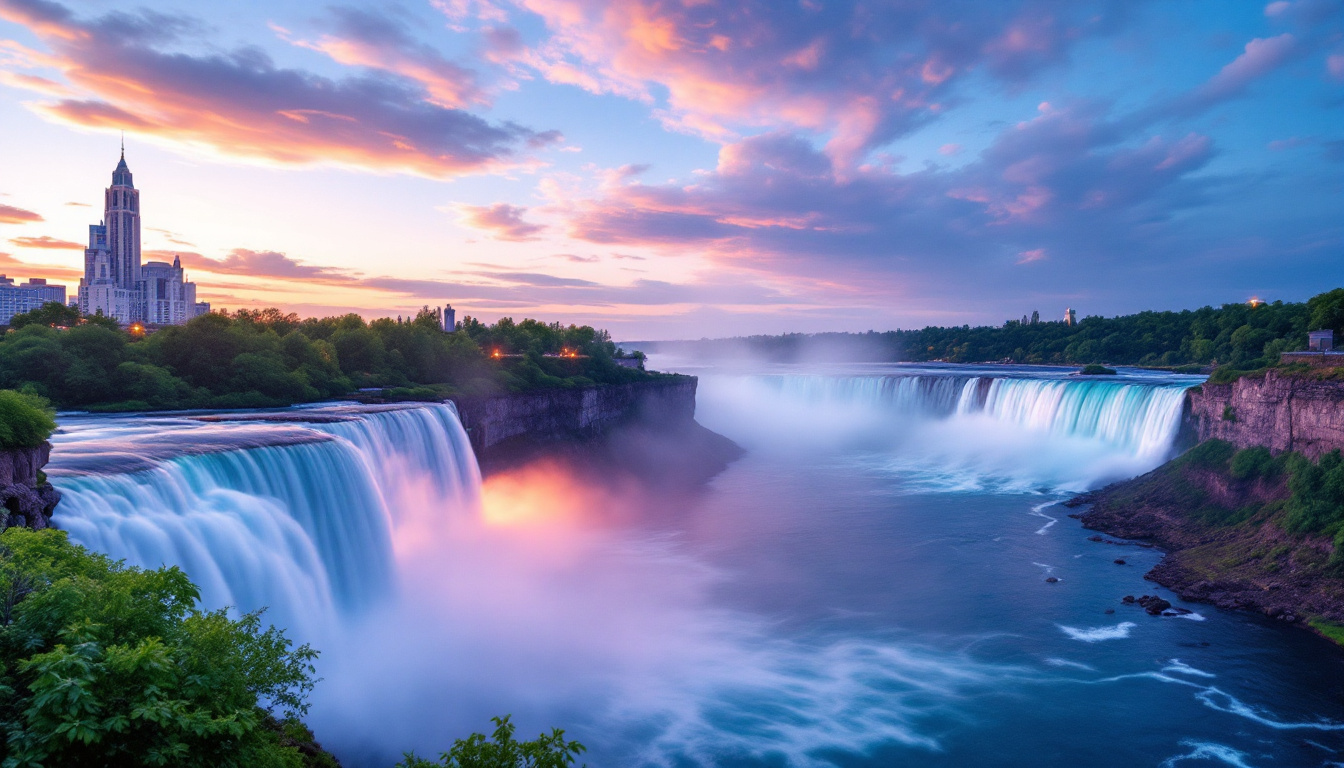
I figured Niagara Falls was just a really big waterfall you look at from behind a railing. Turns out somebody once turned it off, a 63-year-old schoolteacher rode over it in a barrel and lived, the whole thing is slowly crawling backward toward Lake Erie, and a 7-year-old boy survived a 167-foot plunge wearing nothing but a life jacket. The most famous waterfall on Earth has a wilder résumé than you’d ever guess.
1. They literally turned off the American Falls in 1969.
For about five months in the summer and fall of 1969, the U.S. Army Corps of Engineers built a temporary dam upstream and diverted the entire Niagara River away from the American Falls — leaving the cliff face bone dry. The plan was to study the eroding rock and figure out whether to clear the giant pile of fallen boulders at the base. Tourists showed up by the thousands to walk out and stare at a waterfall with no water. They eventually decided to leave the rocks alone and switched it back on.
2. A 63-year-old schoolteacher was the first person to go over in a barrel — and she survived.
On October 24, 1901, Annie Edson Taylor climbed into a custom wooden barrel padded with a mattress, had the air pressurized with a bicycle pump, and went over the Horseshoe Falls. She emerged battered but alive, with a small gash on her head, and reportedly told reporters that nobody should ever try it again. She did it hoping to get rich and famous. She got famous, mostly went broke anyway, and died in poverty — but she earned her spot in history as the first person to survive the plunge.
3. The falls are slowly moving backward — and have traveled about 7 miles already.
Niagara isn’t sitting still. The rushing water constantly eats away at the softer rock under the hard cap stone, the cliff edge undercuts and collapses, and the whole waterfall retreats upstream a little at a time. Over the last 12,000 years or so, this erosion has marched the falls roughly 7 miles back from where they started near present-day Lewiston. Engineering has slowed the pace dramatically, but in the deep future the falls will keep creeping toward Lake Erie.
4. Nikola Tesla’s vision powered the world’s first large-scale hydroelectric plant here.
Niagara was where the famous “War of the Currents” was effectively settled. The power station that opened at Niagara in the 1890s used Tesla’s alternating-current system — backed by George Westinghouse — to send electricity all the way to Buffalo, more than 20 miles away. It proved AC could move power over long distances in a way Edison’s direct current never could. There’s a statue of Tesla on Goat Island today, gazing out over the river that helped electrify the modern world.
5. A 7-year-old boy survived going over the falls with no barrel — just a life jacket.
In 1960, a small boat capsized upstream and a 7-year-old named Roger Woodward was swept over the Horseshoe Falls wearing only a life jacket and swim trunks. Against every conceivable odd, he survived the 167-foot drop and was plucked out of the churning water at the base by the crew of the Maid of the Mist tour boat. He remains the first person known to have gone over the falls unprotected and lived to tell about it.
6. About 20% of the entire planet’s fresh water flows over or sits behind Niagara.
The falls are the dramatic finale of the Great Lakes, which together hold roughly one-fifth of all the fresh surface water on Earth. The Niagara River is the drain connecting Lake Erie to Lake Ontario, and an enormous volume of water pours over the brink — more than 3,000 tons every single second during peak daytime flow. Standing at the railing, you’re watching a meaningful slice of the world’s drinkable water rush past you.
7. Roughly half the river never even reaches the falls — it’s quietly diverted for power.
To keep the hydroelectric plants running, the U.S. and Canada signed a treaty that siphons a huge share of the Niagara River away through tunnels before it ever reaches the brink. During tourist season in the daytime, they let more water flow over for the view; at night and in the off-season, even more gets pulled for electricity. So the thunderous cascade you photograph is, in part, a managed performance — the engineers literally dial the flow up and down.
8. The Horseshoe Falls froze enough in 1848 that the river briefly stopped.
The falls have never frozen solid all the way through — the water moves far too fast and forcefully for that. But in late March 1848, an ice jam upstream at Lake Erie plugged the river so completely that the flow slowed to a trickle for about 30 hours. Locals walked out onto the exposed riverbed collecting souvenirs, and some genuinely feared the world was ending. Then the ice broke loose and the falls roared back to life.
9. A man went over in a barrel and survived — only to die slipping on an orange peel.
Bobby Leach went over the Horseshoe Falls in a steel barrel in 1911 and lived, spending six months in the hospital recovering from his injuries. He toured the world telling daredevil stories for years. Then in 1926, while walking down a street in New Zealand, he slipped on an orange peel, badly injured his leg, developed complications, and died. The man survived Niagara Falls. He did not survive a piece of fruit on the sidewalk.
10. The water at the base of the falls is a stunning blue-green — because of pulverized rock.
That postcard-perfect color isn’t a trick of the light. As an estimated 60 tons of dissolved minerals and finely ground rock flour pour over the brink every minute, the suspended particles scatter light and tint the water that famous milky blue-green. In other words, the falls are constantly grinding their own cliffs into powder, and that powder is exactly what gives Niagara its signature color. The waterfall is, in a sense, painting itself.
Which one made you rethink the railing-and-a-rainbow version of Niagara? Send this to the friend who thinks it’s just a big waterfall.
