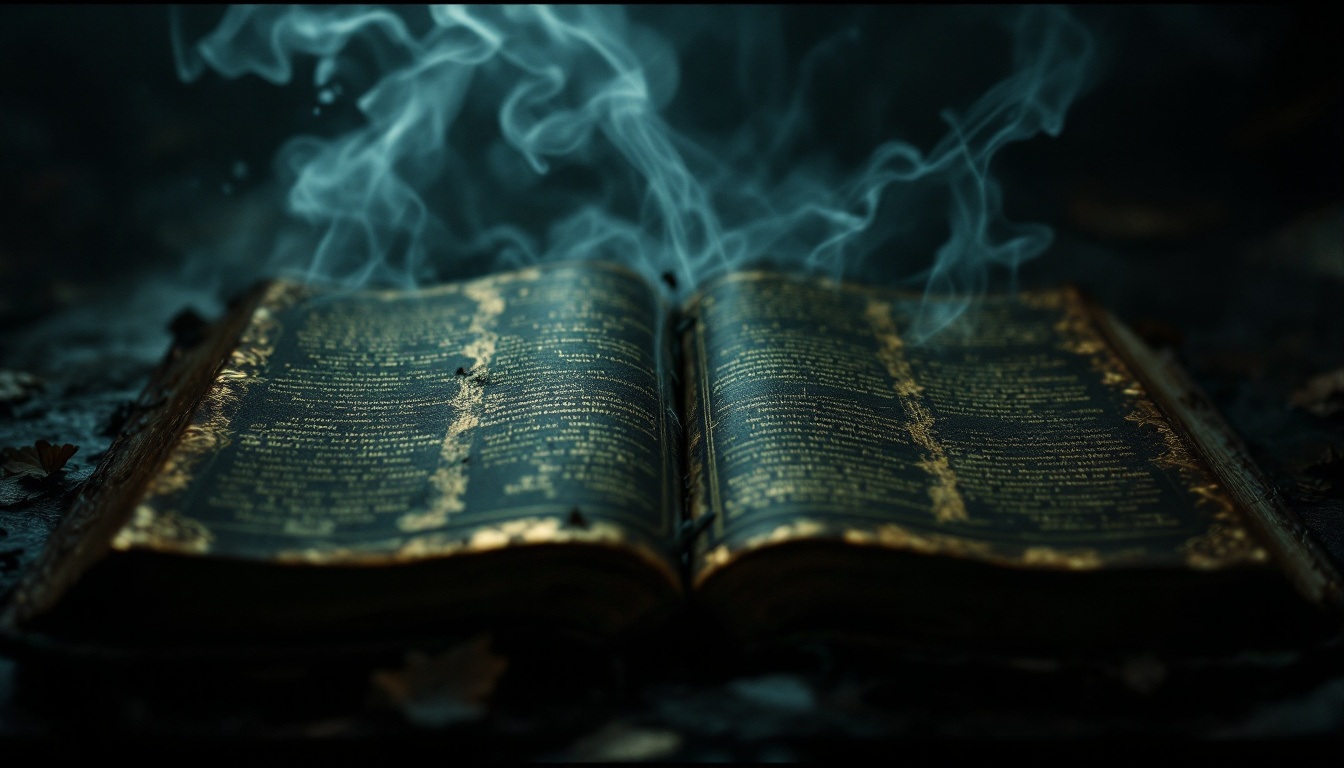
So there’s a book. It’s about the size of a hardcover novel, maybe two hundred and forty pages, bound in plain limp vellum the color of an old saddle. It lives now in a climate-controlled vault at Yale University, in the Beinecke Rare Book and Manuscript Library, where it’s catalogued as MS 408. And I want to tell you the one thing about it that has driven people quietly out of their minds for six hundred years: nobody on Earth can read a single word of it.
Now, I don’t mean it’s in a hard language. I don’t mean it’s Latin you forgot or Old German you’d need a specialist for. I mean that every page of this book is covered, top to bottom, in a flowing, confident, beautiful script — written by a steady hand that clearly knew exactly what it was doing — in an alphabet that matches no known language, living or dead, anywhere in human history. Whoever wrote it wrote it fluently. There are no scratch-outs, no hesitations, no corrections. They wrote it the way you’d write a grocery list, like it was the most natural thing in the world. And to this day, not one human being has been able to say what a single sentence of it means.
Let me back up and tell you how we even know how old it is, because that part’s settled, and it’s the only part that is. In 2009, researchers at the University of Arizona took four tiny samples of the vellum — the actual animal-skin pages — and ran them through radiocarbon dating. The results came back with a tight window: the calfskin those pages are made from comes from animals that died somewhere between 1404 and 1438. Early fifteenth century. That’s before Gutenberg’s printing press. That’s during the time of Joan of Arc. The ink sits properly on the page in a way consistent with that age, too — so this isn’t a case of someone scribbling on old blank parchment. The book is genuinely, verifiably about six hundred years old. Whatever else is a mystery, the calendar is not.
And here’s where I have to describe the inside to you, because the contents are honestly stranger than the writing. The book is divided into sections, and people have nicknamed them based on the pictures. There’s a botanical section — page after page of detailed, hand-painted plants, with roots and leaves and flowers rendered in real care. Except botanists have gone through them, and the overwhelming majority of these plants don’t exist. They’re not real species. They look like plants the way a dream of a plant looks like a plant. Then there’s an astronomical section, full of suns and moons and stars and what appear to be zodiac symbols. And then — and this is the one that gets everybody — there’s what scholars politely call the “balneological” section, which is a fancy word for bathing. It’s pages of small naked women, frolicking in interconnected pools and green tubes and plumbing that looks like something out of a strange waterpark, all linked together by channels nobody can explain. Nobody knows what any of it is showing. Nobody knows what it’s for.
So you’d think — surely, somebody’s cracked this. We’ve broken Egyptian hieroglyphs. We read Linear B. We’ve got supercomputers. And that’s the part of this story I find almost impossible to let go of. Because the people who have failed to read this book are not amateurs. The man it’s named for, a rare-book dealer named Wilfrid Voynich, bought it in 1912 from a Jesuit college in Italy, and spent the rest of his life trying to figure out what he’d bought, and died in 1930 having gotten nowhere. During World War II, some of the finest codebreakers America ever produced — the same kind of minds that were busy cracking Japanese and German military ciphers, the people who broke codes for a living and were very, very good at it — took a swing at the Voynich Manuscript in their spare time. They got nothing. After the war, William Friedman, the legendary cryptologist who founded the NSA’s predecessor and is considered one of the greatest codebreakers in history, ran a whole study group at it for years. His conclusion, after all that, was essentially a shrug. He couldn’t break it either.
And it’s not for lack of trying since. The full manuscript is online now, every page scanned in high resolution, free for anyone on the planet to study. Linguists have run it through statistical analysis and found something genuinely eerie: the “words” in the text behave, statistically, like real language. They follow patterns. Certain words show up more often in certain sections — the way you’d expect plant-words to cluster in a plant chapter. The letter frequencies aren’t random gibberish; they have the texture of an actual writing system. Which leaves us with a maddening fork in the road. Either it’s a real language or cipher so clever that six centuries of human ingenuity hasn’t dented it — or it’s the most elaborate, internally consistent hoax anyone has ever pulled off, a stack of beautiful nonsense built so carefully that it mimics meaning without ever having any. And in the last few years, with all our artificial intelligence and machine learning, people have pointed the most powerful pattern-finding tools ever built straight at it. Headlines pop up every so often — “AI cracks the Voynich Manuscript!” — and every single time, the actual experts look at the work, shake their heads, and say no, not this one either. The machines that can beat us at chess and fold proteins and write essays have looked at this six-hundred-year-old book and come away as stumped as the codebreakers of 1944.
So what is it? I’ll be honest with you the way a storyteller has to be: nobody knows, and anyone who tells you they’re certain is selling something. The leading guesses run the whole range. Maybe it’s a real medieval text in an unknown cipher — a pharmacist’s or healer’s private book of recipes, locked up so no rival could steal the secrets. Maybe it’s a constructed language somebody invented from scratch. Maybe it’s the work of a deeply troubled mind, written in a private script that meant something only to its author. Or maybe — and there are serious scholars who lean this way — it was a Renaissance-era con, a gorgeous fake whipped up to sell to a wealthy collector who wanted a book of ancient secrets and got, instead, the world’s most expensive book of nothing. We may never know. The thing has outlasted everyone who’s ever tried to read it.
But here’s what stays with me. Somewhere in the early 1400s, a person sat down with good vellum and good ink and a steady, practiced hand, and filled two hundred and forty pages with a careful, flowing script that they clearly understood perfectly — drawing plants that don’t grow and stars that don’t shine and women bathing in plumbing that leads nowhere. They knew exactly what they were saying. And then they closed the book, and they died, and they took the whole thing with them. For six hundred years it has sat on shelves and in vaults and now behind climate-controlled glass at Yale, open to the world, scanned and studied and stared at by the smartest people of every generation since — saying something, clearly saying something, in a voice no living person has ever been able to hear.
Unsolved Mystery
