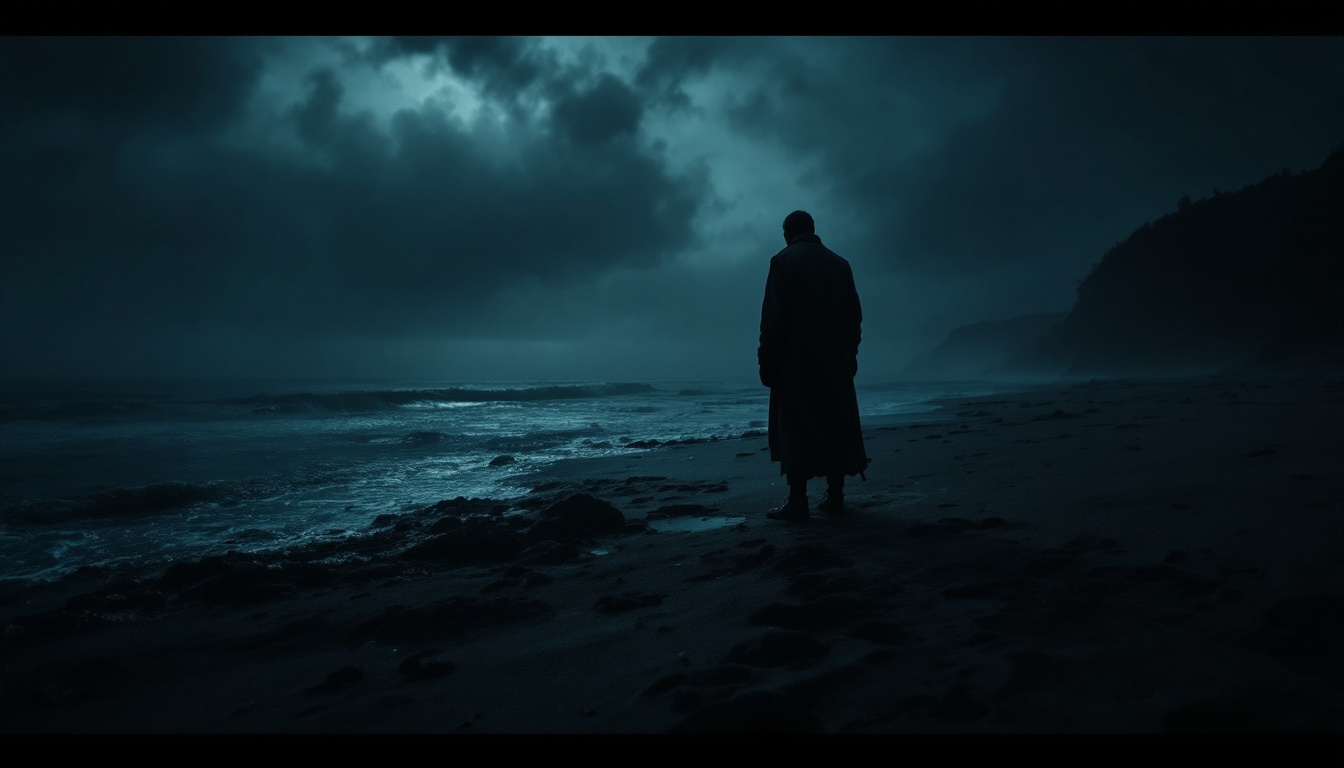
Let me set the scene for you, because this one has stayed with people for nearly eighty years. It’s the morning of December 1, 1948, on Somerton Park beach near Glenelg, just south of Adelaide, Australia. The summer sun is already up. A well-dressed man is slumped against the seawall, head resting on the rocks, a half-smoked cigarette tipped on his collar as though it fell from his lips while he slept. Passersby had noticed him the evening before and assumed he was drunk or dozing. He wasn’t. He was dead — and he was about to become one of the most haunting unsolved cases of the twentieth century.
Here’s the first strange thing, and it only gets stranger from here. The man had no wallet, no ID, no name. Every single label had been carefully cut out of his clothing. Who removes the tags from their own shirt and trousers? The autopsy deepened the puzzle: his spleen was three times normal size, his organs severely congested, his stomach showing signs of hemorrhage — all classic fingerprints of poisoning. And yet, I want you to sit with this, every chemical test came back clean. No poison was ever found in his body. The pathologist was convinced he’d been killed by a barbiturate or some hypnotic drug, possibly one that breaks down and vanishes after death. But conviction isn’t proof, and the coroner could never officially say how this man died.
Now we get to the part that turned a sad beach death into a genuine cipher mystery. Months later, a doctor re-examining the body noticed a tiny fob pocket sewn into the waistband of the trousers — easy to miss. Tucked inside was a scrap of rolled paper. Printed on it were two words in an ornate typeface: Tamám Shud. It’s Persian. It means “It is over.” “It is finished.” The scrap had been torn from the very last page of a book — a copy of the Rubáiyát of Omar Khayyám, that famous old collection of verses about living for the moment because death comes for us all. I get chills every time. The man carried his own epitaph stitched into his pants.
The police went hunting for the book that scrap had been torn from, and incredibly, a man came forward. He’d found a rare edition of the Rubáiyát tossed into the back seat of his unlocked car, parked near the beach right around the time of the death — and yes, its final page had been torn out, matching the scrap perfectly. But the book held two more secrets. Faintly pressed into the back cover, as if someone had written on a page resting on top of it, were five lines of jumbled capital letters: WRGOABABD, MLIAOI, WTBIMPANETP, and more. A code. The best cryptographers in Australia, and later codebreakers around the world, have stared at those letters for decades. To this day nobody has cracked them in a way the authorities accept. They may be a cipher. They may be the doodled first letters of words. They may mean nothing at all — but try telling that to the man who hid a code in a book and a poem in his pocket.
And there was one more thing scrawled in that book: a local telephone number. It belonged to a young nurse, Jessica Thomson — “Jo” to her friends — who lived on Moseley Street in Glenelg, barely four hundred meters up the beach from where the body was found. When police showed her a plaster cast of the dead man’s face, witnesses said she looked like she might faint, like she’d seen a ghost. But she insisted she didn’t know him. She took whatever she knew to her grave. Years later, her own daughter would say she believed her mother did know the man’s identity — and that there was a connection to something secret, possibly espionage. This was the dawn of the Cold War, remember, and Adelaide sat near a rocket-testing range the British were keeping very quiet about. Was our nameless man a spy? A defector? A jilted lover? The theories multiplied like rabbits.
The physical clues only tantalized further. His calf muscles were unusually high and pronounced — the kind you’d see on a ballet dancer or someone who spent years in heeled boots. His toes were oddly wedge-shaped. A suitcase turned up, abandoned at the Adelaide railway station, almost certainly his — and inside, the labels had been cut out of nearly everything, except for a few items bearing the name “T. Keane.” Police chased Keanes across the English-speaking world and found that none of them were missing. It was as if the dead man had deliberately erased himself before lying down on that beach to die.
So who was he? For seventy-four years, no one knew. Then in July 2022, a University of Adelaide professor named Derek Abbott — who had spent over a decade obsessed with this case, and who, in a twist worthy of fiction, had actually married Jessica Thomson’s granddaughter — announced a breakthrough. Working with the American genetic genealogist Colleen Fitzpatrick, Abbott extracted DNA from hairs preserved in the plaster death mask, built a family tree of some four thousand names, and matched it to distant relatives. The Somerton Man, he declared, was Carl “Charles” Webb, an electrical engineer and instrument maker born in Melbourne in 1905. South Australia Police have not officially confirmed it. And here’s what keeps me up at night: even if Abbott is right, even if we finally have a name — we still don’t know how Carl Webb died, why his labels were cut, what that code means, why he was on that beach, or what Jessica Thomson saw in that plaster face. The man finally has a name. The mystery still doesn’t have an ending.
Unsolved Mystery
