
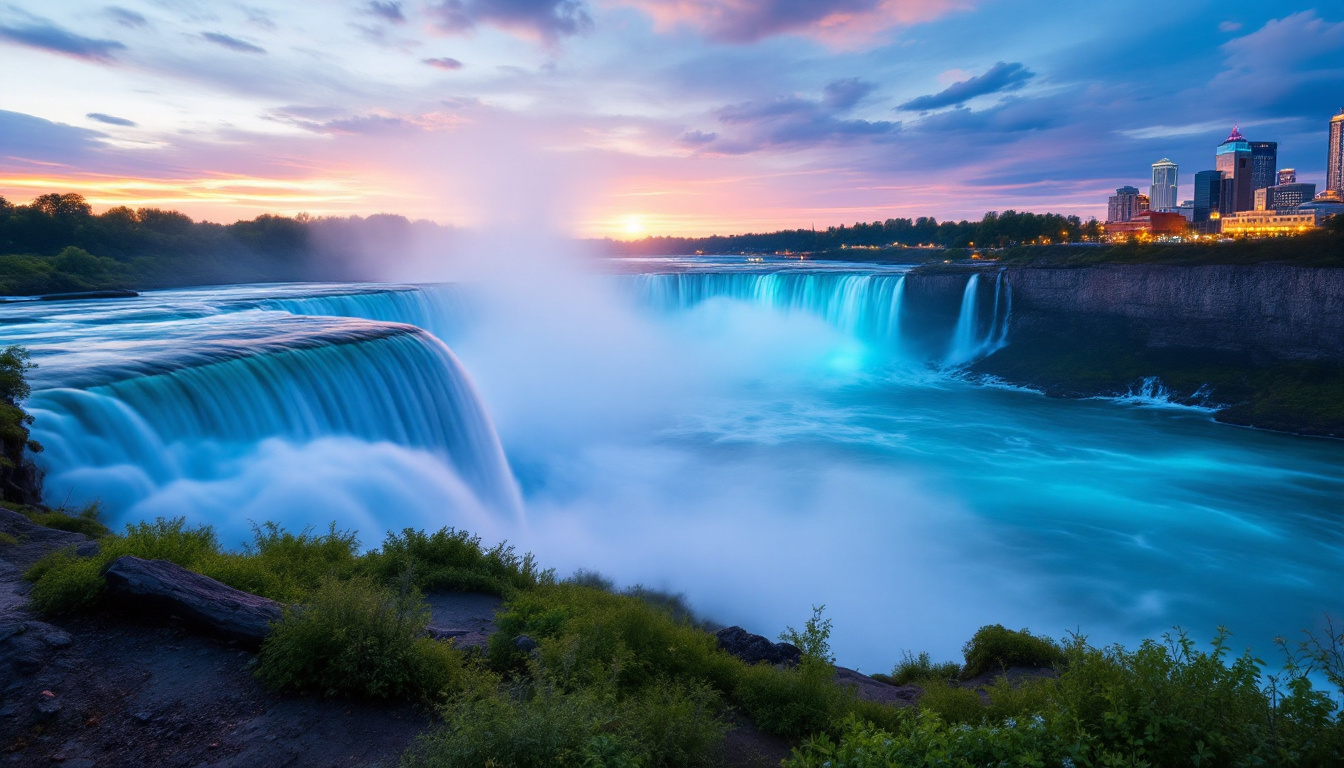
Okay, I’ll admit it: I thought Niagara Falls was just a big, wet honeymoon cliché until I started digging. Then I learned that engineers literally switched the American side off like a garden hose back in 1969, that a 63-year-old schoolteacher rode over it in a barrel as a retirement plan, and that the whole thing is quietly creeping toward Buffalo as we speak. Grab your raincoat. These ten are stranger than anything the gift shop will sell you.
1. In 1969, the U.S. Army Corps of Engineers turned the American Falls completely off.
For five months, the American Falls were bone dry. Starting June 1969, crews dumped over 28,000 tons of rock to build a cofferdam that rerouted the river toward the Canadian Horseshoe Falls. The plan was to study the unsightly boulder pile at the base and maybe haul it away. Roughly 100,000 gawkers showed up in the first week alone to walk around and stare at a waterfall with no water. In the end, the engineers bolted down the rock face, decided the boulders cost too much to remove, and just turned it back on.
2. A 63-year-old schoolteacher was the first person to survive going over in a barrel.
Annie Edson Taylor went over Horseshoe Falls in a padded oak barrel on October 24, 1901 — her 63rd birthday. It was, no joke, her retirement plan. She figured fame and fortune awaited. Two days before her own plunge, she test-ran the barrel with a house cat, which survived. So did Annie, emerging dazed with just a cut on her forehead. The cruel twist: she never cashed in, and died penniless years later, with her funeral paid for by public donations.
3. The next barrel survivor died years later by slipping on an orange peel.
Bobby Leach became the second person to survive the falls in a barrel in 1911, crawling out battered, bruised, and bleeding but alive. He spent years touring the world bragging about cheating death by waterfall. Then, in 1926, while on a publicity tour in New Zealand, he slipped on an orange peel and badly hurt his leg. The wound got infected, the leg was amputated, and complications killed him. Survived a 167-foot plunge; undone by breakfast garbage.
4. A 7-year-old boy survived the falls with nothing but a life jacket.
In July 1960, seven-year-old Roger Woodward was swept over Horseshoe Falls wearing only a small orange life vest after a boating accident. No barrel, no padding, no plan. A Maid of the Mist crew spotted the flash of orange in the churning water below and maneuvered close enough to fish him out with a life preserver. Roger walked away with a concussion. He remains the only person to go over Niagara Falls unprotected and live.
5. Niagara isn’t even close to the tallest waterfall — it’s all about volume.
If you’re picturing a sky-high curtain of water, recalibrate. The drop at Horseshoe Falls is only about 167–188 feet — shorter than plenty of waterfalls you’ve never heard of. What makes Niagara legendary isn’t height, it’s sheer brute flow: more than a million gallons of water can pour over the brink every single second. It’s less “tallest” and more “you could not pay me enough to stand under that.”
6. A tightrope walker once cooked an omelette halfway across the gorge.
In 1859, French daredevil Charles Blondin walked a 1,100-foot rope strung high above the Niagara gorge. And he got bored doing it normally. So he started improvising: crossing blindfolded, on stilts, in a sack, pushing a wheelbarrow. One time he hauled a small stove out to the middle, sat down, cooked an omelette, and ate it. Another time he carried his terrified manager across on his back — the poor man had to climb off and remount several times so Blondin could rest.
7. Most of the time, a majority of the river never reaches the falls at all.
Treaties between the U.S. and Canada let power companies siphon off enormous amounts of the Niagara River upstream before it ever hits the edge. During peak daytime tourist hours, at least half the water is allowed to flow over for the views. But the rest of the time, a large share of the river gets diverted into tunnels and turbines. The thundering spectacle you photograph is, in a sense, the version they decided to let you see.
8. The falls power millions of homes — and run partly on a giant water battery.
The Niagara power projects crank out a massive combined capacity, making the area one of the biggest power producers in the region. Here’s the clever part: at night, when electricity demand drops, surplus power pumps water uphill into a reservoir. Then during the day, that water is released back down through the turbines to generate power a second time. It’s essentially a colossal rechargeable battery made of water and gravity.
9. The falls are slowly walking backward toward Buffalo.
Niagara Falls isn’t a fixed landmark — it’s a slow-motion migrant. Over the centuries, the falls eroded upstream, gradually carving the gorge and retreating toward Lake Erie. Left alone, it would keep right on marching. Geologists have long known the falls are essentially on a multi-thousand-year journey to relocate themselves, no moving truck required.
10. Diverting all that water has nearly stopped the erosion in its tracks.
Here’s the flip side of #9: by pulling so much water out of the river for power, engineers have dramatically slowed the falls’ retreat. The historic several-feet-per-year has dropped to roughly a foot per year or less. Add in underwater weirs and patch-up repairs on the rock face, and humans have effectively hit the brakes on a geological process. We didn’t just harness Niagara Falls. We basically put it in slow motion.
Which one made your jaw drop? Send this to the friend who’s already planning their honeymoon there…
