
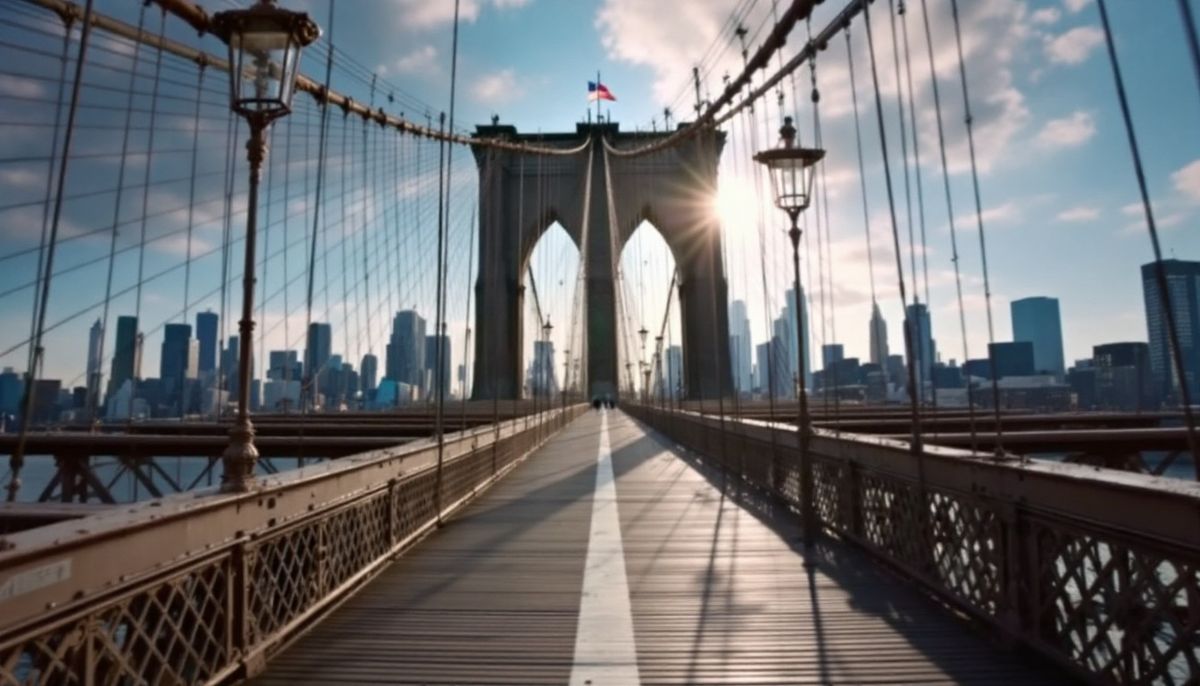
You’ve seen it a thousand times — in movies, on postcards, looming over the East River like it’s always just been there. But the story of how the Brooklyn Bridge actually got built is wilder than anything Hollywood put on it. Three different Roeblings paid for it with their bodies. A woman ran the whole project from her husband’s bedside. And the man who finally convinced America the thing wouldn’t collapse? He did it with twenty-one elephants. Keep reading — number 6 is one of the saddest things ever to happen in New York, and it happened just six days after the ribbon was cut.
1. The man who designed it died before a single tower went up.
John A. Roebling, the brilliant German-born engineer who dreamed up the bridge, never saw construction begin. In June 1869, while surveying the site at the Brooklyn waterfront, his foot was crushed between the pilings and an incoming ferry. The injury led to tetanus, and he died about three weeks later. The most ambitious bridge in the world lost its visionary before the foundations were even dug.
2. His son took over — and it nearly killed him too.
Washington Roebling, John’s son, stepped in to finish his father’s work. But the job came with a hidden enemy. Crews dug the bridge’s massive underwater foundations inside pressurized chambers called caissons, and coming back up too fast caused what workers called “caisson disease” — known today as decompression sickness, or “the bends.” Washington was hit so badly that he was left partially paralyzed, in chronic pain, with damaged sight and hearing. The bridge that made the Roebling name also broke two generations of the family that built it.
3. The real chief engineer for years was a woman — Emily Roebling.
With Washington bedridden and unable to visit the site, his wife Emily Warren Roebling became his eyes, ears, and voice. For more than a decade she carried his instructions to the engineers, learned advanced mathematics and the technical details of bridge construction, relayed progress back to him, and effectively managed the project day to day. At a time when women weren’t allowed to be engineers, she was running one of the greatest engineering feats on earth — and almost nobody knew it.
4. Emily was the first person to ride across — with a rooster on her lap.
When the bridge was finally ready in 1883, it was Emily Roebling who took the first official trip across in a carriage. And she didn’t go empty-handed — she carried a live rooster with her, an old symbol of victory. After thirteen brutal years and a family nearly destroyed by it, you can hardly blame her for the victory lap.
5. They literally fought a fire deep underwater.
In December 1870, a fire broke out inside one of the wooden caissons buried beneath the riverbed — a sealed, pressurized chamber where men worked by candlelight in compressed air. Crews battled the blaze for hours in those bizarre underground conditions, and the damage set construction back by months. It was while helping fight that very fire that Washington Roebling’s own health began its sharp decline. A fire, underwater, in a box pumped full of pressurized air — and they put it out.
6. Six days after it opened, a panic on the bridge killed 12 people.
The bridge opened to enormous fanfare on May 24, 1883. Six days later, on May 30 — Memorial Day — huge crowds packed onto it. On a narrow stairway, a woman tripped and fell, another woman screamed, and a rumor ripped through the crowd that the bridge was about to collapse. The resulting stampede crushed and trampled people against the railings. Twelve people died and dozens more were injured. The very fear the engineers had spent years fighting — that the bridge wasn’t safe — turned deadly in a matter of minutes.
7. P.T. Barnum marched 21 elephants across to prove it was safe.
After the deadly stampede, public confidence in the bridge was shaken. Enter showman P.T. Barnum. On May 17, 1884, he led a parade of 21 elephants — including his famous giant, Jumbo — across the Brooklyn Bridge, along with 17 camels. It was a publicity stunt, sure, but it worked: if the bridge could hold a herd of elephants without flinching, New Yorkers figured it could hold them. Trust restored, one pachyderm at a time.
8. When it opened, it was the longest suspension bridge on Earth.
The Brooklyn Bridge wasn’t just impressive — it was record-shattering. Its main span stretched 1,595 feet, making it the longest suspension bridge in the world when it opened, by a wide margin. It held that title for two decades until the Williamsburg Bridge surpassed it in 1903. For people in 1883, it was the equivalent of looking up at the tallest skyscraper ever built.
9. It was the first suspension bridge in the world built with steel cables.
The Brooklyn Bridge didn’t just set a length record — it changed how bridges were made. It was the first suspension bridge to use steel for its cable wire, instead of the iron used before it. Those four massive main cables were spun from thousands of individual steel wires, a then-revolutionary technique that allowed the bridge to span a distance no iron bridge could safely manage. The age of steel infrastructure essentially started here.
10. It took 14 years and the lives of around two dozen workers to build.
Construction dragged on from 1869 to 1883 — fourteen long years of digging, spinning cable, and battling the river. The human cost was steep: an estimated two dozen or so workers died over the course of the project, from the bends, falls, fires, and accidents. Every time you see that bridge glowing at dusk, remember it stands on top of one of the toughest, deadliest construction stories in American history — and it’s still carrying traffic nearly a century and a half later.
Which one got you — the underwater fire, the elephants, or the woman who secretly ran the whole thing? Forward this to the history buff in your life who thinks they know New York…
