
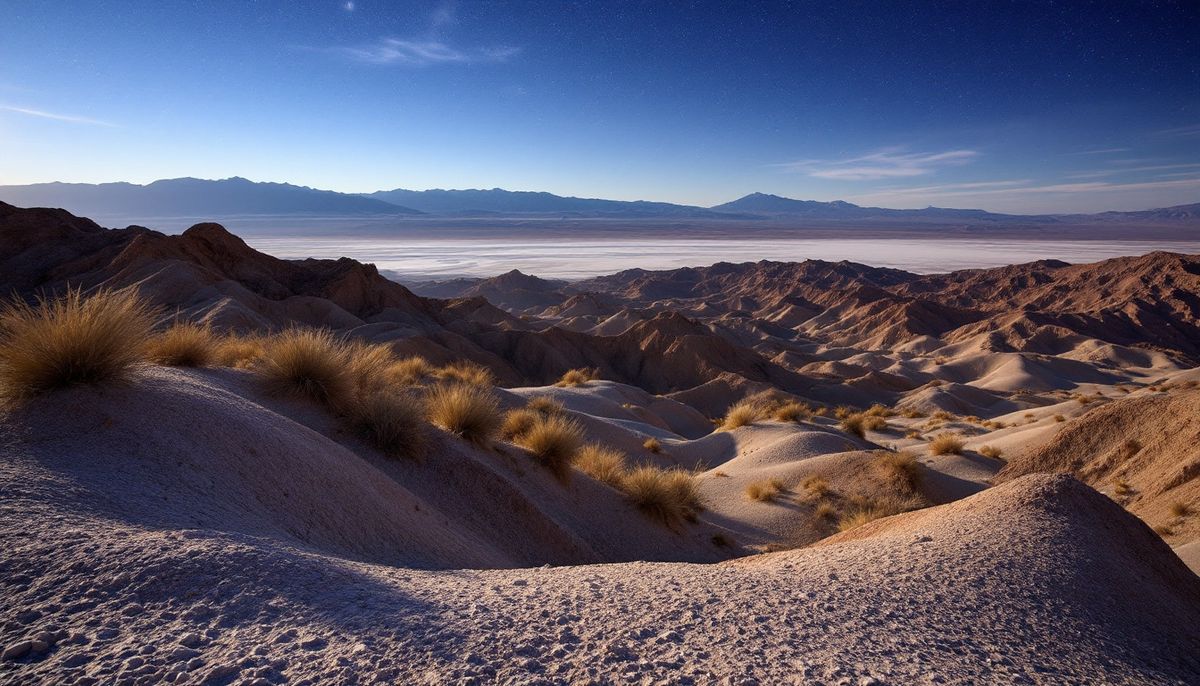
You know Death Valley is hot. That’s the whole reputation — a sun-blasted wasteland with a name that sounds like a warning label. But here’s what gets me: this “lifeless” desert holds the hottest temperature ever recorded anywhere on Earth, hides the lowest spot on the entire continent, grows rocks that crawl across the desert floor by themselves, and once a decade erupts into a carpet of wildflowers. Oh, and you can get snowed on there. Keep reading — number 4 is a mystery scientists couldn’t crack for over 60 years.
1. It holds the hottest air temperature ever recorded on Earth — 134°F.
On July 10, 1913, a U.S. Weather Bureau station at Furnace Creek logged a temperature of 134°F (56.7°C). More than a century later, it’s still the official record for the highest air temperature ever measured anywhere on the planet. Some modern weather historians argue the old reading runs a few degrees too hot, but the World Meteorological Organization still recognizes it. Either way, Death Valley isn’t messing around — it hit a verified 130°F as recently as 2020 and 2021.
2. Badwater Basin is the lowest point in North America — 282 feet below sea level.
At a spot called Badwater Basin, the ground sits a full 282 feet below sea level, making it the lowest point on the entire continent. It’s a vast, cracked plain of salt flats — nearly 200 square miles of mostly table salt left behind by water that evaporated long ago. The name comes from a small spring-fed pool there so loaded with salt that it’s undrinkable. One thirsty traveler’s mule reportedly refused to drink it, and the name stuck.
3. From its lowest point to its highest peak is over 11,000 feet of vertical drama.
Stand at Badwater Basin and look up. Towering above the valley floor is Telescope Peak at 11,049 feet — meaning Death Valley packs more than 11,000 feet of elevation change inside a single national park. That’s part of what makes the place so wild: the lowest spot in North America and an 11,000-foot mountain are practically next-door neighbors, separated by some of the most extreme terrain in the country.
4. The “sailing stones” move across the desert by themselves — and nobody could explain it for decades.
On a dry lakebed called Racetrack Playa, heavy rocks — some weighing hundreds of pounds — slide across the flat ground on their own, leaving long trails carved in the mud behind them. For over 60 years, people blamed wind, magnetism, even aliens, because nobody had ever actually seen them move. The mystery was finally solved in 2014: on rare cold nights, thin “windowpane” sheets of ice form, then break up in the morning sun and get nudged by a light breeze, shoving the rocks along at a slow crawl. Real, documented, and somehow still spooky.
5. It’s the largest national park in the lower 48 states.
Death Valley sprawls across more than 3.4 million acres — bigger than the state of Connecticut, and larger than any other national park outside Alaska. So when people picture a quick stop to snap a photo of the salt flats, they’re badly underestimating it. You could spend days inside the park and still not see most of it. It’s not a valley so much as an entire desert kingdom.
6. It’s one of the driest places in North America — about 2 inches of rain a year.
Death Valley averages roughly 2 inches of rainfall in an entire year. For comparison, plenty of U.S. cities get that in a single rainy afternoon. The valley is so dry partly because it sits in the rain shadow of several mountain ranges — by the time storms climb over all those peaks, they’ve got nothing left to drop. Hottest and driest, all in one place. It earns the reputation.
7. Once a decade, the dead desert explodes into a wildflower “superbloom.”
Every so often, when the rare rains line up just right, Death Valley pulls off a stunning magic trick: the barren ground bursts into a sea of color. Wildflower seeds can lie dormant in the soil for years, waiting, and when conditions finally cooperate they all wake up at once and bloom in a “superbloom.” It’s rare — roughly once a decade, with big ones in 1998, 2005, 2016, and again in early 2026. The hottest, driest place in North America, briefly carpeted in gold and purple flowers. Hard to believe until you see it.
8. Yes, it snows in Death Valley.
It sounds like a contradiction, but the high country tells a different story than the valley floor. Telescope Peak, the park’s tallest mountain, is regularly capped with snow in winter and can stay white for months. So while it’s brutally hot down in the basin, you can stand there and look up at a snow-covered summit at the same time. Few places on Earth serve up that kind of split personality.
9. The name came from a stranded Gold Rush party in 1849.
In the winter of 1849, wagon trains of fortune-seekers heading for the California gold fields took a “shortcut” and got hopelessly lost in the valley. They were trapped for weeks, eating their oxen to survive while two men hiked nearly 300 miles for help and came back to rescue them. As the survivors finally climbed out, the story goes, one of them turned back and said, “Goodbye, Death Valley.” The name stuck — even though, despite the harrowing ordeal, only one member of the group actually died there.
10. It’s home to a tiny endangered fish living in one spot on Earth.
In a water-filled limestone cavern called Devils Hole lives the Devils Hole pupfish — a small, electric-blue fish found nowhere else on the planet. Its entire natural habitat is a single warm pool fed by a cave so deep that divers still haven’t reached the bottom. The population has dipped into the dozens, making it one of the rarest fish in the world. A creature surviving in 92-degree water in the middle of the hottest desert in North America — life finds a way, even here.
Which one floored you most — the self-moving rocks or the snow? Forward this to the friend who thinks they could “totally handle” Death Valley in July…
