
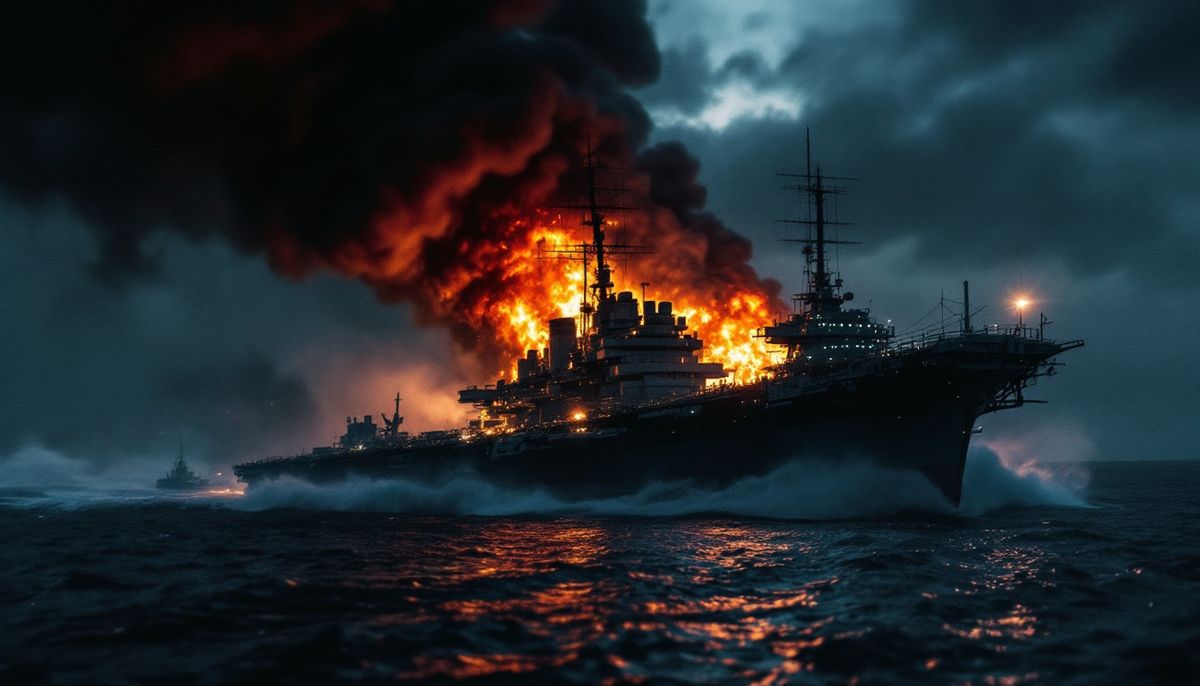
Most of us know the date — December 7, 1941 — and the phrase that followed it. But the story behind “a date which will live in infamy” is fuller, stranger, and in some ways more sobering than the textbook version. A battleship that still weeps oil into the harbor. A crucial target the attackers completely missed. A second warship resting nearby where a war finally ended. These are real events and real lives, told with care. Here are ten things worth knowing.
1. The whole attack lasted only about 110 minutes.
The first wave struck Pearl Harbor at 7:48 a.m. Hawaiian time, and in roughly an hour and fifty minutes — two waves of planes — the assault was over. In that short span, 2,403 Americans were killed and another 1,178 wounded. It is staggering to think how much was lost, and how much history was set in motion, in less time than a feature-length movie.
2. Nearly half of all the deaths happened on a single ship — the USS Arizona.
A bomb pierced the battleship USS Arizona and detonated near her forward ammunition stores. The explosion was catastrophic, and the ship sank within minutes. Of the roughly 2,400 Americans killed that morning, 1,177 died aboard the Arizona — almost half the total. Among them were all 21 members of the ship’s band. The Arizona accounts for one of the deadliest moments in U.S. naval history.
3. The USS Arizona still leaks oil — and people call it “black tears.”
When she sank, the Arizona carried roughly a million and a half gallons of fuel oil. More than eighty years later, the wreck still seeps small amounts of oil to the surface every single day — droplets that shimmer up beside the white memorial built over her. Visitors and historians call them the ship’s “black tears.” Many see it as the Arizona still mourning the men entombed within her hull.
4. The Arizona was never raised — she remains a tomb and a memorial.
Unlike many ships hit that day, the Arizona was too devastated to salvage and return to duty. The decision was made to leave her where she fell, with the remains of many of her crew still aboard. Today the gleaming white USS Arizona Memorial spans the sunken hull without touching it, honoring the more than 1,100 sailors and Marines who never came home. Survivors of the ship have even chosen to be interred with their shipmates.
5. The Japanese came to destroy the Pacific Fleet — but missed its most important ships.
The goal of the attack was to cripple the U.S. Pacific Fleet in one blow. But the fleet’s three aircraft carriers — Enterprise, Lexington, and Saratoga — were not in the harbor that morning. Enterprise and Lexington were out at sea ferrying aircraft, and Saratoga was on the mainland. Those carriers would soon become the backbone of America’s war in the Pacific. It was the single greatest gap in the attack.
6. The repair shops and fuel tanks were left largely untouched.
Beyond the carriers, the attackers also left Pearl Harbor’s dry docks, repair facilities, and massive above-ground fuel storage tanks mostly intact. Those installations let the Navy patch up and rebuild far faster than anyone expected. Had the fuel reserves and shipyards been destroyed, the fleet might have been forced back to the West Coast for months — a far heavier blow than the one actually dealt.
7. Most of the battleships sunk or damaged that day fought again.
It’s a remarkable testament to American salvage crews: of the battleships knocked out at Pearl Harbor, the majority were raised, repaired, and sent back into the war. The Nevada returned to service by late 1942; the California and the West Virginia — both sunk in the harbor — were refloated, rebuilt, and back in action by 1944. Ships pulled from the mud of Pearl Harbor would later help carry the fight across the Pacific.
8. The attack ended America’s debate about staying out of the war.
Before December 7, the country was deeply divided over whether to enter World War II. The attack ended that argument almost overnight. The next day, President Franklin Roosevelt asked Congress for a declaration of war, and it passed with only a single dissenting vote in the House. Pearl Harbor pulled a reluctant nation fully into the largest conflict in human history.
9. “A date which will live in infamy” was nearly a different phrase.
Roosevelt’s address to Congress on December 8, 1941, opened with one of the most famous lines in American oratory: “Yesterday, December 7, 1941 — a date which will live in infamy.” But his first draft read “a date which will live in world history.” He crossed out “world history” and wrote “infamy” — a small edit that turned a plain sentence into a line remembered for generations.
10. The ship where World War II ended now rests at Pearl Harbor too.
The battleship USS Missouri — the “Mighty Mo,” on whose deck Japan formally surrendered in Tokyo Bay in September 1945 — is permanently berthed at Pearl Harbor today as a museum. She sits not far from the Arizona Memorial, deliberately turned away from it out of respect. Together they bookend the war: the Arizona marking the day it began for America, and the Missouri marking the day it ended.
More than eight decades later, Pearl Harbor still has stories to tell. Share this with someone who’d want to remember.
