
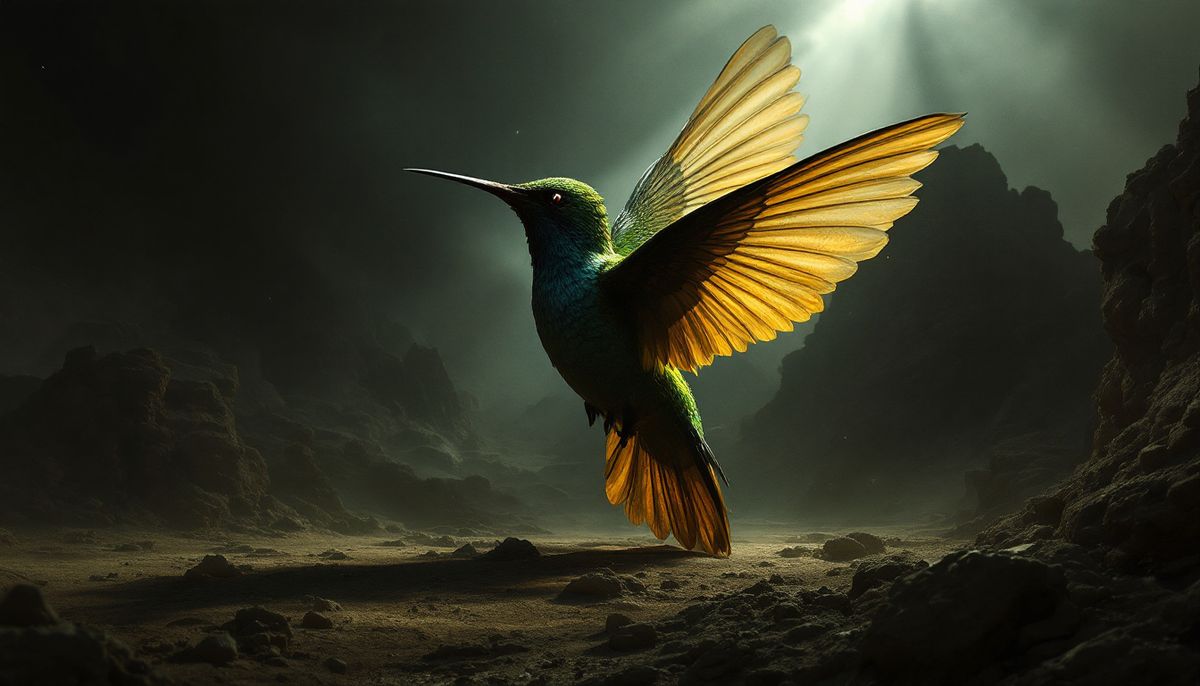
Picture the place first, because the place is half the mystery. South of Lima, between the Andes and the Pacific, there’s a stretch of Peruvian desert so dry it almost doesn’t qualify as a landscape — a flat, rust-colored plain called the Nazca pampa where it might rain for twenty minutes a decade. Nothing grows. Nothing moves but the wind. And scratched into that emptiness, spread across nearly twenty square miles, are hundreds of enormous drawings: a hummingbird the length of a football field, a monkey with a coiled tail, a spider, a condor, a killer whale, and straight lines that run dead-flat for miles as if drawn with a cosmic ruler. Here’s the part that gets under your skin. Stand right on top of one of these figures and you’d never know it was there. You’d see a shallow scuff in the dirt and walk on. The drawings only resolve into shape from the air — from a height no human being could reach for at least a thousand years after they were made. So the question almost asks itself: who carves a giant hummingbird into the ground for an audience that can only be looking down?
Let me tell you who, because that part we actually know. The lines were made by the Nazca people — and the Paracas culture before them — somewhere between roughly 500 BCE and 500 CE. That’s the era of the Roman Republic on the other side of the planet, people with no metal tools, no horses, no wheels, working in a desert with their hands and simple wooden stakes. And the method, once you hear it, is almost disappointingly elegant. The Nazca pampa is carpeted with small stones stained a dark reddish-brown by iron oxide baked on over millennia. Underneath that crust, the ground is a pale, yellowish-gray. So all the artists had to do was rake away the dark stones along a planned path and pile them at the edges, exposing the lighter earth beneath. No deep digging. No carving. Just removing the top layer to draw with the contrast — dark surface, light line. A child could grasp the technique. Coordinating it across a hummingbird three hundred feet long, perfectly proportioned, with curves that hold their shape over that whole distance, is another matter entirely. But it was human hands. We have the discarded stake remnants, the pottery, the worn footpaths. There is no mystery about the makers.
The mystery is everything else — starting with the fact that almost nobody knew they were there until airplanes did. The local people had always been aware of “the lines,” and a Peruvian archaeologist named Toribio Mejia Xesspe studied a few of them from the ground in the 1920s. But you can’t see the big picture standing in it, and for centuries that’s all anyone could do. Then commercial flights began crossing the region, and pilots glancing down at the pampa started reporting something impossible — gigantic animals and shapes etched into the desert below them. By 1941 an American scholar, Paul Kosok, flew over the drainage and the world finally understood the scale of what was down there. An entire open-air gallery, hidden in plain sight for two thousand years, revealed only when humans finally learned to fly. There’s something almost poetic about that. The drawings waited, patient and enormous, for the one vantage point that could take them in.
So why are they there at all? This is where the serious detective work begins, and where one name dominates the early chapters: Maria Reiche, a German mathematician who devoted half a century of her life to these lines — measuring them, mapping them, sweeping them clean with a broom, sleeping out on the pampa to protect them. Reiche championed the most romantic of the scholarly theories: that the lines were a colossal astronomical calendar, that certain lines pointed to where the sun set on the solstice or where key stars rose, a giant instrument for tracking the heavens. It’s a beautiful idea, and it made the Nazca lines famous. But here’s where I have to be the honest narrator — modern researchers have largely taken that theory apart. When astronomers ran the alignments rigorously, the lines pointed in too many directions to mean anything special; with that many lines, some were always going to line up with something in the sky by pure chance. The grand celestial calendar, sadly, doesn’t hold.
What has held up better is far more down-to-earth — and it’s about the one thing that matters most in a desert: water. In a place this parched, survival hinges on the underground streams and seasonal trickles that feed the valleys. A growing body of evidence suggests the lines and figures were tied to rituals meant to call the rains and honor the water that meant life or death. Archaeologists have found worn, compacted paths along many of the figures, along with broken pottery and offerings — the signs not of something meant to be looked at, but of something meant to be walked. Picture processions of people pacing the outline of the spider or the hummingbird as a kind of moving prayer, a ceremony aimed not at any earthly viewer but at the gods believed to be watching from above. That reframes the whole puzzle of “why make art nobody can see.” Maybe the audience was never supposed to be human. Maybe it was always the sky.
And the desert itself has been the perfect curator. This is the practical answer to a question people often forget to ask — how do scratches in loose dirt survive two thousand years? Because the Nazca pampa is one of the driest places on Earth, almost no rain ever comes to wash the lines away. The ground stays warm and stable, a layer of morning dampness and minerals helped harden the surface into a protective crust, and the steady winds tend to sweep stray sand back out of the grooves rather than burying them. A more forgiving climate would have erased these figures in a generation. It took the harshest desert imaginable to keep them. The very emptiness that makes the place feel like the edge of the world is exactly what let the drawings outlast every empire that rose and fell while they sat there in the sun.
Now — I’d be cheating you if I didn’t mention the theory you’ve probably already heard, the one that put Nazca on late-night television. In 1968 a writer named Erich von Däniken sold millions of copies of a book claiming the lines were runways and signals for ancient astronauts — extraterrestrials who supposedly guided primitive humans. It’s a thrilling story. It is also, by the near-unanimous verdict of archaeologists, nonsense. The “runways” lead nowhere and would collapse under any aircraft; the loose soil couldn’t bear the weight. The damning rebuttal came from an investigator named Joe Nickell, who in modern times gathered a small team, used only the simple tools the Nazca would have had, and reproduced one of the giant figures with stunning accuracy in a matter of days — no aliens, no aerial guidance, just careful planning, stakes, and string. The lines aren’t evidence that humans needed help. They’re evidence of how staggeringly capable humans were on their own. Honestly, that’s the better story. The truth here is more impressive than the myth.
And the truth keeps growing. As recently as 2024, researchers from Japan’s Yamagata University, working with AI to scan the desert, identified hundreds of previously unknown geoglyphs — parrots, cats, monkeys, killer whales, even drawings of severed heads — many of them smaller figures that had gone unnoticed for centuries. After two thousand years and a hundred years of study, the Nazca pampa is still handing over secrets. So we’re left where the best mysteries always leave us — knowing far more than we used to, and still not knowing the one thing we most want to. We know who made the lines, and how, and how they survived. What we’ll never fully recover is the prayer in the mind of the person dragging away those dark red stones, drawing a hummingbird the size of a stadium for an audience in the sky. The figure is still out there in the desert, exactly as they left it, waiting for someone to look down and wonder. We’ve been wondering for a hundred years now. I suspect we always will.
Unsolved Mystery
