
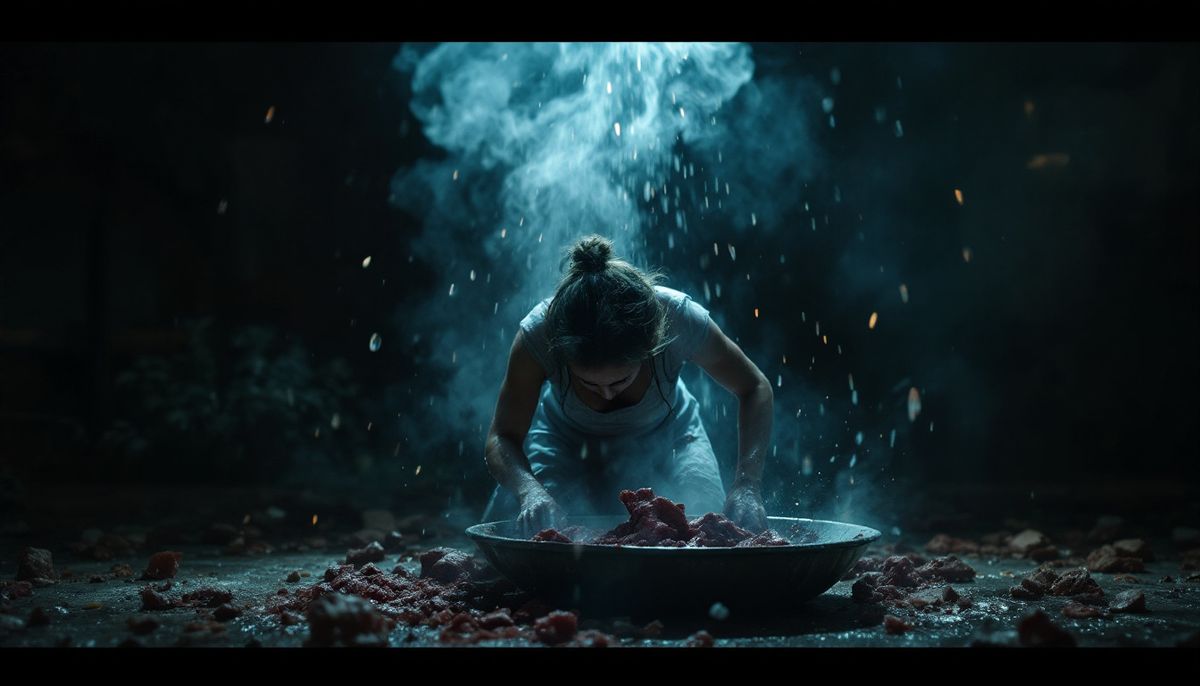
Picture the scene, because the ordinariness of it is what makes the whole thing so strange. It’s late morning on March 3, 1876, in a quiet pocket of Bath County, Kentucky, near a spot called Olympia Springs. A woman named Rebecca Crouch is standing in her yard making soap — about as plain a chore as country life offered. The sky above her is clear. No storm, no clouds darkening the horizon, no thunder rolling in from the hills. And then, sometime between eleven and noon, the air around her begins to fall apart into pieces of meat.
I don’t mean a sprinkle of something she mistook for meat. I mean flakes and chunks of red flesh drifting down out of an empty blue sky, some no bigger than a pea, some the size of a man’s finger, scattering across her property for a minute or two before it stopped as suddenly as it began. When it was over, the ground for a stretch of roughly 100 yards by 50 yards was speckled with raw flesh, glistening and fresh. Mrs. Crouch gathered some of it up in a wooden bowl to look at it closer. It was fresh, she said, and it carried a strong smell — something like mutton, or maybe venison. That detail, the smell of game, is going to matter later.
Now here is the part that always gets me. Two local men, hearing about the bizarre fall, did what apparently seemed reasonable to two gentlemen in rural Kentucky in 1876: they tasted it. Their verdict, delivered with the confidence of amateur food critics, was that it was either mutton or venison. I’m not recommending the experiment — please do not eat the mystery flesh that falls from the heavens — but you have to admire the directness. Word spread fast, and a tiny Kentucky farm became a national curiosity almost overnight. Newspapers ran with it under names that sound like rejected horror-movie titles: “The Great Kentucky Meat Shower,” “the Carnal Rain,” “the Kentucky Shower of Flesh.” People wanted an answer, and for a while, the answers only made things stranger.
Because this wasn’t dismissed as a tall tale. Samples were preserved and shipped off to scientists who put them under microscopes and actually studied them. The first theory out of the gate came from a water analyst named Leopold Brandeis, who declared the substance wasn’t meat at all — it was nostoc, a gelatinous blue-green organism sometimes called “witch’s butter” or “star jelly” that swells up when it rains. Tidy explanation. One problem: it hadn’t rained. The sky had been bone dry and clear. Nostoc needs water to bloom, and there hadn’t been a drop. So that door, satisfying as it was, quietly closed.
Then the real microscope work began, and it pulled the mystery in a direction nobody loved. Specimens were examined by a histologist, Dr. J.W.S. Arnold, and by Dr. A. Mead Edwards, a microscopist with the Newark Scientific Association, who published their findings in the scientific journals of the day. Their analysis of the samples broke down like this: two of them looked like lung tissue, two like cartilage, and three like muscle. This wasn’t witch’s butter. This was the inside of an animal — lung, gristle, and muscle — and at least one examiner thought the lung tissue resembled that of a horse or a human infant. Sit with that for a second. A clear sky over a Kentucky farm had rained down a mixed assortment of internal organs and meat, and the best minds with microscopes could only confirm that yes, it was genuinely flesh, and no, they couldn’t agree on whose.
So how does a tidy spread of lungs, muscle, and cartilage end up falling from a cloudless sky? The explanation that has stood up best for nearly 150 years didn’t come from a laboratory. It came, in part, from an old Ohio farmer’s common sense, and it was carried into print by a Dr. L.D. Kastenbine, who laid it out in the Louisville Medical News. His leading theory — still the one most scientists point to today — was vultures. Specifically, buzzard vomit.
It sounds like a punchline, but the biology is airtight. Kentucky had healthy populations of turkey vultures and black vultures, birds that feed communally on carcasses, gorge themselves quickly, and fly in groups. And vultures have a very particular defense mechanism: when they’re startled or threatened mid-flight, they lighten their load by disgorging whatever they’ve just eaten — a foul-smelling spray of partially swallowed meat that doubles as both a getaway maneuver and a deterrent. Now imagine a flock of them cruising over the Crouch farm, bellies full of some unlucky carcass, when something spooks the whole group at once. They all heave at the same time. What comes down is exactly what fell: fresh chunks of lung, muscle, and cartilage from an animal that died on the ground, scattered over a long narrow strip that matches the flight path of a startled flock. Kastenbine even got his hands on a sample and burned it to test it — and reported it gave off the distinct smell of rancid mutton. Mutton. The same smell Mrs. Crouch and the two brave tasters had described. The pieces fit.
But — and a good mystery always has a but — the explanation isn’t quite airless. No one ever produced the flock. No dead carcass was found nearby to account for so much fresh tissue. One examiner’s note that some of the lung tissue resembled a human infant’s has never been fully squared away and tends to get politely set aside, because the alternative is too grim to chase. And there’s the simple, stubborn strangeness of the conditions: a perfectly clear sky, a short violent burst, and then nothing, as if the heavens cleared their throat over one woman’s soap-making and moved on. The buzzard theory explains the what and the how beautifully. It just can’t show you the birds.
Here’s the strangest twist of all, and it’s the reason this isn’t merely a story. In 2004, an art professor at Transylvania University in Lexington named Kurt Gohde went digging through old storage and found a small glass vial, sealed with a sample suspended in alcohol, labeled simply “Olympia Springs.” It was a surviving piece of the meat shower — actual flesh from that 1876 morning, sitting forgotten on a shelf for well over a century. Modern examination of preserved tissue from the event has pointed, once again, toward animal lung. The vial is now kept at the Moosnick Medical and Science Museum, which means the Kentucky Meat Shower is one of the only “it rained from the sky” mysteries you can actually go and look at. A piece of the impossible morning, floating in a jar.
So I’ll leave you with what the evidence really gives us, which is most of an answer and a sliver of unease. A woman making soap under a clear sky watched flesh fall on her yard. The microscopes said lung, muscle, and cartilage. The smell said mutton. The leading explanation — buzzard vomit from a startled flock — fits the biology, the smell, and the scattered strip of debris almost perfectly, and it remains the answer scientists stand behind. And yet no flock was ever seen, no carcass ever found, and a sealed vial of the stuff still sits in a Kentucky museum, fresh enough to study, strange enough that we keep coming back to look. The sky cleared its throat over Olympia Springs that morning. We’re fairly sure we know what it coughed up. We’ve just never been able to point at the birds.
Unsolved Mystery
