
July 3rd
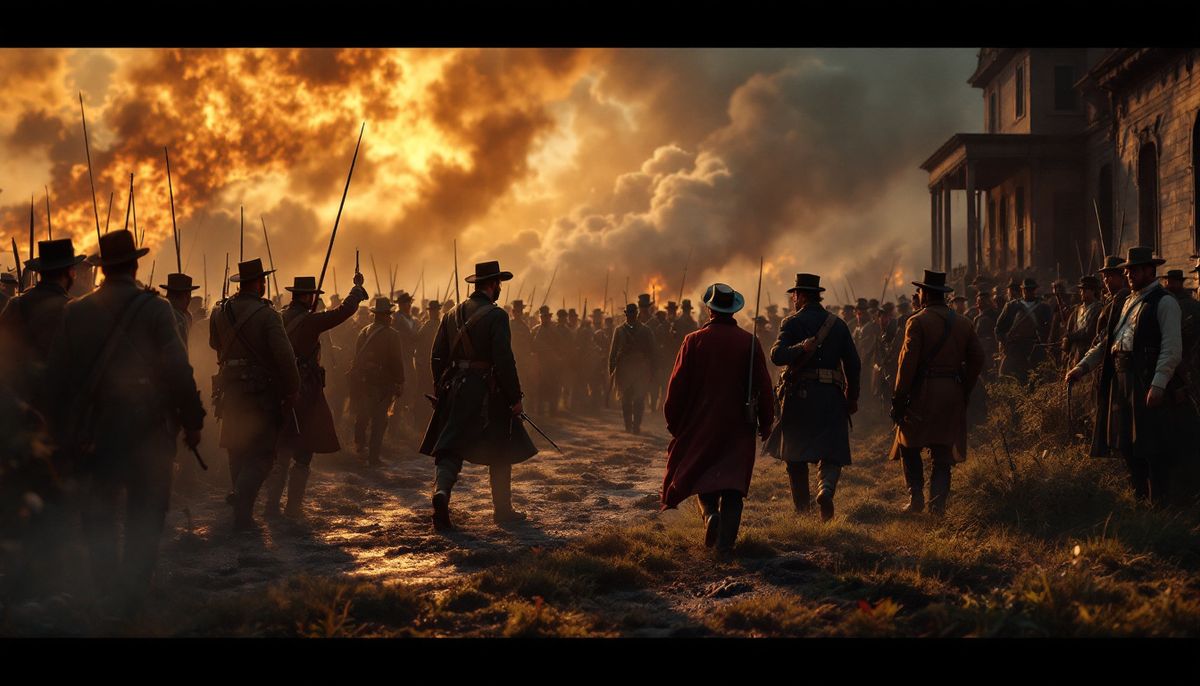
By the morning of July 3, 1863, the little crossroads town of Gettysburg, Pennsylvania, had already swallowed two days of the bloodiest fighting the American continent had ever seen. Robert E. Lee’s Army of Northern Virginia had hammered the Union line on July 1st and again on July 2nd, and yet the boys in blue still clung stubbornly to the high ground along Cemetery Ridge. Lee had one more card to play, and against the urgent objections of his most trusted lieutenant, James Longstreet, he decided to play it straight through the middle.
For nearly two hours that afternoon, the Confederate artillery thundered, more than 150 guns trying to soften the Union center. Then the cannons fell silent, and out of the tree line stepped some 12,000 to 15,000 Confederate soldiers, their battle flags snapping in the summer heat. Among them were the fresh Virginians of Major General George Pickett’s division, and it is his name that history would forever attach to what came next. Shoulder to shoulder, in lines nearly a mile wide, they began to march across three-quarters of a mile of open Pennsylvania farmland toward the waiting Union guns.
What followed was less a battle than a slaughter. Union artillery tore great holes in the advancing ranks, and as the survivors closed the distance, sheets of musket fire ripped them apart. A few hundred men under General Lewis Armistead actually breached the Union line at a stone wall, a spot forever after known as “the high-water mark of the Confederacy” — the farthest north the Southern dream of independence would ever reach. But there was no breaking through. Within an hour it was over. More than half the men who had stepped off into that field were dead, wounded, or captured.
As the shattered remnants stumbled back across the corpse-strewn ground, Lee rode among them, hat in hand, and said simply, “It is all my fault.” The next day, the 4th of July, his broken army began the long, rain-soaked retreat back to Virginia. The Confederacy would fight on for nearly two more years, but it would never again mount a serious invasion of the North. Pickett’s Charge had been the gamble of the war — and its failure marked the moment the tide turned, for good, toward the Union.
Also On This Day…
1775 — A Virginia Planter Draws His Sword on Cambridge Common On July 3, 1775, a tall, dignified Virginian rode out before a ragtag collection of New England militiamen gathered on the common at Cambridge, Massachusetts, drew his sword, and formally took command of the newly formed Continental Army. His name was George Washington. The Congress had handed him a force he himself described as “a mixed multitude of people under very little discipline, order or government,” besieging the British in Boston. He refused any salary beyond his expenses. The disorganized, poorly supplied army he inherited that day would, against staggering odds, go on to win American independence — and Washington would ride from that muddy parade ground into history as the father of his country.
1890 — The Gem State Joins the Union On July 3, 1890, Idaho became the 43rd state admitted to the United States. A rugged land of jagged mountains, deep river canyons, and silver mines, Idaho had boomed during the gold and silver rushes that drew prospectors west by the thousands. Known today as the “Gem State” for the rich mineral deposits hidden in its earth, Idaho would in time become far more famous for something humbler that grew in its volcanic soil: the potato. From mining camps to vast farm fields, the new state took its place in a nation just one day shy of celebrating its 114th birthday.
1985 — Marty McFly Hits 88 Miles Per Hour On July 3, 1985, a science-fiction comedy about a teenager, a flux capacitor, and a souped-up DeLorean roared into American theaters. Back to the Future, starring Michael J. Fox and Christopher Lloyd, had tested so well with audiences that the studio rushed it out ahead of the Independence Day weekend. The bet paid off spectacularly. The film earned more than $11 million in its first weekend, went on to become the highest-grossing movie of the entire year, and launched a beloved trilogy. Four decades later, “Great Scott!” and “Roads? Where we’re going, we don’t need roads” remain as quotable as ever.
From a doomed charge across a Pennsylvania field, to a general drawing his sword for a new nation, to a teenager racing through time in a DeLorean — July 3rd reminds us that history turns on bold gambles. Some end in heartbreak, some in independence, and some in pure popcorn-movie magic.
