
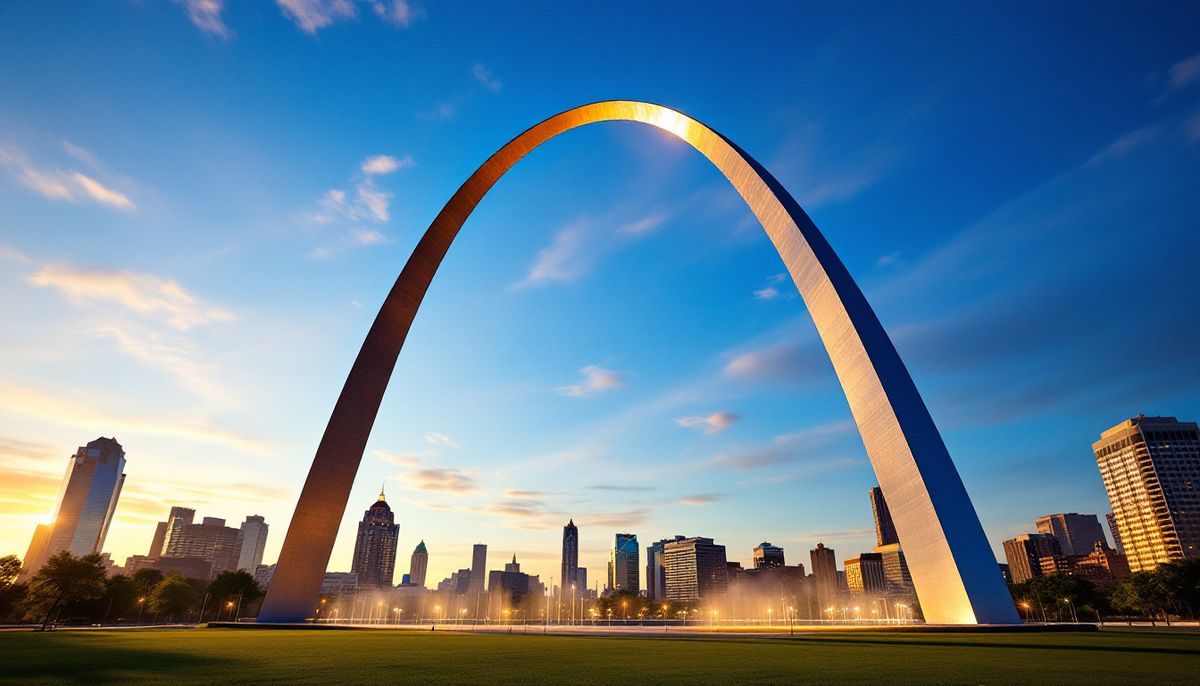
I’ll admit it: I always filed the Gateway Arch under “nice thing you see from the highway in St. Louis.” Then I fell down a research rabbit hole and came out the other side a changed person. Did you know the insurance company literally budgeted for 13 workers to die building it — and lost that bet in the best possible way? Or that on the day they finished it, they had to blast it with fire hoses so the two halves would actually fit together? And don’t get me started on the congratulations telegram that went to the wrong guy. Here are ten Arch facts that’ll make you the most interesting person at your next barbecue.
1. Insurance actuaries predicted 13 workers would die building it. The final death toll: zero.
The Arch was built by men walking on narrow steel tracks up to 630 feet in the air — often without safety nets. The project’s insurance company crunched the numbers and coldly projected 13 fatalities before completion. Instead, from 1963 to 1965, not one single worker died. It remains one of the great safety miracles in American construction history, accomplished with 1960s equipment and pure nerve. Somewhere, an actuary had to explain why his math was gloriously, wonderfully wrong.
2. If the two legs had been off by 1/64 of an inch, the whole thing wouldn’t have closed.
The Arch’s legs were built separately, curving up from opposite foundations for two years, and they had to meet perfectly at the top. The margin of error was 1/64 of an inch — about a third the thickness of a dime. Engineers even did their survey measurements at night, because daytime sunlight heated the steel unevenly and warped the readings. Two years of construction, two independent legs, and they nailed it. Try getting two contractors to agree on where a doorway goes.
3. On the day they finished it, firefighters had to hose it down so the last piece would fit.
October 28, 1965: time to insert the final 8-foot keystone section at the top. One problem — the morning sun had heated the south leg, expanding the steel until the gap shrank by about five inches. So crews sprayed the leg with fire hoses to cool it down and pry the gap back open, then muscled the last piece in before the sun could undo their work. The most sophisticated engineering project of its era came down to guys with water hoses racing the sunrise. It worked.
4. The “congratulations, you won” telegram went to the wrong Saarinen.
The 1948 design competition drew 172 entries — including one from architect Eero Saarinen and a separate one from his famous father, Eliel. When the finalists were notified, the secretary accidentally sent the telegram to dad. The Saarinen family popped champagne to toast Eliel’s triumph… until a phone call two hours later explained the winner was actually his son. To his eternal credit, Eliel opened a second bottle and toasted Eero. Now that’s how you lose to your kid with class.
5. The man who designed it never saw it built.
Eero Saarinen died of a brain tumor in September 1961 at just 51 years old — before construction had even begun. When the final piece was set in place four years later, his widow Aline was there watching. The Arch became his posthumous masterpiece, the crown jewel of a career that also gave us the TWA Flight Center and the tulip chair. He designed one of the most recognizable structures on Earth and never got to stand under it.
6. It’s exactly as wide as it is tall — your eyes just refuse to believe it.
The Arch stands 630 feet tall, and the distance between its legs at the ground is… also exactly 630 feet. Almost nobody perceives it that way — a well-known optical illusion makes vertical lines look longer than horizontal ones, so the Arch reads as dramatically taller than it is wide. For the record, 630 feet makes it the tallest man-made monument in the United States: taller than the Washington Monument (555 feet) and more than twice the Statue of Liberty. It’s also the tallest arch in the world. Not bad for a “rest stop photo op.”
7. The tram to the top was invented in two weeks by a man without a college degree.
Nobody knew how to move people up a curved, tapering, hollow arch — a normal elevator can’t turn corners. Enter Dick Bowser, a parking-garage elevator man with no college degree, who was given exactly two weeks to solve it. His answer: an ingenious mashup of an elevator and a Ferris wheel — little barrel-shaped pods that rotate to stay level as they climb the curve. His design still carries visitors to the top today, essentially unchanged. Two weeks. Some of us need longer than that to pick a couch.
8. In 1966, a pilot flew an airplane straight through it — and got away with it.
On June 22, 1966, the Arch was barely eight months old when a small plane swooped low over the Old Courthouse and threaded the needle right between the legs. The stunt was completely illegal, and the pilot was never caught. His identity stayed an official mystery for roughly 50 years, until a Missouri family came forward claiming it was their late father. Several copycats have buzzed through since, which is why the FAA remains deeply unamused by the world’s most tempting goalpost.
9. It was built to sway 18 inches — but good luck ever feeling it.
The Arch was engineered to flex up to 18 inches in extreme winds and to ride out earthquakes. In practice, it barely budges: it takes a steady 50-mile-per-hour wind just to move the top about an inch and a half. So yes, technically you’re standing in a skyscraper-height structure designed to wiggle. And no, that queasy feeling at the top observation deck is not the sway — that’s just you.
10. It’s not actually a parabola — and it used more stainless steel than any project in history.
Math teachers, look away: the Arch is a weighted catenary — the shape a heavy chain makes hanging between two points, flipped upside down. It’s nature’s strongest arch form, which is why it stands with no internal skeleton poking above the curve of its own skin. That skin took 886 tons of quarter-inch stainless steel, the most ever used on a single project at the time. Sixty years later it still shrugs off storms, tornado debris, and several million fingerprints a year.
Which one made you say “no way”? Send this to the friend who’s climbed to the top — or the one who’s too chicken to try…
