
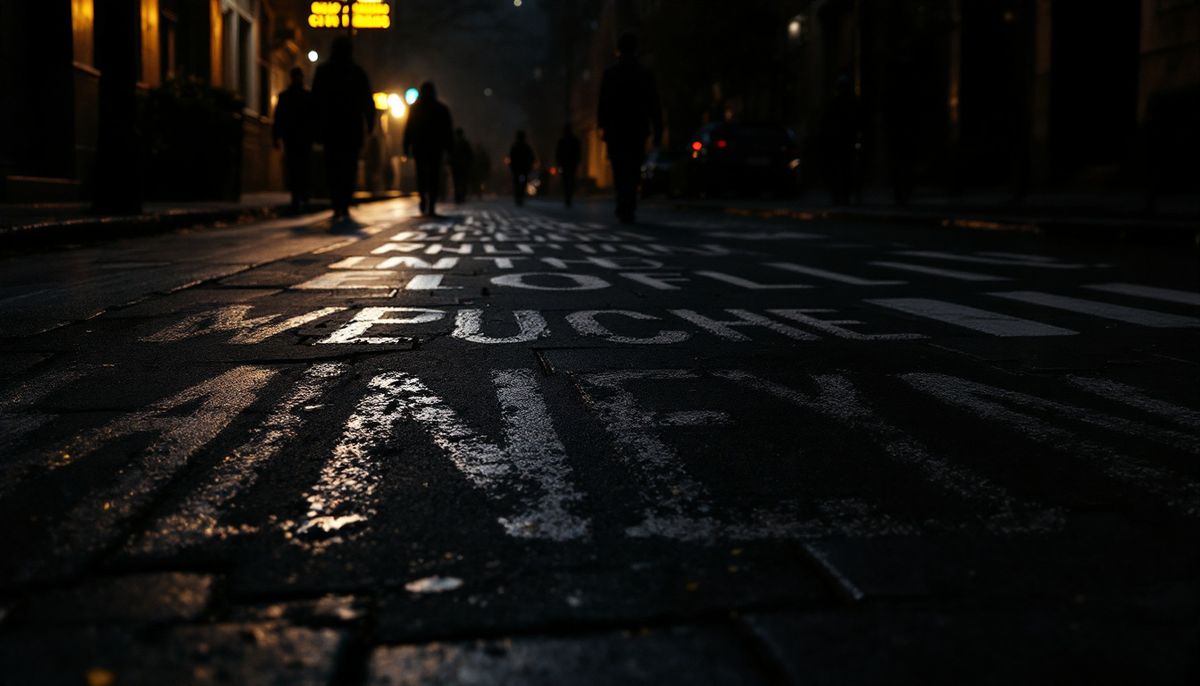
I want you to do something the next time you’re standing at a crosswalk in a big American city. Look down. Not at your phone — at the asphalt itself. Because in more than two dozen cities across the United States, and a handful in South America, the pavement has been carrying a message for over forty years. Hundreds of copies of it. Pressed flat into the road like a fossil, in hand-cut linoleum letters, usually right where your feet land when you step off the curb.
The message is almost always the same, give or take a line: “TOYNBEE IDEA / IN MOVIE ‘2001’ / RESURRECT DEAD / ON PLANET JUPITER.” That’s it. That’s the whole transmission. It appears to mash together the historian Arnold Toynbee and Stanley Kubrick’s 2001: A Space Odyssey into a single proposition — that humanity’s dead can be physically brought back to life, and that the place to do it is Jupiter. Nobody signs it. Nobody claims it. It just keeps showing up: Philadelphia, New York, Washington, Baltimore, Boston, Kansas City, St. Louis — and then, impossibly, Buenos Aires, Rio de Janeiro, Santiago. Whoever made these crossed borders to do it.
Now, here’s the part that gets me: the craft. These aren’t stickers. Each tile is cut by hand from layers of linoleum and asphalt crack-filler, wrapped in tar paper, and laid down on the road surface — where the weight of passing traffic slowly bakes it into the asphalt until it’s part of the street itself. The tar paper wears away and the message is simply there, fused into public infrastructure, sometimes for decades. It’s a delivery mechanism designed so the city itself would do the installing. Whoever invented it solved a real engineering problem — how does one person permanently mark hundreds of intersections without ever being seen? — and then used that breakthrough to tell us about Jupiter.
And some tiles say more. A few carry long, furious side-rants — paranoid manifestos etched in tiny linoleum letters, accusing the news media, particularly the Knight Ridder newspaper chain, and the Soviet Union of conspiring to suppress the resurrection idea. One famous tile instructs the reader to “lay tile alone,” a set of operating instructions from the tiler to, apparently, future tilers. This is where the mystery stops being cute. This was not a hoax or an art-school prank. Read enough of the side text and you realize you’re looking at one person’s absolute conviction, maintained across decades and thousands of miles, that they’d discovered the most important idea in human history and that powerful forces were smothering it.
So who was it? There are threads — tantalizing ones. In 1983, a Philadelphia man identifying himself as James Morasco phoned newspapers pitching this exact theory: colonize Jupiter with Earth’s resurrected dead. A David Mamet play from the same era, 4 A.M., features a late-night radio caller with an eerily similar idea — and people have argued ever since about which came first, the play or the tiler. But when researchers finally tracked down the real James Morasco of Philadelphia, he turned out to be an elderly carpenter whose family said he’d never heard of any of it — and he died in 2003, while new tiles kept right on appearing. The name, it seems, was a mask.
The deepest dig anyone has done — a years-long investigation chronicled in the 2011 documentary Resurrect Dead — landed on a reclusive Philadelphia man named Severino Verna. The circumstantial case is genuinely compelling: right neighborhood, right obsessions, a history of broadcasting on shortwave radio, and — my favorite detail in the entire saga — a car with a hole cut in the floor, which would let a driver drop and position a tile through the floorboard while appearing to be just another vehicle idling at a red light. It fits. It fits beautifully. But Verna never confirmed a word of it, no one ever caught the tiler in the act, and a theory that fits is not the same thing as an answer. Some of the later tiles differ enough in style that researchers believe copycats joined in — meaning even if you solved the original, you’d only have solved some of the streets.
And that’s where this one has to end, because that’s where it actually stands. Somewhere out there is — or was — a person who devoted forty years to hand-cutting a message about resurrecting the dead on Jupiter and fusing it into the roads of two continents, and we cannot tell you with certainty who they were, why Toynbee, why Kubrick, why Jupiter, or whether the whole campaign was desperate sincerity or something stranger. The tiles are still down there right now, being driven over by people who will never once look at their feet. The message got delivered hundreds of times. What it means — and who sent it — is still stuck in the asphalt.
Unsolved Mystery
