
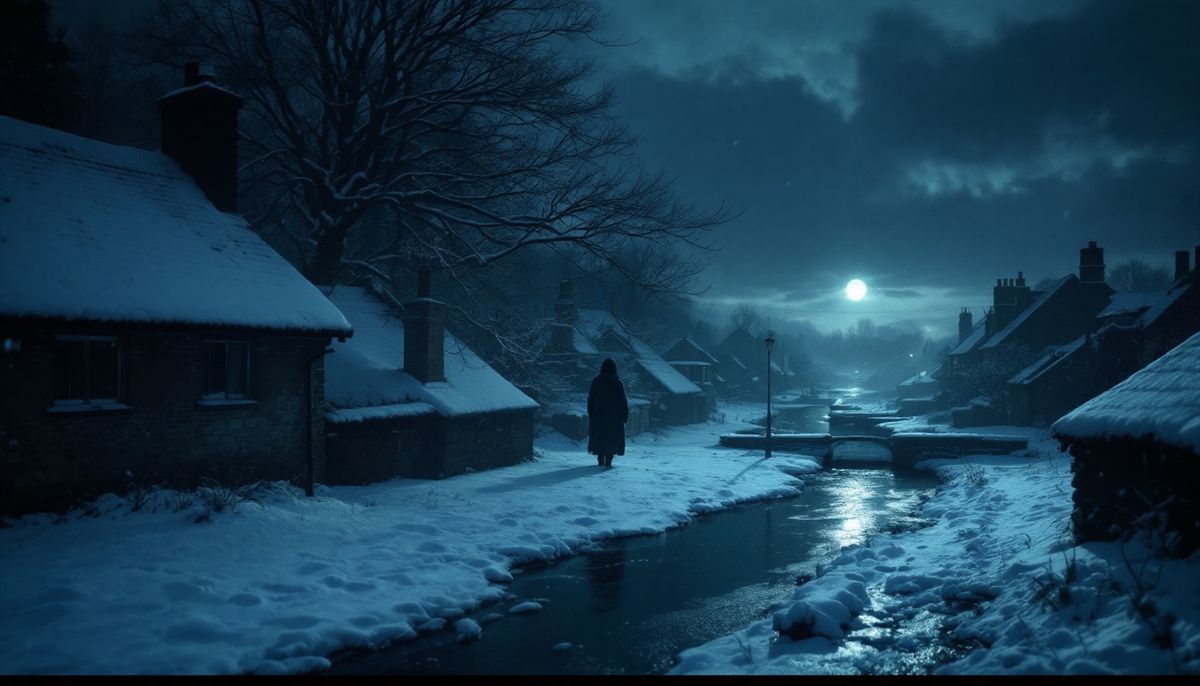
Let me set the scene for you, because the setting is half the mystery. It’s the night of February 8th, 1855, in the county of Devon, in the south of England. A hard snow falls in the evening and then stops — leaving the whole countryside under a fresh, unbroken white sheet. A perfect recording surface. Whatever moves through Devon that night is going to leave a signature. And something did.
When the villagers woke on the morning of the 9th, they found tracks in the snow. Not paw prints. Not boot prints. Hoofprints — small ones, about four inches long, shaped like a donkey’s shoe, some of them apparently cloven. And here’s the detail that made grown men reach for their shotguns: the prints ran in a single file line. Not left-right-left like any four-legged animal on earth, but one print directly in front of the next, eight inches apart, like something walking upright on two hooved feet. The trail didn’t wander the way an animal wanders, either. It ran straight — through villages, across gardens, over fields — as if whatever made it had somewhere to be.
Now, one strange trail is a curiosity. What turned this into a national sensation was the scale. Reports of the same prints came in from more than thirty parishes — Exmouth, Topsham, Dawlish, Teignmouth, Totnes — a zigzag route that later writers stretched to anywhere from forty to a hundred miles. (I’ll be honest with you up front: that hundred-mile figure is legend’s territory. Nobody walked the whole route with a measuring tape. But the thirty-odd separate sightings, in a single night, are documented.) And the trail did things no animal should do. Witnesses swore the prints marched up to a fourteen-foot wall and continued on the other side without a gap. That they crossed rooftops and haystacks. That they entered a six-inch drain pipe and came out the far end. That they stopped at the edge of the Exe estuary — a stretch of water two miles wide — and picked up again on the opposite bank, as if the thing had simply walked across.
The reaction was exactly what you’d expect from rural England in 1855. Tradesmen in Dawlish formed an armed posse and followed the tracks with pitchforks and bludgeons until the trail ran into dense woods and the dogs — this detail is in the contemporary accounts — refused to go in, backing out howling. Clergymen preached that the Devil himself had walked through Devon, drawn by the sins of the parish. Some people wouldn’t leave their homes after dark for weeks. The story made The Times of London on February 16th, and the Illustrated London News ran correspondence about it for a month, including sketches of the prints sent in by a vicar named H.T. Ellacombe, who had traced them himself and pronounced himself utterly baffled.
So what actually walked through Devon that night? The theories started immediately, and I’ll give you the honest tour. Badgers, whose overlapping paw prints can resemble hooves. Wood mice, whose hopping gait leaves a mark eerily like a cloven print — but a mouse doesn’t clear a fourteen-foot wall. An escaped kangaroo, seriously proposed at the time because a private menagerie nearby was rumored to be missing two — though nobody ever explained why a kangaroo would leave hoofprints, or why it was never found. Swans and gulls with ice-crusted feet. And my personal favorite for sheer ingenuity: an experimental balloon that slipped its mooring at the Devonport dockyard, trailing a shackle at the end of a rope that went tap… tap… tap… across the countryside — over walls, over rooftops, across the river — exactly the places no animal could go.
And then there’s the explanation most modern investigators favor, which is quieter and, if you ask me, stranger in its own way: that there was no single trail at all. That a freak snowfall preserved thousands of ordinary tracks — dogs, donkeys, birds, rabbits — which then thawed slightly and refroze, distorting into uncanny hoof shapes. And that frightened people across thirty parishes, comparing notes through newspapers and pulpits, stitched all those separate tracks into one continuous journey that never actually happened. In other words: the thing that walked a hundred miles through Devon that night may have been the story itself.
But here’s why I can’t quite close the book, and why nobody else has either. The distortion theory explains hoof-shaped prints. It does not explain why so many separate witnesses — farmers, tradesmen, a tracing-in-hand vicar — independently described the same four-inch print, the same eight-inch stride, the same impossible single-file line. No one ever produced the kangaroo, the balloon, or a confession. And whatever it was, it happened exactly once. One night, one snowfall, one trail — and then Devon’s snow fell clean and ordinary every winter after, for the next hundred and seventy years. The prints melted within days. All we have left is what the witnesses swore they saw: the marks of two hooved feet, walking upright, in a dead straight line, toward somewhere we’ll never know.
Unsolved Mystery
