
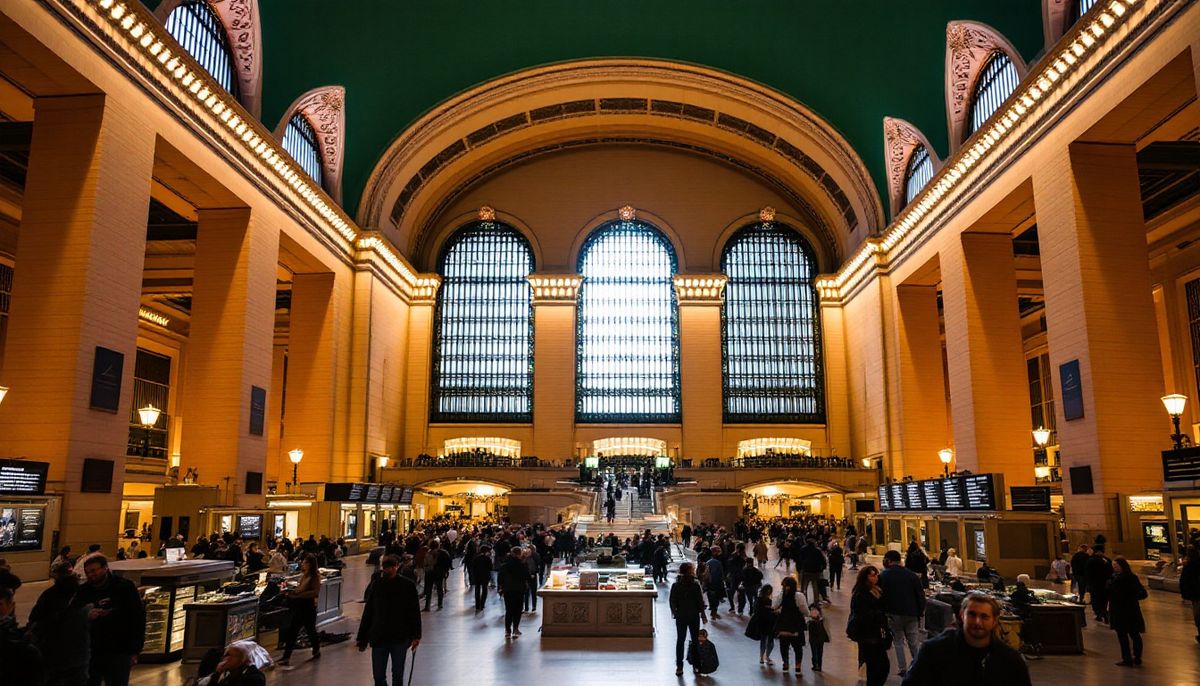
Confession: I always thought of Grand Central as the place you sprint through while dodging tourists taking photos of the ceiling. Then I actually looked into that ceiling — and discovered it’s painted backwards. On purpose. Allegedly. That was just the beginning: there’s a basement so secret that guards had shoot-on-sight orders, a train platform hidden under a luxury hotel, and the fact that every single departure time on the board is a small, deliberate lie. This place has 44 platforms — more than any station on Earth — and roughly a century of secrets stacked on top of them. Here are ten Grand Central facts that’ll make you miss your train on purpose.
1. The famous ceiling is painted backwards — and the Vanderbilts’ excuse was legendary.
Look up at the great zodiac mural in the Main Concourse and you’re seeing the constellations reversed, flipped east-to-west from how they actually appear in the sky. When an astute commuter pointed this out shortly after the terminal opened in 1913, the embarrassed powers-that-be didn’t admit a mistake. Instead, the story became that the ceiling shows the heavens from God’s point of view — looking down on the stars from above, rather than up from Earth. That is a five-star, hall-of-fame excuse. “It’s not wrong, it’s divine perspective” deserves a spot in every performance review.
2. That small dark rectangle on the ceiling? It’s 70 years of cigarette smoke, left there on purpose.
When the ceiling was restored in the 1990s, crews scrubbed away decades of grime and revealed the brilliant turquoise underneath. But near the crab of the Cancer constellation, they deliberately left one small dark patch untouched. Why? So future generations could see what they were dealing with: the gunk was analyzed and found to be mostly tar and nicotine from millions upon millions of cigarettes smoked in the concourse over the decades. It’s a tiny monument to the era when everyone smoked indoors — and possibly history’s most effective anti-smoking ad.
3. Every departure time on the board is a lie — by exactly one minute.
Here’s the terminal’s most charming secret: the trains actually leave one minute later than the posted schedule. If the board says 5:42, the doors close at 5:43. Metro-North built in the buffer to give sprinting commuters one final, merciful minute to make their train without diving through closing doors. It’s a small institutional kindness baked right into the timetable. Somewhere there’s a person who has made their train every day for twenty years and never known why.
4. There’s a secret platform under the Waldorf Astoria — and FDR used it to hide his wheelchair.
Track 61 sits beneath the Waldorf Astoria hotel, off-limits and off the map. Its most famous user was President Franklin D. Roosevelt, whose private rail car could roll in beneath the hotel, allowing him to take a freight elevator up — largely concealing from the public just how much polio had limited his mobility. An old armored rail car still sits down there in the dark. New York’s fanciest hotel has a basement with a presidential ghost story, and most guests have no idea.
5. The basement was so secret in WWII that guards reportedly had shoot-on-sight orders.
Deep below the terminal — deeper than any other basement in the city, roughly ten stories down — sits M42, a sub-basement housing the rotary converters that powered the trains. During World War II, moving troops and materiel depended on those machines, and they had a comical weakness: a single bucket of sand tossed into them could grind them to a halt. Nazi saboteurs sent to the U.S. in 1942 had targets like it in mind, which is why the room didn’t appear on any blueprint and unauthorized visitors risked being shot. Today it’s a VIP tour stop. Bring no sand.
6. The clock on the information booth is worth an estimated $10-20 million — and the booth hides a secret staircase.
That four-faced clock atop the Main Concourse information booth is the terminal’s most famous meeting spot (“meet me at the clock”). Each of its four faces is made of opal, and estimates have pegged its value at $10 million to $20 million. As a bonus, inside the marble information booth itself is a hidden spiral staircase connecting it to the booth on the lower level — so the attendants can travel between floors without ever fighting the crowd. The staff has a secret passage and a priceless timepiece. The rest of us have a Casio and the 4 train.
7. There’s a spot where you can whisper into a corner and be heard 30 feet away.
Outside the famous Oyster Bar on the lower level, four tiled archways form the Whispering Gallery. Stand facing one corner, whisper into the tile, and a friend at the diagonal corner across the way will hear you perfectly — the sound rides the curve of the Guastavino tile ceiling. It’s been the site of countless marriage proposals, presumably because “I whispered it into a wall and she heard it anyway” is a great story. Just remember the acoustics work for everyone. The wall keeps no secrets.
8. There’s a hole in the ceiling from the time they parked a rocket in the concourse.
In 1957, months after Sputnik rattled America, a Redstone missile was put on display right in the Main Concourse — a 63-foot rocket standing among the commuters. To secure it, workers cut a hole in the famous ceiling for a stabilizing cable. When the rocket left, the hole stayed, and it’s still visible today near the Pisces constellation. Officials kept it as a little scar of history. The ceiling now features the heavens, God’s perspective, 70 years of cigarettes, and one hole from the Space Race. Busy canvas.
9. Jackie Kennedy Onassis helped save it — all the way to the Supreme Court.
By the 1970s, Grand Central’s owners wanted to crown it with a massive office tower, as had already happened to the old Penn Station — demolished in 1963 to widespread heartbreak. Jacqueline Kennedy Onassis threw her fame behind the preservation fight, writing, “is it not cruel to let our city die by degrees?” The battle went to the U.S. Supreme Court, which ruled in 1978 in Penn Central v. New York City that the landmark law stood — a decision that still protects historic buildings nationwide. Every commuter under that turquoise ceiling owes Jackie a nod.
10. There’s a full tennis court hidden upstairs — in a room that used to be a CBS television studio.
High above the Main Concourse, the terminal’s upper floors once housed CBS studios, where Edward R. Murrow broadcast in the 1950s. Later the space found a stranger second act: it became a private tennis facility, and today the Vanderbilt Tennis Club still operates a court on the fourth floor. That’s right — while you’re sprinting for the 5:42 (really the 5:43), someone directly overhead is working on their backhand. Grand Central contains multitudes. Mostly, apparently, forehands.
Which one made you say “no way”? Send this to the friend who’s always sprinting for the train — they’ve got an extra minute and they don’t even know it…
