
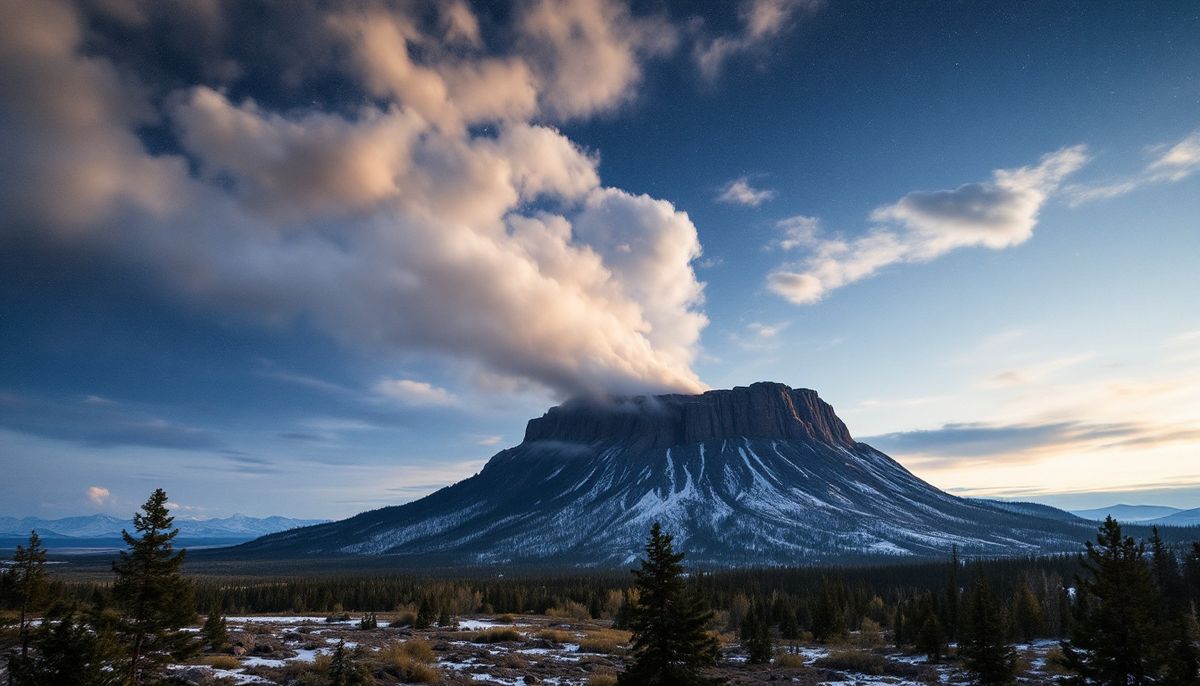
I used to think NORAD was just the thing that tracks Santa every December. Then I learned that the Santa tracking started because of a wrong number in 1955 — a kid dialed a department store’s Santa hotline and got a colonel at a top-secret air defense command instead. And that’s somehow not even the wildest thing about this place. There’s a literal city buried under 2,000 feet of granite in Colorado, sitting on more than a thousand giant springs, behind doors that weigh as much as a loaded semi truck. Here are ten facts about America’s doomsday mountain that’ll make you the most interesting person at your next barbecue.
1. There’s an entire city buried under 2,000 feet of solid granite.
Cheyenne Mountain Complex isn’t a bunker — it’s a campus. Fifteen buildings, most of them three stories tall, sit inside a hollowed-out mountain near Colorado Springs, protected by up to 2,000 feet of solid granite overhead. The complex has its own power plants, water supply, medical facility, cafeteria, and fitness center, and it can seal itself off and sustain hundreds of people for weeks without any help from the outside world. It’s been called “America’s Fortress.” Your HOA could never.
2. The blast doors weigh 25 tons each — and they’ve only been slammed shut for real once.
Two massive blast doors guard the complex, each roughly three and a half feet thick and weighing about 25 tons — yet they’re so precisely engineered they can swing closed and seal in under a minute. Built at the height of the Cold War, the complex went through decades of drills without ever “buttoning up” over an actual threat. Then came the morning of September 11, 2001, when the doors closed for real. Decades of practice, one genuine use. That’s either a great safety record or the world’s most expensive door.
3. The whole thing sits on more than 1,300 giant springs.
The buildings inside the mountain don’t actually touch the rock. They’re mounted on a network of more than 1,300 massive steel springs — each one weighing around 1,000 pounds — so that if a nuclear blast or earthquake shakes the mountain, the buildings can flex and sway instead of cracking. The structures also avoid touching the cavern walls, with flexible connections on the pipes and cables. In other words, the most fortified facility in America is technically a bounce house.
4. The main tunnel is designed to let a nuclear blast pass straight through.
Here’s the genius part: the tunnel through the mountain doesn’t dead-end at the blast doors. It runs through to an opening on the other side, and the doors are set off to the side of the main passage. If a nuke ever detonated at the entrance, the blast wave would blow straight through the tunnel and out the far end — like wind through a hallway — instead of hammering the doors head-on. The deadliest force humans ever created, defeated by clever hallway design.
5. The Santa Tracker exists because a kid called the secret military hotline.
In December 1955, a Sears ad in Colorado Springs invited children to phone Santa directly. But a call came in on the operations hotline at CONAD — NORAD’s predecessor — reaching Colonel Harry Shoup instead. (Accounts differ on whether the ad misprinted the number or a child misdialed, but the call was very real.) Rather than hang up on a kid, Shoup played along, and his crew began giving “Santa position reports.” Seventy years later, NORAD Tracks Santa is a beloved annual operation handling millions of calls and website visits. One colonel’s good mood became a global tradition.
6. It was built to survive a multi-megaton nuclear near-miss.
The complex was engineered during the Cold War to ride out a nuclear strike — commonly cited as capable of withstanding a 30-megaton blast landing as close as a couple of kilometers away. That’s a warhead roughly 2,000 times more powerful than the Hiroshima bomb, detonating practically next door. The mountain is also shielded against electromagnetic pulse, the blast that fries electronics. It was, quite literally, designed to be the last place in America still answering the phone.
7. There are lakes inside the mountain — and workers cross one by boat.
Deep inside the complex sit excavated reservoirs holding millions of gallons of water for drinking, cooling, and firefighting, plus a separate reserve of diesel fuel for the generators. The largest water reservoir is big enough that maintenance crews famously cross it in a small boat. Yes, there are people whose job description includes rowing across an underground lake inside a nuclear-proof mountain. And you thought your commute was interesting.
8. It’s run by two countries — the only command of its kind.
NORAD isn’t just American. It’s the North American Aerospace Defense Command, a binational operation the United States and Canada have run together since 1958 — the only such two-nation command in the world. Canadian officers stand watch alongside Americans, and by agreement the deputy commander is always a Canadian. So when Hollywood shows a lone American general commanding the mountain, know that in reality, there’s a Canadian nearby, politely keeping an eye on things.
9. Crews blasted out nearly 700,000 tons of granite to build it.
Construction began in 1961, and excavation crews spent years drilling and blasting roughly 693,000 tons of granite out of the mountain’s heart before the complex became fully operational in 1966-67. All that digging happened at the height of Cold War urgency, with the Cuban Missile Crisis unfolding mid-project. They essentially hollowed out a mountain with explosives, on a deadline, while the world flirted with Armageddon. And your contractor can’t finish a bathroom in six months.
10. Hollywood loves it — but these days it’s the backup, not the headquarters.
Cheyenne Mountain has starred in everything from WarGames to Stargate SG-1, which set its fictional alien-portal command right inside the mountain. The reality took a twist in 2006, when NORAD’s day-to-day operations moved down the road to Peterson Air Force Base, leaving the mountain as a fully maintained alternate command center — kept on what officials call “warm standby,” ready to take over at a moment’s notice. The world’s most famous doomsday bunker is now essentially the world’s most secure spare office. Still beats your building’s “emergency stairwell.”
Which one made you say “no way”? Send this to the friend who still calls the Santa Tracker every year — they’ve been phoning a military command post this whole time…
