
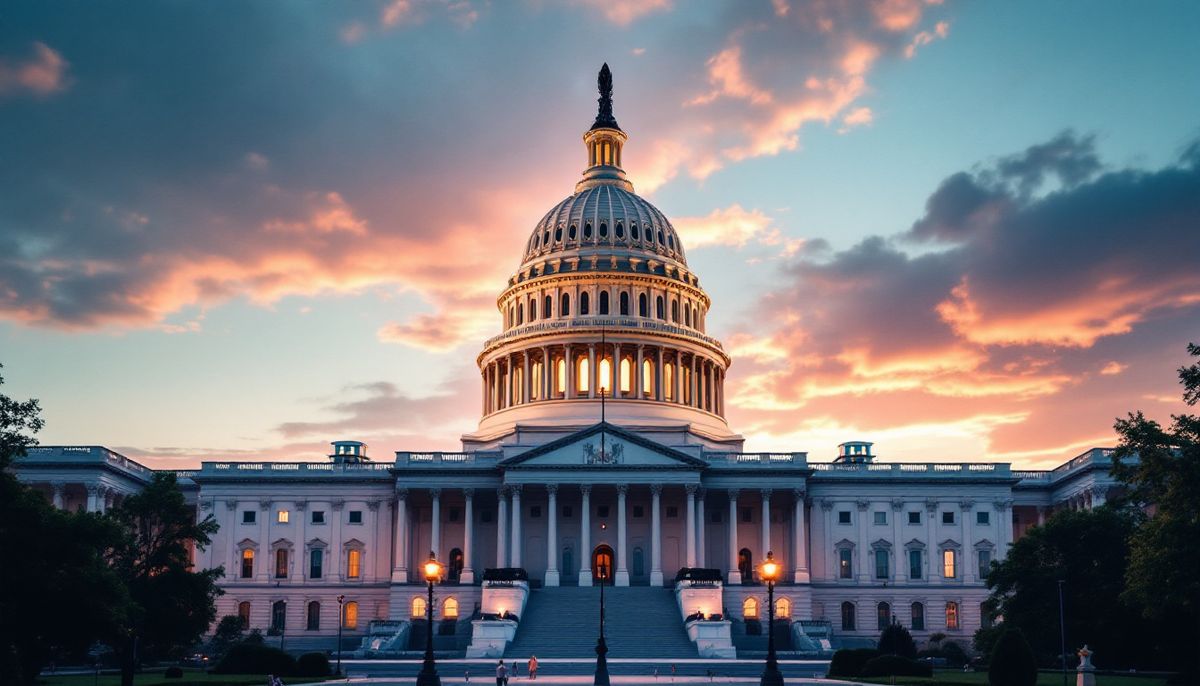
I thought I knew the Capitol: big white dome, lots of arguing inside, appears behind every news anchor in Washington. Then I started digging and found out the “stone” dome is actually nine million pounds of painted cast iron that swells in the summer heat. There’s an empty tomb in the basement built for a president who refused to be buried there. And yes, there are bathtubs down there too — real marble ones, and the reason they exist says everything about 1850s Washington. Here are ten Capitol facts that’ll make you the most interesting person at your next barbecue.
1. The dome is a nine-million-pound iron imposter — and it grows on hot days.
That majestic white dome isn’t marble or stone. It’s cast iron — nearly nine million pounds of it — painted to match the stone building below. Fireproof, cheaper, and lighter than masonry, it was the high-tech choice of the 1850s. And because it’s metal, it behaves like metal: on hot summer days the dome expands, and the whole structure can grow by several inches before shrinking back at night. The most famous “stone” dome in America is basically a giant radiator doing daily breathing exercises.
2. There’s a tomb under the Rotunda built for George Washington. It’s empty.
When the Capitol was designed, Congress planned to make it Washington’s final resting place — a crypt beneath the Rotunda with a tomb two stories below, so visitors could pay their respects at the heart of the nation. One problem: Washington’s will said Mount Vernon, and his family honored it. Congress asked. The family said no. So the Capitol has spent two centuries with a presidential tomb and no president in it. It’s the most prestigious vacancy in America.
3. Statuary Hall has a spot where you can hear a whisper from across the room.
The old House chamber — now National Statuary Hall — has a curved, domed ceiling that plays tricks with sound. Stand on the right spot and you can clearly hear a whisper from clear across the hall while people in between hear nothing. Legend says John Quincy Adams, who served in the House after his presidency, parked his desk at an acoustic sweet spot to eavesdrop on the opposition. Historians debate that one, but tour guides demonstrate the whisper trick to astonished visitors every single day. The building leaks secrets by design.
4. Congress has its own private subway — and it’s been running since 1909.
Beneath the Capitol runs a miniature subway system connecting the building to the House and Senate office buildings. It started in 1909 with battery-powered vehicles, and today’s little trains still shuttle lawmakers to the floor for votes so they never have to brave the weather — or the public. Some cars are open-air, like an amusement park ride with dress shoes. It may be the only subway in America where the passengers complain about everything except the subway.
5. Look up in the Rotunda and you’ll see George Washington… as a god.
Painted on the canopy 180 feet above the Rotunda floor is “The Apotheosis of Washington” — a fresco of the first president literally ascending into heaven, robed in purple, flanked by goddesses. “Apotheosis” means becoming a god. Artist Constantino Brumidi painted it in 1865, working flat against the curved ceiling, and made the figures up to 15 feet tall so they’d look life-sized from the floor. The man who refused to be a king has spent 160 years on that ceiling being worshipped anyway.
6. The British burned it in 1814 — and a freak storm helped save the city.
On August 24, 1814, British troops marched into Washington and torched the Capitol, piling up furniture to feed the flames. The congressional library inside went up with it. Then, barely a day into the occupation, a monster storm — complete with a tornado — slammed the city, tearing at the invaders and helping douse the fires. The British withdrew shortly after. The Capitol was rebuilt bigger and grander, but you can still find scorch-marked stones in the building. Washington’s weather has been fighting for the home team ever since.
7. There are marble bathtubs in the basement — because senators needed a bath.
In the 1850s, most congressmen lived in boarding houses without running water. So the Senate installed spa-quality marble bathtubs, carved in Italy, in the Capitol basement, where members could soak before debating the great issues of the day. Some of the tubs survive down there still. Say what you will about modern politics — at least today’s scandals no longer include the phrase “the senator is in his bathtub.”
8. The same wooden platform has held America’s honored dead since Lincoln.
When Abraham Lincoln was assassinated in 1865, carpenters hastily built a simple pine catafalque — a platform to hold his casket in the Rotunda. That same cloth-draped platform has been used ever since, bearing presidents, generals, justices, and heroes as they lie in state. Between services, it waits quietly on display at the Capitol Visitor Center — for years it was stored in Washington’s empty tomb. A rush carpentry job from 1865 became one of the most sacred objects in American civic life.
9. The statue on top was cast with the help of an enslaved man — who freed himself with the skill.
Crowning the dome is the 19.5-foot bronze Statue of Freedom. When the time came to cast it, the foundry hit a crisis: the Italian sculptor who knew how to disassemble the plaster model demanded a raise and walked. The man who solved it was Philip Reid, an enslaved craftsman at the foundry, who devised a way to separate the model into sections using a pulley. By the time Freedom was hoisted atop the dome in 1863, Reid was a free man — emancipation had reached Washington. Freedom’s final assembly, in every sense, was his work.
10. George Washington laid the cornerstone in 1793 — and nobody can find it.
On September 18, 1793, Washington himself, in full Masonic regalia, laid the Capitol’s cornerstone with a silver trowel. Then the building grew, and grew, and burned, and was rebuilt, and grew some more — and somewhere along the way, everyone lost track of exactly where that stone is. Searches, including with metal detectors hunting the silver plate laid with it, have come up empty. The most documented building in America is still sitting on a mystery. Somewhere under Congress is the one stone that started it all, keeping its location classified.
Which one made you say “no way”? Send this to the friend who’s been to D.C. a dozen times — or the one who still thinks the dome is made of stone…
