
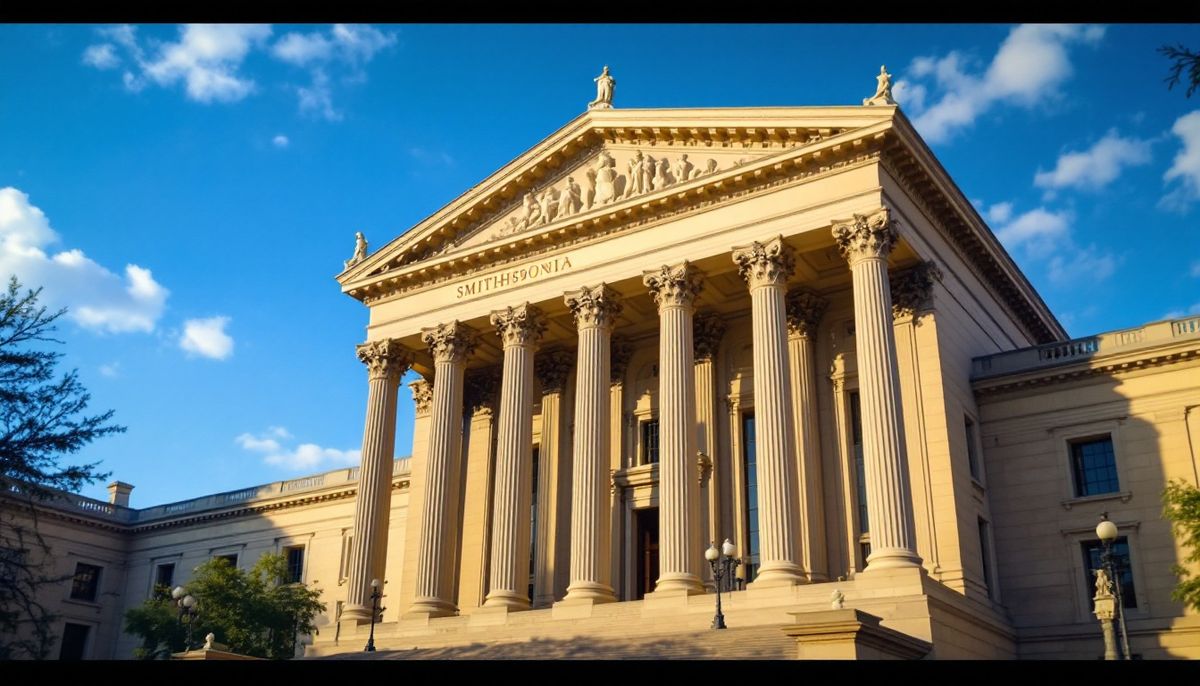
You’ve heard it called “the nation’s attic,” and you probably picture the Hope Diamond and a few dinosaur bones. But the real story is stranger than that. The whole thing was funded by a British scientist who never once set foot in America — and only saw it as a place to spite the country he came from. There are roughly 157 million objects in the collection, and you’ll never see most of them. Oh, and the original Kermit the Frog lives there. Let’s open the attic. Number 9 will reframe what “the world’s largest museum” actually means.
1. It was funded by a British scientist who never set foot in America.
James Smithson was a wealthy English chemist and mineralogist who died in 1829 having never once visited the United States. Yet his will left his entire fortune to found “in Washington, under the name of the Smithsonian Institution, an establishment for the increase and diffusion of knowledge among men.” Nobody is entirely sure why he picked a country he’d never seen — historians suspect it was partly bitterness over being born out of wedlock and shut out of his noble English family. America got the world’s greatest museum complex out of one man’s grudge.
2. His entire fortune was shipped to America as 100,000+ gold coins.
When the bequest finally came through, it didn’t arrive as a tidy bank transfer. It came as 104,960 gold sovereigns, packed into 11 boxes and sailed across the Atlantic aboard a ship called the Mediator in 1838. The U.S. Mint then melted the whole pile down to reconvert the gold. The Smithsonian still keeps two of those original 1838 sovereigns in its collection today — the lone survivors of the treasure chest that started it all.
3. It’s the largest museum, education, and research complex on Earth.
This isn’t marketing fluff — the Smithsonian is genuinely the biggest museum and research complex in the world, with no real rival. It’s not one building or even one campus. It’s a sprawling federation of museums, libraries, research centers, and labs, most clustered in Washington, D.C., but reaching as far as Panama. When people say “the Smithsonian,” they’re really talking about an empire of knowledge wearing a single name.
4. It’s actually about 21 museums plus the National Zoo.
Most people think “the Smithsonian” is a single museum. It’s not — it’s roughly 21 separate museums and galleries, plus the National Zoo, all under one umbrella. That includes the Air and Space Museum, the Natural History Museum, the American History Museum, and many more. The National Zoo, founded back in 1889, sits on 163 acres in Rock Creek Park and is home to more than 2,000 animals. One bequest, an entire constellation of institutions.
5. It holds about 157 million objects — and you’ll never see most of them.
The Smithsonian’s collections total nearly 157 million artifacts, artworks, and specimens — the largest holdings of any museum complex on the planet. Here’s the kicker: only a tiny fraction is ever on public display at any given time. The overwhelming majority lives in storage, archives, and research facilities. The galleries you walk through are just the visible tip of an almost unimaginable iceberg of stuff.
6. This is why it earned the nickname “the nation’s attic.”
Because the Smithsonian collects and stores such a staggering, sprawling, sometimes random assortment of American treasures, it picked up the affectionate nickname “the nation’s attic.” Like a real attic, it’s packed with everything from priceless national icons to oddball curiosities — all kept, cataloged, and tucked away just in case. It’s the place where America keeps the things it can’t bear to throw out.
7. The original Kermit the Frog lives there.
Among those 157 million objects? Jim Henson’s original Kermit the Frog. The puppet was donated to the National Museum of American History, and Henson’s family later added more than 20 puppets and props, including early versions of Miss Piggy, Oscar the Grouch, and other Muppet co-stars. So yes — the actual frog who taught generations “it’s not easy being green” sits in the same institution as the Star-Spangled Banner. America contains multitudes.
8. It houses the real Star-Spangled Banner and the actual Wright Flyer.
The Smithsonian isn’t holding replicas. It has the genuine Star-Spangled Banner — the very flag that flew over Fort McHenry in 1814 and inspired Francis Scott Key to write the national anthem. It also displays the original 1903 Wright Flyer, the actual machine the Wright brothers flew at Kitty Hawk for humanity’s first powered flight. At its unveiling, one observer said it was “a little as if we had before us the original wheel.”
9. The 45.5-carat Hope Diamond has been on display since 1958.
The legendary Hope Diamond — a deep blue, 45.5-carat stone shrouded in tales of curses and misfortune — has called the Smithsonian’s National Museum of Natural History home since 1958, when jeweler Harry Winston donated it. It’s one of the most visited museum objects in the world, drawing crowds who come to stare at a rock said to doom its owners. The Smithsonian, apparently, has survived the curse just fine.
10. Most of its museums are completely free — and the Castle started it all.
Here’s the part that surprises visitors most: the great majority of Smithsonian museums charge no admission whatsoever. You can walk in and see the Hope Diamond, the Wright Flyer, and the original Kermit without paying a dime. And it all traces back to the “Castle” — the original 1855 red sandstone building on the National Mall, designed by James Renwick Jr. Fittingly, James Smithson himself is now entombed inside it, the founder who never visited finally resting in the country he gave everything to.
So which one got you — the British grudge that built it, or the original Kermit hiding in the nation’s attic? Forward this to the friend who thinks they already know everything about D.C.
