
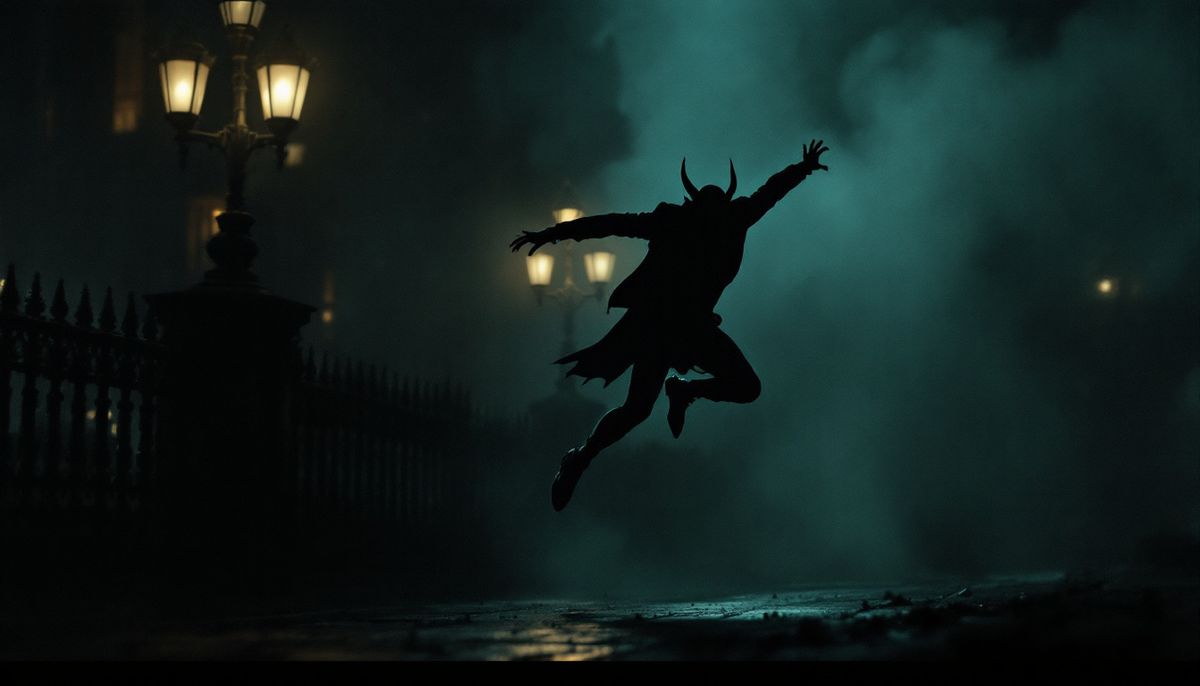
Let me take you back to a London you’d barely recognize. It’s the autumn of 1837, and the city is a maze of gaslit lanes, fog so thick you could lose your own hand in it, and long stretches of road between the streetlamps where the dark closes in completely. Queen Victoria has only just taken the throne. And out on Clapham Common, on a night like any other, a young woman named Mary Stevens is walking home when something steps out of the shadows. The way she would later tell it, a figure leapt at her, seized her in his arms, kissed her face, and began clawing at her clothes with hands she said were “cold and clammy as those of a corpse.” She screamed. Neighbors came running. And whatever it was bounded away into the night before anyone could lay a hand on it. That’s the first thread of one of the strangest stories the Victorian age ever produced—because for the next seventy years, people across England swore the thing kept coming back.
The reports multiplied fast. Through that autumn and into the winter, residents on the southern fringes of London described a creature ringing doorbells and tearing at whoever answered, a figure that could clear walls and rooftops in a single impossible bound. By January 1838, the newspapers had given him a name that stuck: Spring-Heeled Jack. Some called him “Steel-Sprung Jack,” and the very names tell you how confused people were about what they were dealing with—was this a man wearing some fiendish mechanical contraption on his boots, or something that wasn’t a man at all? The accounts piled detail upon detail. He had eyes that glowed like red coals. He could breathe blue and white flame. He wore a dark cloak, and beneath it, some said, a tight oilskin suit. His hands ended in metallic claws. And above everything else, he could leap—over hedges, over high garden walls, clean over the heads of the men who tried to catch him.
Here’s the part that lifts this above ordinary fireside spookery: a real official, in a real public record, took it seriously. In January 1838, the Lord Mayor of London read aloud at the Mansion House a letter from an anonymous resident complaining that some gang of well-to-do troublemakers had wagered they could terrorize the suburbs in monstrous disguises. The Lord Mayor admitted he’d received many such complaints, and once the story hit the papers, the floodgates opened. Letters poured in from across the city. The Times covered it. And then came the two cases that turned a rumor into a genuine panic.
On the evening of February 20, 1838, eighteen-year-old Jane Alsop answered a frantic knock at her father’s door in the village of Old Ford. A man stood there in the dark, urgent, claiming to be a policeman. “For God’s sake, bring me a light,” he cried, “for we have caught Spring-Heeled Jack in the lane!” Jane fetched a candle and handed it to him—and the moment she did, the story goes, he threw off his cloak, vomited a jet of blue-white flame into her face, and set upon her with clawed hands, tearing at her dress and her skin until her sister dragged her back inside and bolted the door. Jane was left with cuts on her neck and arms. Just over a week later, another young woman, Lucy Scales, reported being attacked in a similar fashion near her brother’s house, struck by a burst of flame to the face that left her in violent fits for hours. Two victims. Two formal accounts. A city already primed to believe.
So what on earth was happening? The most enduring explanation points not at a demon but at a man—and a very particular man at that. Suspicion fell, both in the rumors of the time and in print decades later, on Henry de la Poer Beresford, the 3rd Marquess of Waterford. He was young, rich, athletic, and notorious across England as the “Mad Marquess,” a aristocrat famous for cruel and elaborate pranks, for getting into drunken scrapes, for a documented streak of nastiness toward women, and—crucially—for a habit of donning disguises and vanishing before anyone could collar him. He was known to be in the London area during the early attacks. The theory practically writes itself: a bored, wealthy hooligan with the means to rig up a costume and the temperament to enjoy the terror, possibly on a bet, exactly as that letter to the Lord Mayor suggested. It’s the explanation a lot of historians find most plausible for that first wave of 1838.
But I have to be honest with you, the way an honest storyteller should be: the Waterford theory has a crack running right through it. The Marquess died in a riding accident in 1859—and Spring-Heeled Jack kept right on appearing for nearly half a century after that. In 1877, soldiers at the Aldershot army garrison reported a figure that bounded up to their sentry posts and slapped their faces before springing away into the dark. The following year, at Colchester, something similar happened—and there, a soldier finally drove his bayonet into the leg of one of these leaping phantoms, only to discover the “demon” was a flesh-and-blood subaltern officer playing a vicious joke. Sightings drifted up through the Midlands and into Scotland and Liverpool, where the last commonly cited report came in 1904. A dead aristocrat can’t be doing all of that. Which leaves us with the messier truth.
And the messier truth is probably this: Spring-Heeled Jack was never one thing. Skeptical investigators who’ve combed through the old records argue the legend was built and inflated by a perfect storm of Victorian forces. Start with one or two real assaults—maybe Waterford’s prank, maybe a copycat or two. Add a young, sensationalist press that discovered terrified readers buy more newspapers. Pour in the penny dreadfuls, those cheap serialized thrillers that turned Jack into a recurring fictional character, first a villain and later almost a caped hero, until nobody could tell where the news stopped and the story began. Stir in a population steeped in older folklore—tales of devils, imps, and roguish night-creatures stretching back centuries. Set it all in a fog-choked city lit by flickering gas, where every shadow could hide a monster and a leaping prankster in a cloak might genuinely look supernatural. That’s the recipe for a mass panic. Every dark figure, every doorbell prank, every drunk in a frightening getup became “Jack,” and each retelling made him taller, faster, and more demonic than the last.
So I’ll leave you where the records actually leave us, which is somewhere wonderfully unsettled. There almost certainly was something on Clapham Common in 1837, and something at Jane Alsop’s door in 1838—we have the complaints, the newspaper columns, the official who read them aloud at the Mansion House. But the creature who could leap over rooftops and breathe fire? He was assembled, year by year, out of a real prank or two, a hungry press, a flood of cheap fiction, and a city that wanted, in some shivering way, to believe. The honest answer is that Spring-Heeled Jack was part flesh, part folklore, and part the dark working of a crowd’s imagination—and after almost two hundred years, no one has ever pulled the cloak back far enough to show us the whole of what stood underneath.
Unsolved Mystery
