
June 30th
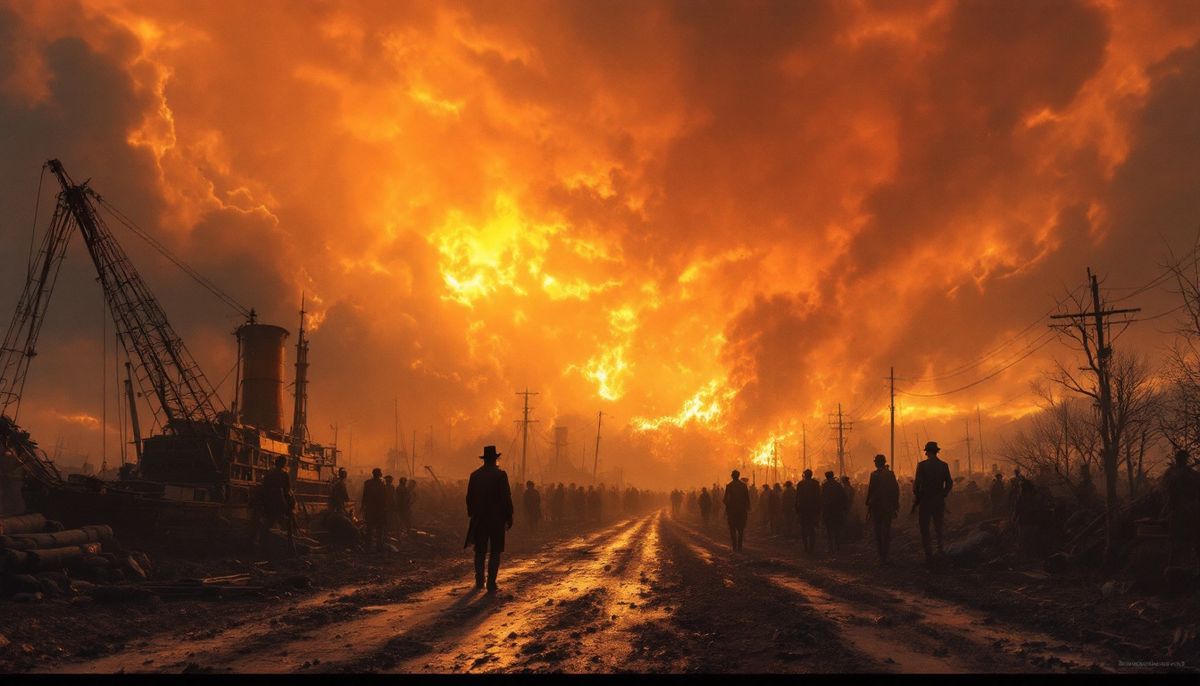
A little after seven o’clock on the morning of June 30, 1908, the few thousand people scattered across the vast Siberian wilderness near the Tunguska River looked up to see something no human being had ever recorded before: a column of blue-white light, brighter than the sun, streaking across the sky and growing until it seemed to split the heavens in two. Reindeer herders of the Evenki people would later say it looked as though the sky itself had been torn open and set ablaze.
Then came the explosion. High above the remote taiga forest, a chunk of rock from space — perhaps 150 to 200 feet across — detonated in midair with a force estimated at up to 15 megatons of TNT. That is roughly a thousand times the power of the bomb that would later level Hiroshima. There was no crater, because the object never touched the ground. It simply vanished in a single, apocalyptic burst of heat and pressure several miles up.
The shockwave that followed flattened an estimated 80 million trees across some 830 square miles, snapping mature pines like matchsticks and laying them all in the same outward direction, like spokes radiating from a wheel. A herder sitting on his porch dozens of miles away was hurled from his chair and knocked unconscious. Witnesses felt a wave of heat so intense they were sure their shirts were about to catch fire. The blast was registered on instruments as far away as Britain, and for nights afterward the skies over Europe and Asia glowed so brightly that people could read newspapers outdoors at midnight.
And then — almost unbelievably — the world mostly shrugged. The region was so impossibly remote, and Russia in 1908 so consumed by its own turmoil, that no scientific expedition reached the site for nearly twenty years. When researcher Leonid Kulik finally trekked into the devastation in the late 1920s, he found a haunting graveyard of scorched, fallen timber stretching to the horizon, with not a single impact crater to explain it.
To this day, the Tunguska event remains the largest impact explosion in recorded human history — a sobering reminder that the quiet sky above us is not always so quiet. Had that rock arrived just a few hours later, the spin of the Earth would have placed a major city beneath it instead of an empty forest. It is one of history’s great near-misses, and a humbling lesson in how much of our safety we owe to nothing more than luck and timing.
Also On This Day…
1859 — A Frenchman Strolls Across Niagara Falls on a Rope On June 30, 1859, a crowd of some 25,000 thrill-seekers gathered on both sides of the Niagara Gorge to watch a slender French acrobat named Jean-François Gravelet — known to the world as “The Great Blondin” — attempt the impossible. Stretched before him was a tightrope, just over three inches thick, running 1,100 feet across the chasm and suspended a dizzying 160 feet above the churning rapids. With nothing but a long balancing pole, Blondin set out. Halfway across he stopped, sat down, lay back as if relaxing on a sofa, then rose and performed a backflip before sauntering to the other side. The entire crossing took about five minutes — and on later trips he would do it blindfolded, on stilts, and even carrying his terrified manager on his back.
1934 — Hitler Turns His Knives on His Own On June 30, 1934, Adolf Hitler launched one of the most chilling power grabs of the twentieth century — a bloody purge of his own Nazi Party that history would call the Night of the Long Knives. Fearing the growing power of Ernst Röhm and his brown-shirted street army, the SA, Hitler ordered SS units to round up and execute Röhm along with scores of other men he viewed as rivals or threats. Over the following days, hundreds were killed, including a former German chancellor and one-time allies who had helped Hitler rise. The murders were dressed up as crushing a coup that never existed. With this single stroke of terror, Hitler erased his rivals, frightened the rest of Germany into silence, and tightened his grip into the absolute dictatorship that would soon drag the world into war.
1936 — A First-Time Novelist Publishes an American Phenomenon On June 30, 1936, a former Atlanta newspaper reporter named Margaret Mitchell saw her one and only novel arrive in bookstores. It was called Gone with the Wind, and almost overnight it became a national sensation. The sweeping Civil War-era epic sold a million copies in its first six months — an astonishing figure for the depths of the Great Depression — and went on to win the Pulitzer Prize. Three years later it was transformed into one of the most beloved and successful films ever made. Mitchell, who had quietly written the manuscript over a decade while recovering from an ankle injury, never published another novel. She didn’t need to. With a single book, she had created one of the most enduring works in all of American literature.
From a fireball that flattened a Siberian forest, to a daredevil dancing above Niagara, to a first-time author who conquered a nation with a single book — June 30th proves that history’s most unforgettable days arrive without warning. The sky can catch fire, and the world can change, all before breakfast.
