
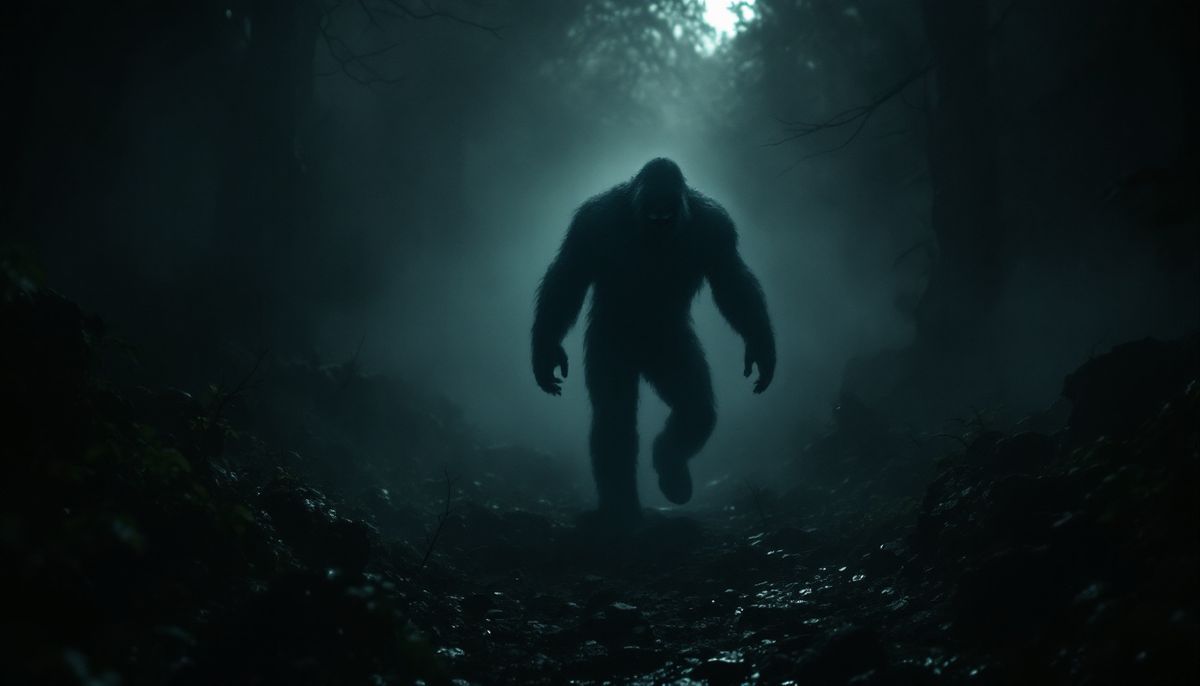
Let me put you on the bank of a creek in Northern California, because the where matters as much as the what. It’s the afternoon of October 20, 1967, in a remote drainage called Bluff Creek — a tributary of the Klamath, roughly 25 logging-road miles northwest of the little town of Orleans, deep in the Six Rivers National Forest. Two men are riding northeast on horseback, upstream, along a sandbar. One is Roger Patterson, a former rodeo rider chasing the Bigfoot legend with a rented 16mm camera. The other is Bob Gimlin, a quiet horseman who came along for the trip. And then, the story goes, the horses smell it before the men see it. They spook. And there — across the creek, walking away through the gravel and the fallen timber — is the thing that would launch sixty years of argument.
What Patterson got on film is almost laughably short. Strip away the bouncing footage shot from horseback and what remains is about 23 feet of film — under a minute of usable footage, 954 frames running at 16 frames a second, roughly 59 seconds of a tall, dark, hair-covered figure striding across the creek bed. The figure walks with a long, swinging gait, arms hanging low, and then comes the moment that burned itself into American folklore. Around the frame everyone calls “352” — picky researchers will tell you it’s actually closer to frame 354, but 352 is the name that stuck — the creature turns its head and upper body and looks back over its right shoulder, straight into the lens. That single look-back, captured by a man who wasn’t even supposed to find anything, became the most famous image in the entire history of the unexplained. People nicknamed the figure “Patty.” And the fight over what Patty actually is has never stopped.
Here’s what makes this case so different from your average blurry photo: it didn’t quietly fade. It got studied. For nearly sixty years, scientists, film specialists, anatomists, and even Hollywood costume designers have run this footage through every analysis they could think of — and they still can’t agree. That’s the part that keeps it alive. This isn’t a campfire rumor. It’s a piece of physical film that the smartest people in several fields have stared at for decades without reaching a verdict.
Take the case for it being real. The believers don’t lead with faith — they lead with anatomy. Anthropologist Jeff Meldrum, who has spent a career on this, points to the figure’s proportions: arms that hang longer relative to the body than a human’s, a walking pattern with a bent-knee “compliant” gait unlike the stiff-legged stride of a person, and a torso that rotates in a way he argues is hard to fake. Most striking to the believers is what appears to be muscle moving and flexing beneath the skin and hair as the figure walks — not the loose, sliding wrinkle of a costume, but mass shifting underneath the surface. The walk has been taken seriously enough that gait researchers connected to Stanford’s Motion and Gait Analysis Lab — people who literally wrote a definitive textbook on human walking — worked with Meldrum to try to replicate Patty’s stride, and found it genuinely difficult to reproduce. To this camp, the question is simple: how does a rodeo cowboy in 1967, working on a shoestring, build a suit good enough that experts a half-century later still can’t dismiss it?
Now the case against — and it’s a heavy one. In the summer of 1967, a costume designer named Philip Morris said he sold Roger Patterson a gorilla suit, and later explained exactly how he’d have hidden a zipper down the back by combing the fur over it. Then there’s Bob Heironimus, a Yakima, Washington man who came forward decades later — in the early 2000s — and flatly confessed: I was the one in the suit. By his account, Patterson and Gimlin promised him around a thousand dollars to wear the costume and walk across that creek bed, money he says he never received. Skeptics point out that the so-called “fur line” running down Patty’s back sits right where a costume’s zipper would be. Add it up and you have a tidy explanation: a man who wanted fame and money, a commercial gorilla suit, a hired walker, and a piece of film that made all three famous. For a lot of people, that’s case closed.
But — and this is why the thing refuses to die — the hoax story has its own loose threads. Bob Gimlin, the second man who was actually there that day, has spent the rest of his life insisting the figure was real and flatly denying that Heironimus had anything to do with the trip. Patterson’s widow said the same. And Patterson himself maintained the footage was genuine right up until he died of cancer in 1972, never recanting, never cashing in on a confession that would have made headlines. Even the famed primatologist Jane Goodall, asked about Bigfoot, declined to dismiss the possibility outright. So you’re left with dueling sworn accounts from people who were standing on that creek bank — one man saying it was a costume, another swearing on his life it wasn’t — and no zipper, no suit, no smoking gun ever produced that everyone agrees on.
I have to be the honest narrator here, because this is exactly the kind of story where legend wants to outrun the facts. What we can say for certain is small and specific: two men, one camera, fifty-nine seconds of film on a California creek in 1967, and a single backward glance that became iconic. Everything past that splits into two stubborn camps. The believers have anatomy and a gait nobody’s cleanly duplicated. The skeptics have a confession, a costume salesman, and plain common sense. The mainstream scientific world has mostly shrugged and filed it under “unproven.” And the one thing that would settle it forever — an actual suit, an actual creature, an actual undeniable proof — has never turned up in nearly sixty years of looking.
So I’ll leave you where the film itself leaves us: with Patty mid-stride, turning to look back over her shoulder, frozen in that frame. Real animal or man in a suit, that look has been staring back at us for almost six decades, and not one analysis — not the anatomists, not the costume experts, not the confessions — has been able to make her blink. Whatever crossed Bluff Creek that October afternoon, it’s still out there in those 954 frames, walking away from us, refusing to be solved.
Unsolved Mystery
