
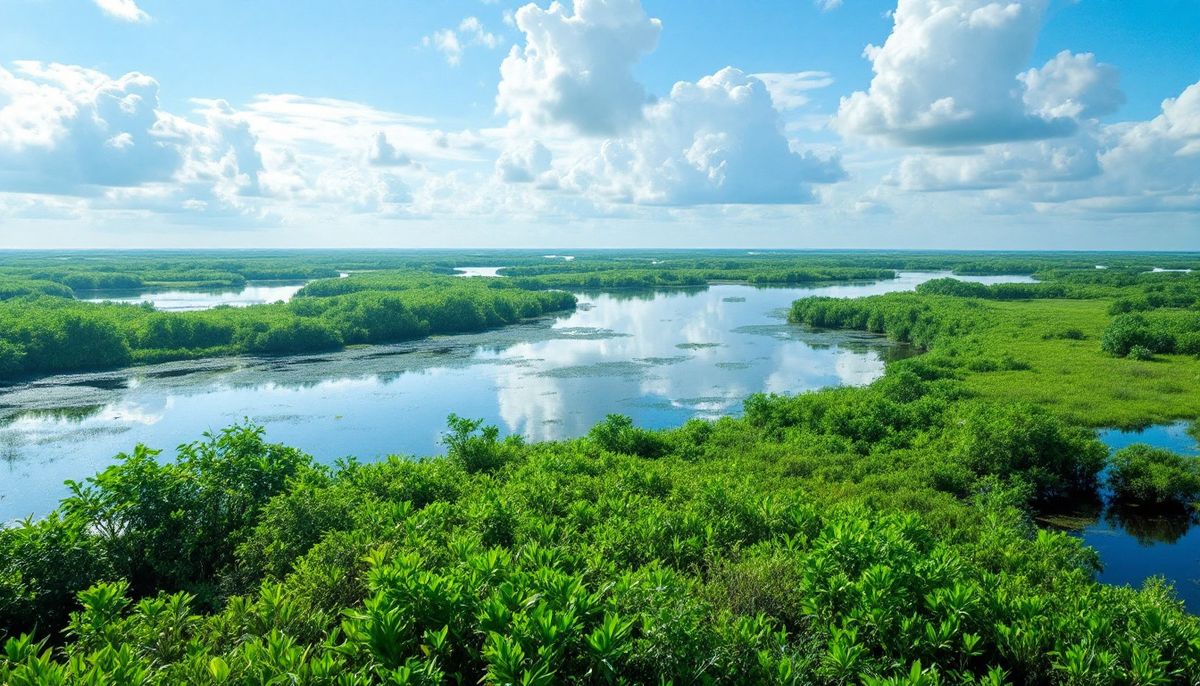
You probably picture the Everglades as a steamy, mosquito-clouded swamp full of gators. Half right. The truth is stranger: it’s actually a river — one so wide and shallow you could stand in the middle of it and barely get your ankles wet. It’s the only place on the planet where two different prehistoric reptiles share a backyard, it’s being slowly eaten by escaped pet snakes, and we very nearly drained the whole thing out of existence. Here are 10 things that’ll change how you see America’s “River of Grass.” Number 4 might make your skin crawl.
1. It’s not a swamp — it’s a river that moves about as fast as you read.
This is the big one almost nobody knows. The Everglades isn’t standing swamp water; it’s an enormous, painfully slow-moving river. Historically it spilled out of Lake Okeechobee and crept roughly 100 miles south to the Gulf — a sheet of water about 60 miles wide but only inches deep in many places. It flows so gently you can’t see it move with the naked eye. Picture a river wider than the drive across an entire state, flowing slower than a turtle’s stroll. That’s the Everglades.
2. The famous nickname “River of Grass” came from one woman’s 1947 book.
Writer and activist Marjory Stoneman Douglas gave the Everglades its identity. Until her book The Everglades: River of Grass came out in 1947, most people dismissed the place as a worthless swamp to be drained and built over. Douglas reframed it in three words that stuck forever — and spent the rest of her very long life (she lived to 108) fighting to protect it. Her book has sold over half a million copies and is still considered one of the most important conservation works ever written.
3. That “grass” isn’t actually grass.
The sawgrass that gives the River of Grass its name is a bit of a fraud — it’s not a grass at all, but a sedge. The giveaway is the stem: true grasses are round, while sedges like sawgrass are triangular. And it earns the “saw” honestly. Each blade is lined with tiny, razor-fine teeth sharp enough to slice your skin open if you run a hand along it. This stuff still blankets 65 to 70 percent of the remaining Everglades and can grow up to 10 feet tall. Beautiful from a distance. Do not hug it.
4. It’s the ONLY place on Earth where alligators and crocodiles live together in the wild.
Here’s a fact that sounds made up but isn’t. Alligators and crocodiles exist in different parts of the world and almost never overlap — except in South Florida. The Everglades sits at the very southern edge of the American alligator’s range and the very northern edge of the American crocodile’s range, and they meet right here. Gators rule the freshwater marshes and rivers; crocs prefer the salty coastal bays and mangroves. Nowhere else on the planet do these two ancient reptiles share the same wild neighborhood.
5. Escaped pet pythons are devouring the place.
One of the worst ecological disasters in modern America is unfolding in the Everglades, and it started in fish tanks and pet cages. Burmese pythons — native to Southeast Asia, released or escaped from the exotic-pet trade — have exploded across more than a thousand square miles of South Florida. These giant constrictors have wiped out staggering numbers of native mammals like raccoons, opossums, rabbits, and bobcats. They’re so big and so hungry they’ve even been documented eating deer and, yes, alligators. Florida now holds public python-hunting contests just to try to keep up.
6. It’s one of only a handful of places on Earth with THREE major international honors.
The Everglades isn’t just a national park — it’s globally recognized as an environmental treasure. It’s a UNESCO World Heritage Site (1979), an International Biosphere Reserve (1976), and a Wetland of International Importance under the Ramsar Convention (1987). Being on all three of those lists at once puts the Everglades in extraordinarily rare company — only a tiny number of places worldwide have earned that triple distinction. The world, in other words, considers this “swamp” irreplaceable.
7. It’s home to one of the rarest big cats in America.
The endangered Florida panther — a tawny, long-tailed cougar — makes its last stand in and around the Everglades. The population dipped so low that for years only an estimated handful survived in the wild, and habitat loss remains its greatest threat. Today conservationists track every cat they can. When a new tract of restored Everglades wetland recently came back online, panthers were spotted hunting and roaming it again — a small, hopeful sign for one of the most endangered mammals in the country.
8. Gentle giants glide through its waters too.
It’s not all teeth and claws. The Everglades and its surrounding waters are vital habitat for the manatee — the slow, blimp-shaped, plant-munching “sea cow” that’s beloved by basically everyone who’s ever seen one. These federally protected aquatic mammals drift through the warm coastal waters grazing on underwater plants. Restoring the Everglades’ natural water flow is considered key to keeping Florida’s imperiled manatees fed and healthy.
9. We nearly destroyed it on purpose.
For most of the 20th century, the official plan for the Everglades was to get rid of it. Engineers carved hundreds of miles of canals, levees, and pumps to drain the “useless” wetland for farms and housing. It worked too well — today the Everglades is roughly half its original size, and about half of its historic water flow has been diverted away. A place that once stretched across much of South Florida was hacked down to a fraction of itself, all in the name of progress.
10. It’s now the site of the biggest ecosystem rescue in American history.
Having nearly wrecked it, we’re now spending billions trying to bring it back. In 2000, Congress authorized the Comprehensive Everglades Restoration Plan — a decades-long effort projected to cost well over $16 billion to undo the damage and restore natural water flow. Crews have already ripped out crumbling roads, plugged old canals, and built giant pump stations to send water flowing the right way again. It’s one of the most ambitious environmental restoration projects ever attempted anywhere on Earth — a multi-generation bet that we can give the River of Grass its river back.
Which one got you — the snakes eating gators, or the fact that it’s a river the whole time? Forward this to the friend who still thinks the Everglades is “just a swamp.”
