
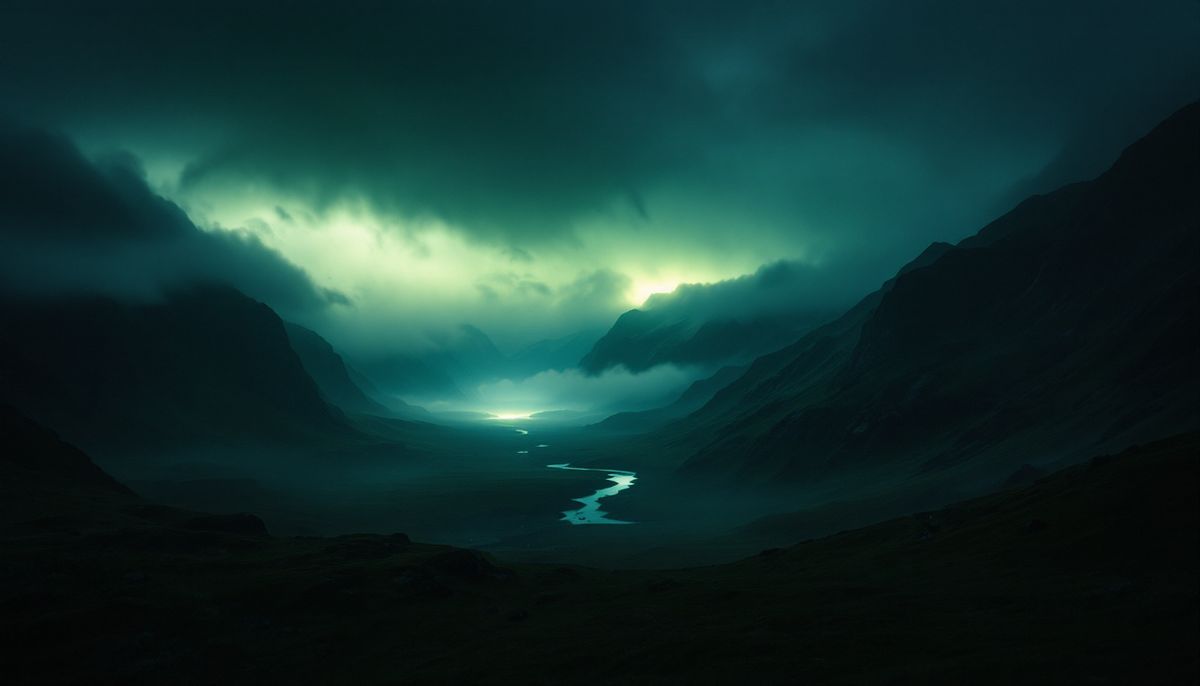
Picture a narrow valley in central Norway, far from anywhere you’d put on a map. Hessdalen — a thin scar of farmland and birch forest about seventy-five miles southeast of Trondheim, where the winters are long and dark and the population could fit inside a school bus. Roughly a hundred and fifty people live there. It is the kind of place where, on a clear night, the stillness has a weight to it. And it was into that stillness, beginning in late 1981, that something started to appear in the sky over the valley floor — something the people of Hessdalen had no word for, and that the scientists who came running still can’t fully name.
They were lights. Not stars, not aircraft, not the aurora that ripples green across that part of the world. These were balls of light — sometimes white, sometimes a warm yellow, sometimes a deep red — that hovered low over the ground, drifted along the valley, blinked out, and came back. Some were small, no bigger than a basketball. Others were reported as large as a car, even a small house. Sometimes they hung motionless above a rooftop for the better part of an hour. Other times they shot off at speeds that beggar belief — instruments later in the project would clock objects moving at thousands of meters per second, then stopping dead, then vanishing. And here’s the part that separates Hessdalen from every grainy UFO story you’ve ever rolled your eyes at: for a stretch of about two and a half years, this didn’t happen once or twice. Between December 1981 and the middle of 1984, the lights were reported fifteen to twenty times a week. Week after week. People started parking on the hillsides at night just to watch the show.
Now, normally this is where a story like this drifts off into the realm of campfire nonsense and shaky home video. But Hessdalen did something almost no other “UFO” phenomenon in history has done. It got serious scientists to point real instruments at it — and keep them pointed for decades. In 1983, a researcher named Erling Strand, working with colleagues who would later be based at Østfold University College, launched something called Project Hessdalen. In the dead of the Norwegian winter, between January and February of 1984, a team hauled radar, magnetometers, spectrum analyzers, and cameras up into that frozen valley and simply waited, watching the sky, trying to measure a thing nobody could explain. That is a remarkable sentence when you sit with it. This is not a hoax that scattered the moment a camera showed up. The opposite happened. The more carefully people looked, the more there was to look at.
And they kept looking. In 1998 the team installed an automatic measurement station in the valley — locals nicknamed it the “Blue Box” — to keep a mechanical eye on the sky around the clock, snapping images and triggering alarms whenever the lights returned. Then, from roughly 1999 to 2004, Italian researchers from that country’s National Research Council joined in for a series of campaigns, bringing heavier instrumentation to a project that had, by then, outlasted most marriages. Think about that. Decades of trained physicists, with budgets and peer-reviewed papers and serious careers on the line, all circling one stubborn question over one tiny Norwegian valley: what is the light?
So — what do they think it is? This is where I have to be straight with you, because the honest answer is the interesting one, and it isn’t aliens. The leading explanations for Hessdalen are all reaching for something natural, something physical, something that ought to obey the laws we already know. The trouble is that none of them quite closes the case. One major hypothesis points at the rock itself. The valley is rich in quartz, and quartz is piezoelectric — squeeze it, stress it, and it generates an electrical charge. Hessdalen sits in geologically active ground, and the idea is that strain on all that buried crystal could pump enormous charge into the air, ionizing it into glowing, floating clouds of plasma. Another version notes the valley once held mines, and that the soil is unusually full of metals — sulfur, zinc, iron, copper. One Italian physicist proposed that the whole valley might behave like a giant natural battery: metal deposits and acidic groundwater on either side of a river, quietly generating current, occasionally belching out a self-contained ball of charged gas. Still other researchers have pointed to radon gas decaying in the air, seeding clusters of ionized dust — a “dusty plasma” — that could account for the lights’ strange pulsing, their structure, even the colors in their spectrum.
Read those one after another and you start to feel the shape of the mystery. Every single explanation is plausible. Every single one is grounded in real chemistry and real physics. And not one of them has been nailed down hard enough to make the others go away. The lights don’t perform on command. They’ve grown rarer over the years — from fifteen-plus sightings a week in the early ’80s down to maybe ten or twenty in an entire year by 2010 — which makes a hard, repeatable, gotcha-it’s-this experiment maddeningly difficult to run. You cannot easily study something that won’t show up. So the instruments still sit in the valley, still watching, and the papers still get written with careful, hedged language, because the truth is that after forty-plus years the most rigorous answer anyone can give is: we have several good guesses, and we can’t yet prove which one is right.
That’s what makes Hessdalen so different from the usual midnight mysteries. There’s no shadowy government, no debunked photograph, no breathless witness who saw little green men. There’s a real valley, real glowing lights documented by hundreds of people, and a small army of patient scientists who have spent half their lives trying to corner a natural phenomenon that simply refuses to be cornered. It is, in a sense, the most respectable unsolved mystery on Earth — a genuine gap in our understanding, sitting out in the open, photographed and measured and still unexplained. The lights are almost certainly something natural. We may even be circling the right answer right now. But until somebody catches that light in a way that shuts the door on every rival theory, the valley keeps its secret. And on a dark Norwegian night, if you stand on the right hillside and wait, it may just decide to show you what no one has ever quite been able to explain.
Unsolved Mystery
