
July 5th
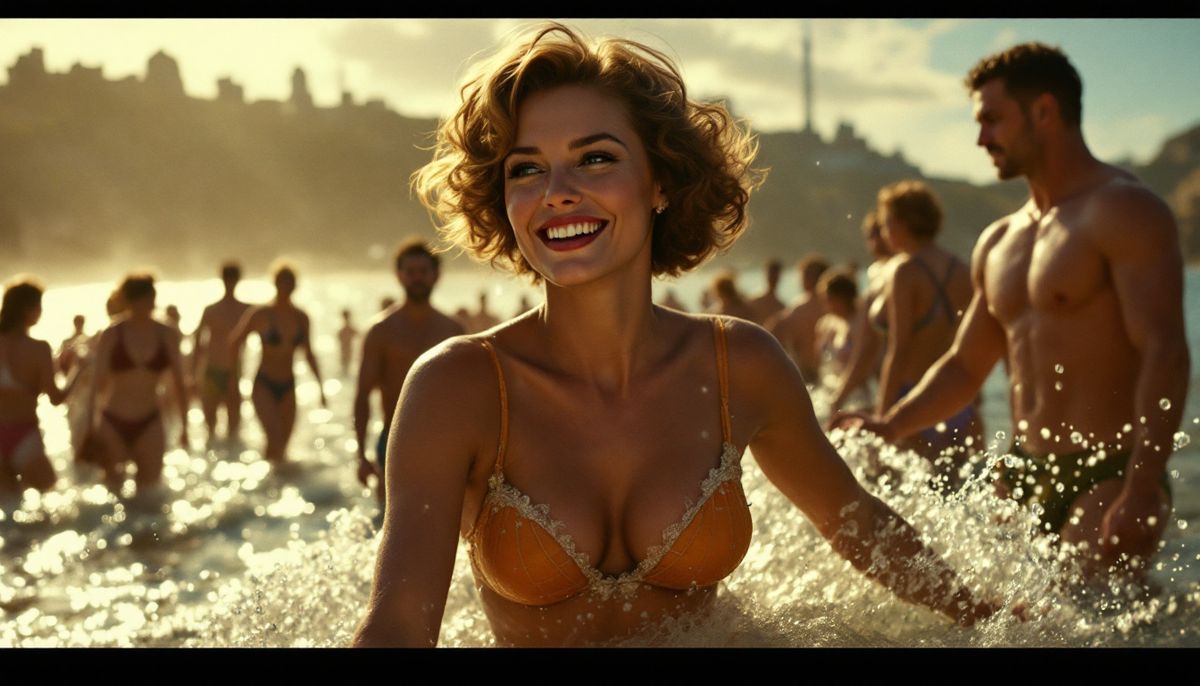
On the warm afternoon of July 5, 1946, a crowd gathered at the Piscine Molitor, the most fashionable swimming pool in Paris, expecting a routine swimwear show. What they got instead was a scandal that would ripple across the globe. A French automobile engineer turned designer named Louis Réard had created something so daring that not a single professional model in Paris would agree to wear it in public.
The garment was tiny — just four small triangles of fabric printed with newspaper type, held together by string. It used so little material that Réard boasted it could be pulled through a wedding ring. Desperate for someone bold enough to model it, he finally turned to a 19-year-old nude dancer from the Casino de Paris named Micheline Bernardini, who had no fear of baring nearly everything in front of a crowd.
Réard called his creation the “bikini,” naming it after Bikini Atoll, the remote Pacific island where the United States had detonated an atomic bomb in a headline-grabbing test just days earlier. The choice was deliberate. Réard was betting his little swimsuit would land on the world like a bomb of its own — explosive, unforgettable, and impossible to ignore.
He was right. The reaction was instant and electric. The design was so shocking that it was banned in Spain, Italy, Portugal, and on the beaches of much of conservative America for years. The Vatican declared it sinful. And yet the public could not look away. Micheline Bernardini reportedly received some 50,000 fan letters in the weeks that followed.
Slowly, the scandal cooled into a sensation. Hollywood starlets embraced it, beach culture exploded around it, and the once-forbidden two-piece became one of the most recognizable garments on Earth. Nearly eighty years later, the bikini that Paris tried to ban remains a summer staple from California to the Riviera — all because one stubborn engineer dared to bet that the world was ready to be shocked.
Also On This Day…
1811 — A New Nation Is Born in South America On July 5, 1811, seven of the ten provinces of the Captaincy General of Venezuela voted to break free from the Spanish Crown, making Venezuela the first South American country to formally declare its independence from Spain. Inspired in part by the American Declaration of Independence, the new congress voted 40 to 4 to sever ties with the empire and build a republic founded on equality and freedom of expression. The road ahead would be long and bloody, with revolutionary heroes like Simón Bolívar leading years of brutal war before independence was truly won. But that single vote lit the fuse, and to this day Venezuelans celebrate July 5th as their national independence day.
1975 — An Underdog Conquers Wimbledon On July 5, 1975, Arthur Ashe walked onto the grass at Wimbledon as a heavy underdog and walked off a champion, becoming the first Black man ever to win the gentlemen’s singles title at the world’s most prestigious tennis tournament. His opponent, the brash defending champion Jimmy Connors, had crushed him in their previous meetings and hadn’t dropped a single set on his way to the final. So Ashe threw out the playbook. Instead of trading power for power, he fed Connors a maddening diet of soft junk shots and pinpoint serves, frustrating the favorite into mistakes. The result was a stunning upset and a milestone that cemented Ashe as one of the most important figures the sport has ever known.
1996 — Science Makes History in a Scottish Barn On July 5, 1996, a lamb named Dolly was born at the Roslin Institute in Scotland — and the world of biology would never be the same. Dolly was the first mammal ever successfully cloned from an adult cell, created from a single cell taken from the udder of a six-year-old ewe. The breakthrough was so sensitive that scientists kept her birth a closely guarded secret for seven months before announcing it to a storm of wonder and controversy. Named after singer Dolly Parton, the little sheep proved that the genetic blueprint inside an adult cell could be coaxed into building an entirely new life, opening doors to medical research that would have seemed like pure science fiction only a year before.
From a swimsuit that scandalized Paris, to a nation born in revolution, to an underdog’s triumph on the lawns of Wimbledon and a sheep that rewrote the rules of life itself — July 5th proves that history’s most unforgettable moments often begin with someone bold enough to do what the world insisted could not, or should not, be done.
