
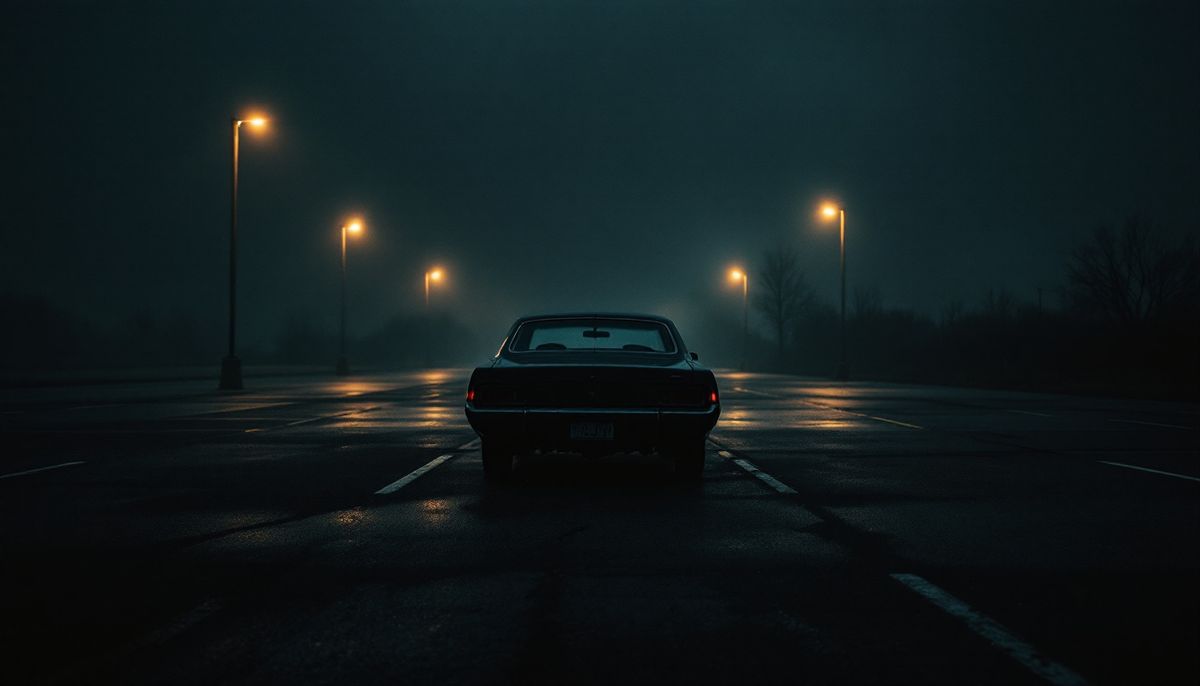
Picture the most powerful labor boss in America standing alone in a suburban parking lot, glancing at his watch, getting angrier by the minute. It’s a hot Wednesday afternoon — July 30, 1975 — outside the Machus Red Fox restaurant in Bloomfield Township, Michigan, a comfortable suburb north of Detroit. The man pacing the lot is James Riddle Hoffa, and for a stretch of American history there were few names more feared or more famous. At its peak under his command, the International Brotherhood of Teamsters counted more than two million members. Hoffa controlled the trucks. And in a country that moved on trucks, controlling the trucks meant you could squeeze almost anyone. Presidents took his calls. Mobsters took his meetings. That afternoon, he was waiting on one of those meetings — and it would be the last time anyone admits to seeing him alive.
You have to understand who Hoffa was to feel the weight of what happened next. He came up hard, organizing warehouse workers as a young man during the Depression, clawing his way through the ranks until he became the union’s general president in 1957. He was brilliant, relentless, and not remotely clean. In 1964 he was convicted of jury tampering and fraud, and in 1967 he went to federal prison. But Hoffa was not a man who stayed buried. In December 1971, President Richard Nixon commuted his sentence and set him free — with one enormous string attached. The terms barred Hoffa from union activity until 1980. And here is the spark that lights this whole tragedy: Hoffa did not intend to honor that ban. He wanted his throne back. He was telling everyone who’d listen that he was coming back to run the Teamsters. The trouble was, in the years he’d been away, other men had taken his chair — men with deep ties to organized crime — and they had no interest in giving it back.
So why was he in that parking lot? By every account, Hoffa believed he was there to make peace. He’d told his family he was meeting two men: Anthony “Tony Jack” Giacalone, a Detroit mob figure, and Anthony “Tony Pro” Provenzano, a New Jersey Teamster boss and mafia captain Hoffa had once feuded with bitterly. A sit-down to smooth things over. Around 2:15 or 2:30 in the afternoon, Hoffa walked to a pay phone and called his wife. He was furious. He’d been stood up, he said — neither man had shown — and he’d be home around four for dinner. Then he hung up. According to what the FBI later pieced together, sometime in the next half hour Hoffa climbed willingly into a car in that lot, almost certainly because he saw someone he trusted behind the wheel or beside it. The car drove off. And Jimmy Hoffa drove off the face of the earth.
The next morning, his green Pontiac was still sitting in the Red Fox lot. Unlocked. No keys missing from any struggle, no blood, no broken glass, no signs of a fight — just an empty, expensive car abandoned by a man famously punctual about getting home to his wife. That detail is the one that has chewed at investigators for fifty years. Hoffa wasn’t snatched off a dark street by strangers. He vanished in broad daylight, in a public place, and he appears to have gone with his killers calmly, because he didn’t see them as killers at all. The FBI poured in. Over the decades that followed, more than two hundred agents would touch the case. They built a thick theory of who was likely involved — the mob, settling the question of Hoffa’s comeback the only permanent way it knew how. But knowing roughly what happened has never been the same as proving it, or finding him. No one was ever charged with his murder. In 1982, with no body and no breakthrough, Jimmy Hoffa was declared legally dead.
And then began the part of this story that refuses to die — the searching. Because when the most powerful labor leader in America evaporates and the ground never gives him back, every rumor becomes a potential grave. The most famous of them all sends a chill down the spine of every football fan: that Hoffa was buried beneath an end zone at Giants Stadium in the New Jersey Meadowlands. That tale was lit up by a mob informant named Donald “Tony the Greek” Frankos in a 1989 Playboy interview, and for two decades people drove past that stadium wondering if the most-watched patch of grass in the tri-state area was sitting on top of him. The FBI never found a shred of evidence for it. When the old stadium was finally torn down in 2010, no Hoffa came up with the rubble — but the legend had already cemented itself into American folklore.
The Giants Stadium story is the colorful one. The serious searches stayed closer to Detroit, and they have been heartbreaking in their precision and their failure. In 2006, the FBI spent two weeks and a quarter of a million dollars tearing apart a horse farm once tied to a Teamsters official, certain they were close. They left with nothing. In 2012 and 2013, investigators converged on a suburban Roseville driveway after a tipster claimed the homeowner — said to be connected to Giacalone’s crew — had mysteriously poured fresh concrete the very day Hoffa vanished. Ground-penetrating radar flagged an anomaly underground. They drilled. They tested the soil. No remains. Over the years the rumored resting places have piled up into a grim American atlas: under driveways, beneath buildings, in landfills, fed to the Florida Everglades, even, in the wildest tellings, ground up and disposed of so completely that nothing could ever be found.
Then there’s the account that Hollywood made famous. A Pennsylvania Teamster and admitted mob enforcer named Frank “The Irishman” Sheeran, near the end of his life, told a biographer that he was the one — that he’d been sent to a house in a Detroit suburb and shot his old friend Hoffa himself, on the orders of a Pennsylvania crime boss. That confession became the spine of the book I Heard You Paint Houses and the 2019 film The Irishman. It’s a gripping, specific, almost cinematic story. But — and this is where the honest storyteller has to step in — many serious investigators and historians have picked Sheeran’s account apart, pointing to forensic and timeline problems, and the house he named yielded no proof when authorities looked into it. Like every other lead, it lands in the same maddening place: plausible, vivid, unprovable. A confession is not a body.
So where does that leave us, fifty years on? With an unlocked car in an empty parking lot, and a silence that has outlasted nearly everyone who could have broken it. The men Hoffa thought he was meeting that day are long dead. Tony Pro, Tony Jack, the wiseguys, the Teamster insiders, Sheeran himself — gone, most of them taking whatever they truly knew into their own graves. The FBI’s case file is thick with names and theories and not one square inch of confirmed earth. We are fairly sure why Jimmy Hoffa died: he wanted his kingdom back, and the wrong people decided he couldn’t have it. But the where — the simple, human question of where a man’s body has lain for half a century — remains as blank as that abandoned Pontiac. He was one of the most recognizable men in the country, and he stepped into a car on a sunny afternoon and was never seen again. Somewhere out there, under a driveway or a stadium or a stretch of ground no one has thought to dig, the answer is still waiting. We just haven’t found him yet.
Unsolved Mystery
