
I would have bet good money I knew everything about the bald eagle. It’s on the Great Seal, it’s on the quarter, it’s screaming majestically in every Fourth of July commercial ever made. Then I started digging, and it turns out almost everything I “knew” about America’s bird was either wrong or wildly incomplete. The scream is dubbed, the Ben Franklin turkey story is a myth, and the bird technically wasn’t even our official national bird until about eighteen months ago. Here are five true things about the bald eagle that genuinely knocked me over.
Did you know that famous eagle scream in movies is actually a different bird?
Every time a bald eagle opens its beak on screen and lets out that piercing, echoing shriek, you’re being lied to. That sound belongs to the red-tailed hawk, and Hollywood has been dubbing it over eagle footage for decades. Why? Because the bald eagle’s real voice is, frankly, embarrassing. Actual eagle vocalizations are a series of high-pitched, stuttering chirps and whistles that experts have compared to a seagull with laryngitis. Sound editors decided long ago that America’s symbol needed a more heroic voice, so the red-tailed hawk became its permanent stunt double. Once you hear the real thing, you can’t unhear it, and you’ll never trust a nature documentary’s audio track again.
Did you know a bald eagle nest can weigh more than your car?
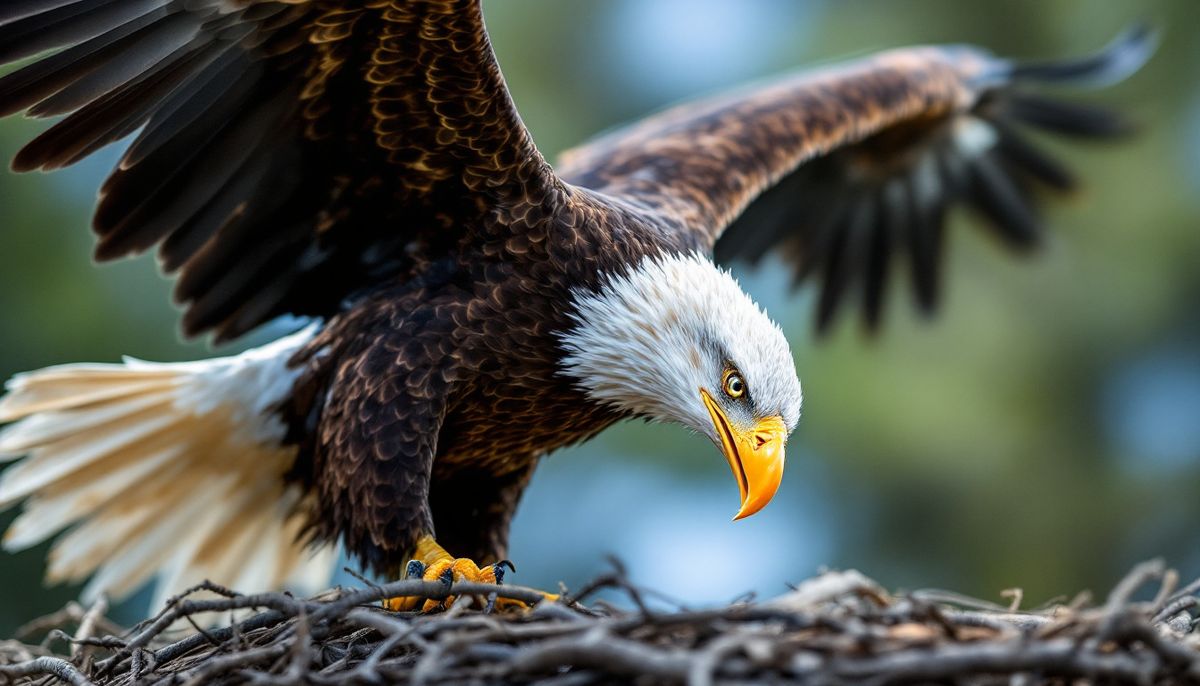
Bald eagles are the general contractors of the bird world, and they never stop renovating. Mated pairs return to the same nest year after year, adding fresh sticks and grass each season, so the nests just keep growing. A typical established nest can weigh up to a ton. But the record holder, a nest found near St. Petersburg, Florida, and examined in 1963, measured 9 feet 6 inches across, 20 feet deep, and was estimated at over 4,400 pounds. That’s more than two tons of lumber, and it still stands as the Guinness World Record for the largest bird’s nest ever documented. For comparison, a Honda Civic weighs about 3,000 pounds. These birds built something heavier than a sedan, in a tree, using only their faces.
Did you know bald eagles can swim?
Picture a bald eagle doing the breaststroke and you’ve got it exactly right. When an eagle sinks its talons into a fish that turns out to be too heavy to lift, it often refuses to let go. Instead, it settles onto the water and starts rowing itself to shore with powerful overhand strokes of its wings, dinner still locked in its grip. Videos of this pop up from Maine to Florida, and it looks precisely as absurd and magnificent as you’re imagining. It’s a genuine risk, though: a waterlogged eagle can’t take off from the water, and some have drowned when the swim was too far. That’s the bald eagle in a nutshell, really. It would rather paddle half a mile than admit the fish won.
Did you know Ben Franklin never actually proposed the turkey as our national bird?
This is one of the most repeated “facts” in American history, and it’s a myth. Franklin never formally proposed the turkey for anything. The whole story traces to a private letter he wrote to his daughter Sarah in 1784, two years after the Great Seal was already adopted. He was mocking a hereditary officers’ club called the Society of the Cincinnati, whose eagle badge was so badly drawn that Franklin joked it looked more like a turkey. Riffing on that, he grumbled that the bald eagle was a bird of “bad moral character” that steals fish from other birds, while the turkey was “a much more respectable bird” and a true American original. It was satire in a private letter, not a policy proposal. Congress never saw it, and the turkey was never on the ballot.
Did you know the bald eagle only officially became our national bird in December 2024?
Here’s the twist ending: for nearly two and a half centuries, the bald eagle was never actually designated the national bird of the United States. It’s been on the Great Seal since 1782, but no law ever made it official, a loophole almost nobody noticed. A Minnesota eagle enthusiast named Preston Cook discovered the omission, drafted a bill himself, and sent it to lawmakers. Congress passed it unanimously, and the president signed it into law on Christmas Eve 2024. And the timing was poetic, because the eagle had just completed one of the greatest comebacks in conservation history: down to 417 known nesting pairs in the lower 48 in 1963, thanks largely to DDT, the species rebounded after the pesticide ban to roughly 316,700 birds today. It came off the endangered species list in 2007 and got its official title seventeen years later. Better late than never.
Send this to the most patriotic person you know… they’ll never watch a Fourth of July commercial the same way again.
