
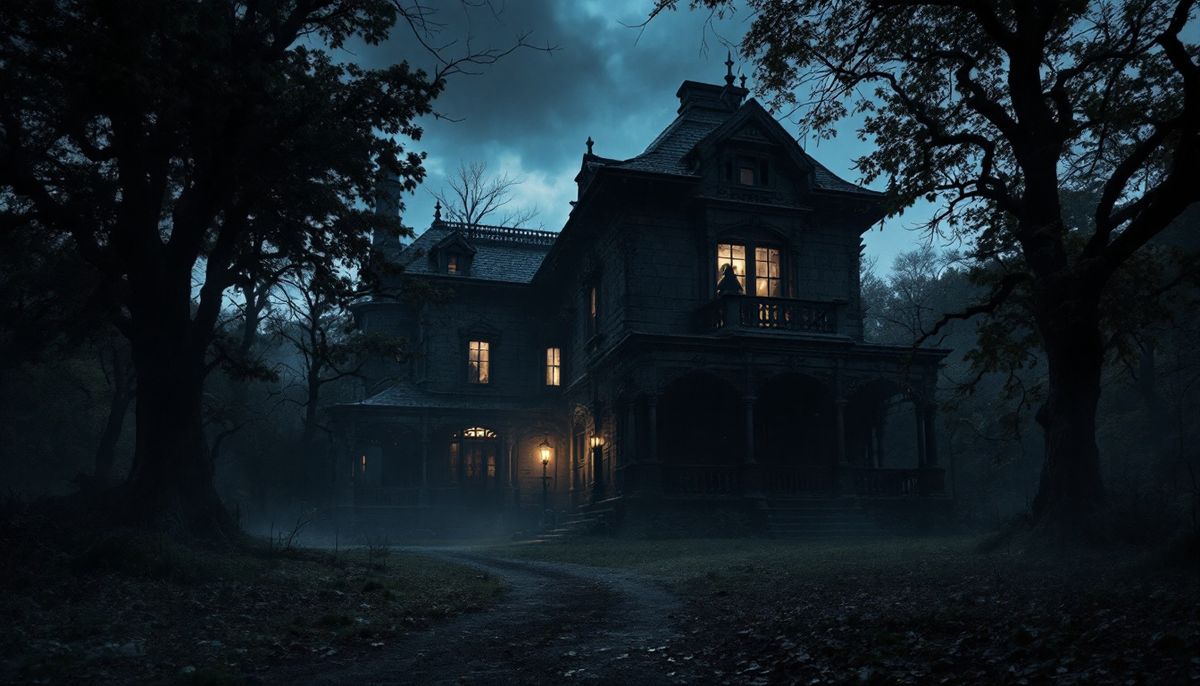
Let me tell you about a house in San Jose, California, with staircases that climb straight into ceilings, doors that open onto two-story drops, and a floor plan so tangled that the woman who built it reportedly needed a map of her own home. And I want to be upfront with you the way I always am: some of what you’ve heard about this place is documented fact, some of it is tour-guide legend — and the honest line between the two is stranger than either.
Start with what nobody disputes. Sarah Winchester was one of the richest women in America. Her husband, William Wirt Winchester, was heir to the Winchester Repeating Arms fortune — the company behind “the gun that won the West” — and when tuberculosis took him in 1881, Sarah inherited a stake worth roughly $20 million, plus a royalty income that worked out to about $1,000 a day. In the 1880s. That’s the kind of money that lets you do absolutely anything. What Sarah did was buy an unfinished eight-room farmhouse outside San Jose in 1886 — and then build. And build. And build. Carpenters worked on that house, on and off, for the next 38 years. Rooms swallowed rooms. The farmhouse metastasized into a labyrinth of roughly 160 rooms, 10,000 window panes, 2,000 doors, 47 stairways and fireplaces — with the number 13 worked obsessively into windows, ceiling panels, and chandeliers. It only stopped when Sarah died in her sleep in September 1922. Workers, the story goes, walked off with nails half-driven.
Now for the legend — and it’s a masterpiece. The story says that after losing her infant daughter Annie in 1866 and then her husband, a grieving Sarah visited a Boston medium who delivered a terrifying verdict: her family was cursed by the spirits of everyone ever killed by a Winchester rifle. To appease them, she must move west and build a house for the ghosts — and never, ever stop building, because the day the hammers fell silent was the day she would die. Under this reading, every bizarre feature has a purpose: the stairs to nowhere and doors into walls were built to confuse vengeful spirits; the séance room at the heart of the house was where Sarah took her nightly construction orders from the dead. It’s a perfect ghost story. It’s also, I have to tell you, almost entirely unverifiable. No record of the medium exists. Sarah left no diary, gave no interviews, and never once explained the house — and historians who’ve dug into the archives note that construction did stop at times, sometimes for months, and Sarah kept right on living.
So what does the sober version look like? Skeptical biographers offer this: Sarah was a wealthy, intensely private widow who treated architecture as her life’s occupation — an amateur builder with unlimited funds, no master plan, and a habit of remodeling on impulse. She kept crews employed year-round in what some describe as quiet philanthropy; workers were famously well paid. And here’s the detail that quietly explains a lot of the “haunted” weirdness: the great 1906 earthquake wrecked large sections of the house, collapsing the seven-story tower and trapping Sarah in a bedroom until servants dug her out. Rather than repair everything, she simply sealed damaged sections off and built around them — leaving doors that open onto open air and stairways that dead-end into ceilings, not because ghosts demanded it, but because the rooms they once led to no longer existed.
But before you file this one under “solved,” let me give you the residue that doesn’t wash out. The number 13 obsession is real and pervasive — that wasn’t earthquake damage. The nightly bell rituals reported by staff, the single séance-style room only Sarah entered — those show up in accounts from people who worked there. And the central question the skeptics can’t answer is the same one the ghost-story crowd can’t: why? Why does a sane, brilliant woman — and her surviving letters show she was both — spend nearly four decades and millions of dollars building a maze she never explained to anyone, including her own family? Grief? Compulsion? Belief? Amusement? She had 38 years to tell someone. She chose not to.
Within two years of her death, the house opened to tourists — Harry Houdini himself toured it in 1924, during his crusade against fraudulent spiritualists, and the “Mystery House” name stuck. It’s still open today, and guides will tell you staff members report cold spots and footsteps in empty halls. Take that part however you like.
Here’s where I leave you. Sarah Winchester is the only person who ever knew what that house was for, and she took the answer to her grave in 1922. Every explanation on the table — cursed widow appeasing ghosts, grieving eccentric who found peace in the sound of hammers — is a story other people wrote for her, after she was gone, over a hundred years of silence. The house is still standing. The blueprints never existed. And somewhere in those 160 rooms is a locked answer nobody has ever found the door to.
Unsolved Mystery
